
The on-demand economy has reshaped how consumers access daily services. From food delivery to taxi booking and now home maintenance, convenience has become the king. Driven by increasing smartphone penetration and the growing preference for instant, trusted local help, according to Grand View Research, the global online on-demand home services market is projected to reach over $14.7 billion by 2030, growing at a CAGR of 16.7% from 2022 to 2030.
Further, platforms like Airtasker, Thumbtack, TaskRabbit, and Urban Company have revolutionized how homeowners find skilled professionals for everything from plumbing repairs to furniture assembly. These marketplaces connect customers to service providers seamlessly, bridging a once-fragmented industry with a tech-driven experience.
Thus, if you are an entrepreneur or startup exploring the cost to build a home service app like Airtasker, understanding the development process and strategic approach is essential. This blog breaks down everything from core features and cost factors to ready-made solutions like Yo!Gigs that can dramatically cut your time-to-market and budget.
Table of Contents
- What is Airtasker?
- How a Home Service App Like Airtasker Works?
- Top Home Services Apps Like Airtasker
- Key Features in an Airtasker-Like App
- Factors Affecting the Cost to Build a Home Service App Like Airtasker
- Cost Breakdown: Scratch Build vs. Readymade Solution
- Tips to Reduce the Development Cost
- Yo!Gigs: A Cost-Effective Solution to Build Your Home Service App Like Airtasker
- Conclusion
- FAQs
What is Airtasker?
Airtasker is an Australian online marketplace that allows users to outsource everyday tasks and errands with ease. Founded in 2012, it has grown into a multimillion-dollar platform connecting millions of users across Australia, the UK, and the US.
The platform operates on a peer-to-peer model, where individuals or businesses can post tasks, and nearby “Taskers” (freelancers or professionals) can bid to complete them. Thus, Airtasker acts as an intermediary that ensures smooth communication, secure payments, and accountability.
Core Highlights of Airtasker:
- Serves both residential and commercial service needs.
- Uses a robust rating & review system for trust.
- Employs flexible pricing (customers set budgets, Taskers quote bids).
- Includes secure in-app payments and real-time notifications.
- Operates on a commission-based revenue model.
Essentially, Airtasker embodies the “service marketplace” concept, connecting supply (taskers) and demand (customers) in a seamless digital ecosystem.
Suggested Read: Guide to Build a Website Like Airtasker
How a Home Service App Like Airtasker Works?
Building a service app like Airtasker starts with a deep understanding of its user flow and functional ecosystem. Essentially, the app facilitates seamless interaction, transparent pricing, and secure transactions between users who need tasks completed and professionals ready to perform them. Here’s how the typical process works:
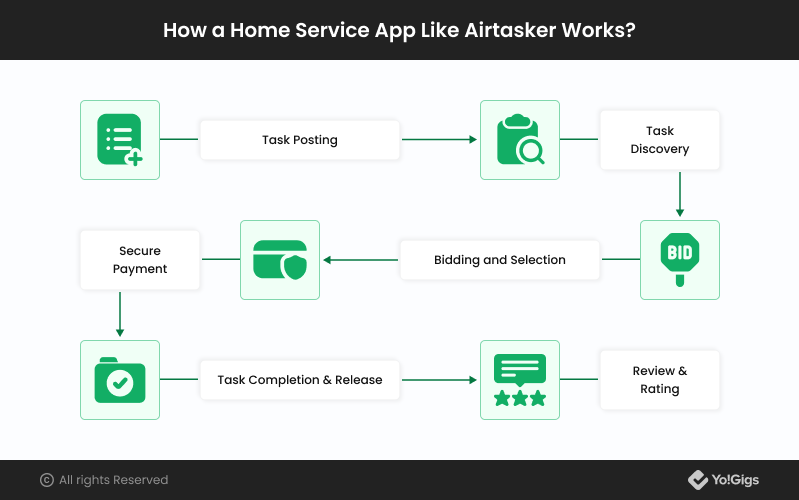
- Task Posting (The Customer/Poster): A user (the Poster) creates a listing detailing the task (e.g., “Assemble IKEA bed”), its location, a deadline, and a budget (either a fixed price or open for bidding).
- Task Discovery (The Tasker/Service Provider): Local service providers (Taskers) who match the necessary skills and geographic criteria receive real-time notifications.
- Bidding and Selection: Taskers submit offers (bids) for the job. The Poster reviews the Taskers’ profiles, ratings, and past work before accepting an offer.
- Secure Payment (Escrow): The Poster pays the agreed-upon amount, but the money is held securely by the app in a digital escrow account.
- Task Completion & Release: The Tasker completes the job. Further, upon mutual confirmation from both parties via the app, the payment is released from escrow to the Tasker, minus the platform’s commission fee.
- Review and Rating: Both parties rate and review each other, fueling the platform’s core element of trust and quality control.
Top Home Services Apps Like Airtasker
Before diving into costs, let’s look at a few market leaders that have mastered this business model:
| App | Region/Market | Specialization | Key Strength |
| TaskRabbit | USA, Canada, UK | Local errands, furniture assembly, and cleaning | Backed by IKEA, a strong brand with trust |
| Thumbtack | USA | Professional services marketplace | Covers 1,000+ categories |
| Urban Company | India, UAE, Singapore | Home services, beauty, and cleaning | Focused on verified professionals |
| Handy | USA | Cleaning & handyman services | Streamlined booking UX |
| Airtasker | Australia, UK, USA | Multi-category peer-to-peer tasks | Flexible pricing, wide range of services |
These platforms showcase different market approaches from gig-based freelancing to professional home service models. When deciding to build your own, it’s crucial to determine which model best fits your region and audience.
Key Features in an Airtasker-Like App
To successfully build a home service app like Airtasker, it’s essential to decide on the necessary and advanced features required for each user type – customers, service providers, and admin/s.
Here’s a breakdown of the key features to include:
1. Customer/Poster App Features
| Feature Category | Description | Necessity |
| User Onboarding | Quick social login, email/phone verification. | High (Basic MVP) |
| Task Creation | Guided flow with category selection, media upload (photos/video), budget setting, and location pinning. | High (Basic MVP) |
| Advanced Search & Filters | Filter by task category, price range, tasker rating, and most importantly, distance. | High (Basic MVP) |
| In-App Chat | Real-time secure messaging for communication pre and post-hire. | High (Basic MVP) |
| Payment Integration | Integration with major gateways (Stripe, PayPal) for secure escrow and one-click payment release. | High (Basic MVP) |
| Review & Rating System | Ability to rate Tasker on quality, punctuality, and professionalism. | High (Basic MVP) |
2. Tasker/Service Provider App Features
| Feature Category | Description | Necessity |
| Verified Profile Management | Comprehensive profile for skills, portfolio, ID verification, and background check status. | High (Basic MVP) |
| Job Feed & Notifications | Real-time, geo-fenced feed showing available tasks in their area. | High (Basic MVP) |
| Bidding/Offer Submission | Simple interface to submit a price, estimated timeline, and a personalized message. | High (Basic MVP) |
| Earnings Dashboard | Track job history, pending payments (in escrow), and total earnings (with commission breakdown). | High (Basic MVP) |
| GPS Integration | For real-time navigation to the job location. | Medium (Post-MVP) |
3. Admin Panel (Backend Management)
This is the control center, which is mandatory from day one, though it is often a web-based portal, not a mobile app.
- User and Task Management: Ability to approve/suspend users (Taskers), and moderate task postings for safety and policy compliance.
- Payment & Commission Management: Financial reconciliation, tracking all escrow funds, generating invoices, and managing the platform’s commission rates.
- Reports and Analytics: Dashboard providing key metrics like active users, tasks posted, task completion rate, and gross transaction value (GTV).
- Dispute Resolution: Tools to mediate and resolve conflicts between Posters and Taskers, including the ability to release or refund escrow funds.
Looking to Launch Your Feature-Rich Home Service App
Factors Affecting the Cost to Build a Home Service App Like Airtasker
The investment required to build an app like Airtasker is heavily influenced by five critical factors. These choices are what cause the cost to swing from $40,000 to over $350,000. Let’s have a look at the factors:

1. Development Approach: Custom vs. Clone
This is the most significant factor influencing the cost:
- Build from Scratch (Custom Development): Developing unique code for every feature, database, and API integration ensures complete customization, better performance, and long-term scalability. However, it also involves a higher upfront cost, longer development time, and a need for a skilled development team to maintain and scale the system efficiently.
- Readymade Solutions:
Readymade or white-label marketplace solutions come preloaded with standard features such as user management, task posting, bidding, and payment processing. They enable faster time-to-market with minimal technical setup while allowing moderate customization for branding and functionality. This approach helps businesses quickly validate their concept, reduce initial costs, and begin generating revenue without heavy development dependencies. It’s best suited for startups or small businesses testing the market. - Clone Scripts:
Clone scripts are pre-built platforms modeled after successful apps like Airtasker, offering the same core structure, workflows, and functionalities. They provide a faster and more affordable route to launching a feature-rich marketplace, with the flexibility to customize design, features, and integrations as needed.
2. Platform Choice: Native vs. Cross-Platform
a. Native Development (Swift for iOS, Kotlin/Java for Android): Offers superior performance, access to all device features (GPS, camera), and the best user experience.
- Cost: Higher, as two separate development teams/streams are required.
b. Cross-Platform Development (React Native, Flutter): Allows a single codebase to run on both iOS and Android.
- Cost: Significantly lower (up to 30-40% less than native) and faster time-to-market. This is often recommended for the initial MVP.
3. Feature Complexity (MVP vs. Advanced)
Adding advanced features requires senior developer expertise and sophisticated backend architecture. Thus, adding to the cost of building the app.
| Feature Type | Cost Impact | Example |
| Basic MVP | Lowest | Simple user profiles, basic search, email/password login, and manual commission. |
| Intermediate | Medium | Secure ID verification, GPS tracking, in-app chat (via third-party API), push notifications. |
| Advanced | Highest | AI-based task matching, dynamic pricing algorithms, in-app video calling, complex Tasker ranking systems, dedicated referral engine. |
4. Developer Location and Hourly Rate
Depending upon the location, labor costs vary dramatically. Hiring a US-based agency or US developers can cost anywhere between $100-$200+/hour, whereas hiring developers or an agency in an Eastern European or South-East Asian country costs $30-$60/hour. Resulting in a final cost difference of over $200,000 for a fully-featured app.
5. Third-Party Integrations and Backend Architecture
Every third-party mapping API (Google Maps/Mapbox), the payment gateway (Stripe/PayPal), and the real-time chat service (Twilio/Sendbird) add integration hours and ongoing subscription fees. Further, the choice of cloud server (AWS, Google Cloud) also dictates scalability costs.
Cost Breakdown: Scratch Build vs. Readymade Solution
To provide a clear financial perspective, let’s analyze the estimated cost for the two primary development approaches: developing from scratch versus using a readymade solution.
1. Custom Development (Built from Scratch)
If you want complete creative control and have a comfortable budget, custom development is the traditional route. You’ll need a full team of UI/UX designers, front-end and back-end developers, QA engineers, and DevOps.
| Component | Estimated Cost (USD) |
| Discovery & Prototyping | $5,000 – $10,000 |
| Front-end & Back-end Development | $20,000 – $45,000 |
| iOS + Android Apps | $20,000 – $50,000 |
| Integrations & APIs | $5,000 – $10,000 |
| Testing & Deployment | $3,000 – $5,000 |
| Maintenance (1 Year) | $5,000 – $10,000 |
- Total: Approximately $40,000 – $100,000 +
- Timeline: 4–6 months minimum.
This approach gives you maximum flexibility, but it ties up significant capital before you even validate your business model.
2. Readymade Solutions
The second approach involves purchasing a pre-built Readymade Software or a SaaS (Software as a Service) solution. This strategy dramatically shifts the focus from writing core code to branding, setup, and customization.
A. SaaS (Software-as-a-Service) Solutions (Subscription-based)
These offer a platform ready to use with zero initial development. Pricing is typically a low monthly fee plus a percentage of transactions. This is ideal for testing the market with minimal risk. However, customization is limited.
- Cost Range: Starts from $250 – $599 per month plus transaction fees.
B. Readymade Software / White-Label Solutions (One-time Purchase)
You purchase the complete source code, which you then host and customize. The upfront cost is low, but you still need a developer for installation, branding, and API integration. Further, readymade solutions provide full source code ownership with a lifetime license.
- Cost Range: Basic Readymade Software starts from $999.
TIP: Utilizing white-label, readymade software offers the lowest barrier to entry, making it feasible to launch a fully functional platform for under $1000.
Launch Your Home Service App Like Airtasker Cost-Effectively
Tips to Reduce the Development Cost
For any entrepreneur aiming to build an app like Airtasker, it is essential to adopt a smart development strategy that cuts expenses without compromising quality. Here are some effective approaches:
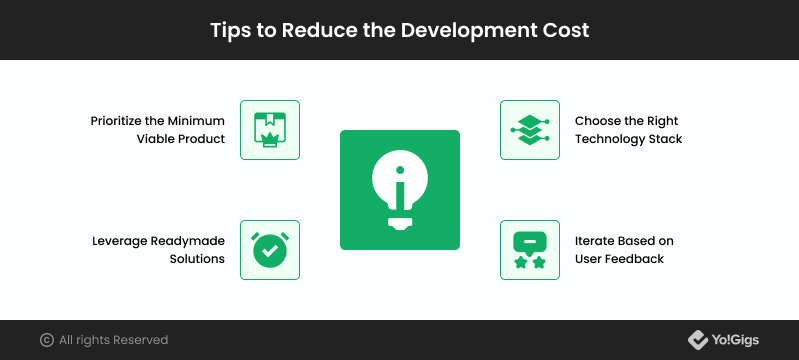
1. Prioritize the Minimum Viable Product (MVP)
An MVP includes only the essential features required to facilitate the core transaction (task posting, bidding, payment, review).
- Strategy: Launch with a cross-platform MVP first (React Native or Flutter). Skip advanced features like AI matching or in-app video calls. This proves your business model and allows you to attract seed funding for Phase 2 development.
- Cost Savings: Reduces initial development hours by 30-40%.
2. Leverage Readymade Solutions
Choosing a readymade service marketplace software eliminates thousands of hours of core development time, such as architecting the database, creating the bidding logic, and building the escrow flow.
- Yo! Gigs: Solutions like Yo!Gigs provide a comprehensive base platform specifically designed for the gig economy. This drastically accelerates the timeline and cuts the initial financial outlay, offering a scalable starting point far superior to beginning with a blank screen.
3. Choose the Right Technology Stack
Opt for stable, open-source technologies for the backend (e.g., Node.js or Python) and use cross-platform frameworks (React Native/Flutter) for the mobile front-end to maximize efficiency.
4. Iterate Based on User Feedback
Don’t spend $50,000 on a feature you think users want. Launch the MVP, analyze user behavior through the Admin Panel, and only invest in features that data proves will drive retention or revenue.
Now, let’s take a look at why a readymade solution like Yo!Gigs is the better choice to build your home service app.
Yo!Gigs: A Cost-Effective Solution to Build Your Home Service App Like Airtasker
In the current landscape, launching a custom platform at a quarter-million-dollar price point is a luxury few startups can afford. This is where specialized, readymade solutions, such as Yo!Gigs, provide a compelling strategic advantage.
Yo!Gigs is a ready-made home service marketplace software designed to replicate and enhance the functionality of platforms like Airtasker. It comes with pre-built modules for task posting, bidding, secure payments, ratings, and reviews, allowing entrepreneurs to launch a professional marketplace without starting from scratch.
Moreover, by leveraging Yo!Gigs, entrepreneurs do not need to build complex infrastructure from scratch. Further, this approach saves both time and development costs, allowing startups to focus on growth, marketing, and customer acquisition.
What You Get with Yo!Gigs
- Fully customizable website + admin panel, Mobile apps
- Secure payment and escrow management
- Advanced search, filters, and user dashboards
- Analytics to track tasks, revenue, and engagement
- SEO-friendly architecture for organic growth
- Dedicated technical support and upgrade path
Most importantly, you get the flexibility to grow. Whether you’re targeting one city or multiple regions, Yo!Gigs scale with you.
Additional Benefits of Leveraging Yo!Gigs
- 100% white label solution
- One-time investment
- No hidden or recurring costs
- Source code ownership
- Supports multiple languages and currencies
- Caters to diverse business niches
- Fully customizable and scalable
- Multiple payment gateways
- Free technical support
Explore the Full Potential of Yo!Gigs
Conclusion
The home services marketplace industry is expanding rapidly, and there’s room for new players who can innovate, localize, and deliver a frictionless experience.
Thus, whether you plan to build from scratch or choose a ready-made solution like Yo!Gigs, your decision should balance budget, time-to-market, and scalability.
Furthermore, if you’re aiming to launch quickly and validate your business model without a six-figure investment, Yo!Gigs is the smartest, most cost-effective starting point.
FAQs
Q 1. How to build an Airtasker clone app?
Ans. Building an Airtasker Clone app follows three main steps:
- Strategy: Define your unique niche (e.g., focus on pet care or senior assistance) to differentiate from the major players.
- Technical Foundation: Choose a development path: either purchase a reputable, white-label Airtasker Clone script (fastest and cheapest) or hire a development team to build an MVP using cross-platform technology.
- Launch and Iterate: Brand the application, integrate local payment and mapping APIs, deploy to the app stores, and use the admin panel analytics to constantly refine the user experience based on real-world data.
Q 2. Are clone scripts scalable or a profitable solution to build Airtasker?
Ans. Yes, clone scripts are scalable and a profitable solution to build an app like Airtasker. Modern clone scripts, when sourced from reputable vendors, are built on scalable architectures, such as Node.js, and cloud hosting like AWS. They are often more profitable because they allow you to launch and start generating revenue faster, with a fraction of the upfront R&D cost associated with custom development.
Q 3. How long does it take to develop a service app like Airtasker?
Ans. The timeline depends heavily on the development approach:
- Readymade Software/Clone script Deployment: 2-4 days. This includes setup, branding, API integration, and testing.
- Custom MVP (Cross-Platform): 4–6 months. This covers discovery, UX/UI design, core backend development, and initial mobile app development for both iOS and Android.
- Full-Featured, Custom Platform: 9-12+ months. This includes advanced features, rigorous security testing, and unique custom designs.
Q 4. What advanced features should be added in an Airtasker-like app to beat competitors?
To move beyond the basic features and truly compete, focus on:
- AI-Driven Matching: Use ML (machine learning) to instantly match a new task to the top 3-5 most qualified and highest-rated Taskers based on past performance, not just location.
- In-App Video Consultation: Allow users to initiate a secure video call with a Tasker for quoting complex jobs (e.g., plumbing or electrical) before committing.
- Integrated Certification and Insurance: Automatically verify and display Taskers’ professional certifications and liability insurance status via API integration with third-party verification services.
- Flexible Pricing Models: Offer both the original bidding model and an “Instant Book” option for standardized services (like cleaning) where the price is fixed and guaranteed.
Q 5. How do service apps make money?
Ans. Service apps primarily utilize the Commission-Based Revenue Model. Additionally, they generate income through multiple revenue streams such as in-app promotions, feature listing, and more.
- Primary Income: A commission fee (typically 15% to 25% of the task price) is deducted from the Tasker’s earnings upon successful completion.
- Secondary Income:
- Premium Subscriptions: Taskers pay a monthly fee for perks like reduced commission, priority visibility, or access to high-value leads.
- Featured Listings: Task Posters pay a small fee to boost their task visibility.
- Advertising: Selling ad space to relevant businesses (e.g., tool suppliers, local hardware stores).
- Service Fees: Some platforms may charge a minor service fee to the Customer/Poster as well.
