
The on-demand service economy has transformed the way people find and hire professionals. From home cleaning and plumbing to personal training, photography, and event planning, customers now expect quick access to trusted service providers through digital platforms. This shift in consumer behavior has made service marketplace websites one of the most lucrative and scalable business models in the digital economy.
Platforms like Thumbtack clearly demonstrate the potential of this model by connecting millions of customers with local professionals across hundreds of service categories. For entrepreneurs and businesses, this success raises a crucial question: what does it actually cost to build a service marketplace website like Thumbtack?
In this blog, you will get to know everything you need to know, from understanding Thumbtack’s business model and the benefits of launching a service marketplace to the features that influence development costs, different development approaches, and proven ways to reduce expenses. Thus, if you’re planning to build a service marketplace website like Thumbtack, this blog will help you make informed, cost-effective decisions.
Table of Contents
- What is Thumbtack?
- Why Build a Service Marketplace Website?
- Top Service Marketplace Websites Similar to Thumbtack
- Features that Define the Cost to Build a Service Marketplace Website Like Thumbtack
- Development Cost: Approaches and Cost Involved
- Comparison Table: Development Approaches for a Service Marketplace Website
- How to Reduce Cost in Building Your Service Marketplace Website Like Thumbtack
- Yo!Gigs: A Readymade Service Marketplace Software Solution
- Conclusion
- FAQs
What is Thumbtack?
Thumbtack is a leading online service marketplace that connects customers with local professionals across a wide range of services. Founded in 2008, the platform enables users to search for services, share project details, receive quotes from professionals, compare professional profiles, and hire the right service provider, all from a single, easy-to-use interface.
The platform operates as a two-sided marketplace:
a. Service seekers post their requirements, such as need a plumber or an electrician near me.
b. Service providers respond with quotes, availability, and profiles.
Thumbtack facilitates these connections and generates revenue through lead generation and service fees.
Unlike product-based marketplaces, Thumbtack focuses entirely on services, making trust, communication, and location-based matching core to its success. Its model has inspired countless entrepreneurs to create service marketplace websites like Thumbtack across various niches and regions.
Why Build a Service Marketplace Website?
Building a service marketplace website offers significant advantages for both platform owners and end users. As the digital adoption accelerates, this model continues to gain momentum due to its flexibility, scalability, and strong revenue potential. Below are the key reasons why this model continues to grow rapidly:
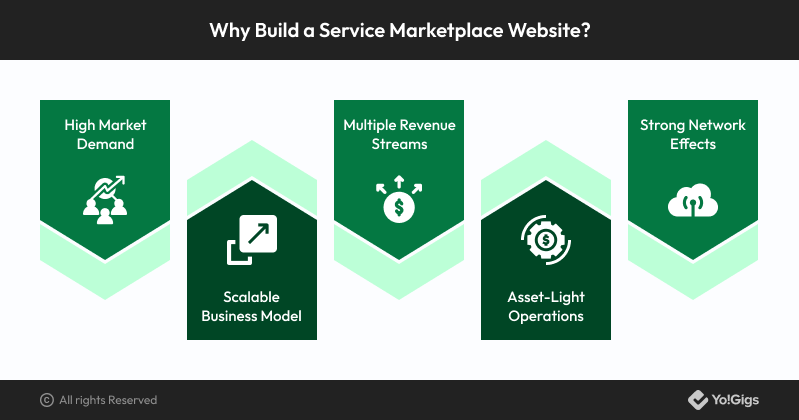
1. High Market Demand
Services are a recurring necessity. Unlike products, services such as repairs, maintenance, wellness, and professional consulting are always in demand, ensuring consistent platform usage and repeat customer engagement.
2. Scalable Business Model
Once the platform is built, growth depends primarily on onboarding more service providers and customers, not managing inventory. This makes it easier to scale across cities, regions, or even countries.
3. Multiple Revenue Streams
A service marketplace can monetize through several channels, such as:
a. Commission per transaction
b. Lead generation fees
c. Subscription plans for professionals
d. Featured listings and promotions
e. Advertising placements
4. Asset-Light Operations
Marketplace owners do not deliver services themselves. This keeps operational overhead low while reducing logistical complexity and financial risk.
5. Strong Network Effects
As more professionals join the platform, customers gain more options. As more customers join, professionals see more value, creating a self-reinforcing growth loop.
These benefits make building a service marketplace website a highly attractive opportunity, especially for a specific niche or geography.
Build a Service Marketplace to Capitalize on the Growing Service Economy
Top Service Marketplace Websites Similar to Thumbtack
Thumbtack is not the only successful platform in the service marketplace space. Several other service marketplaces have validated this business model across different service categories, audiences, and regions. Let’s explore some of the top service marketplace websites similar to Thumbtack:
1. Angi (formerly Angie’s List)
Angi is a well-known leading service marketplace focused on home services such as plumbing, electrical work, remodeling, and maintenance. It prioritizes trust and quality by featuring verified reviews, background-checked professionals, and detailed service provider profiles, helping users make confident hiring decisions.
2. TaskRabbit
TaskRabbit connects users with local freelancers for everyday tasks like furniture assembly, moving assistance, cleaning, and minor repairs. The platform is built for quick, on-demand service bookings and allows users to book professionals based on availability, pricing, and skill set.
Suggested Read: Learn How to Build a Services Website like TaskRabbit
3. UrbanClap (Urban Company)
Urban Company offers standardized home and personal services such as beauty treatments, appliance repairs, and cleaning. Unlike open bidding marketplaces, it focuses on quality control by training service professionals and offering fixed pricing, ensuring a consistent and reliable user experience.
4. Fiverr
Fiverr is a global service marketplace specializing in digital services, including graphic design, content writing, marketing, and programming. Services are offered as predefined packages, making it easy for businesses and individuals to purchase professional services at transparent prices.
5. Upwork
Upwork is a freelance marketplace that connects businesses with skilled professionals for both short-term and long-term projects. It supports complex hiring needs through features like project postings, proposals, hourly contracts, milestone-based payments, and talent vetting tools.
Each of these platforms follows a different variation of the service marketplace model. These platforms highlight the versatility and strong demand for platforms that connect service providers with customers across industries and regions.
Features That Define the Cost to Build a Service Marketplace Website Like Thumbtack
The cost to build a service marketplace website like Thumbtack is heavily influenced by the features you choose to include. Each feature adds value to the user experience, but also increases development effort, complexity, and overall budget. Below are the key features that have the greatest impact on cost:
1. User Registration and Profiles
This feature enables separate sign-up and onboarding processes for customers and service providers. Service providers can create detailed profiles showcasing their skills, experience, certifications, and service offerings, while customers can manage bookings and communication from their accounts. Advanced identity checks and verification steps improve trust but also add to development cost.
2. Service Listings and Categories
A well-structured service listing system allows services to be organized by categories, subcategories, and locations. This improves platform usability and helps customers quickly find relevant services. More complex category hierarchies, filters, and customization options require additional development time and effort.
3. Search and Location-Based Matching
Advanced search functionality helps users find nearby service providers using filters such as location, price range, ratings, availability, and service type. Implementing accurate geo-location and intelligent matching algorithms significantly increases both platform value and development cost.
4. Job Posting and Quote Management
This feature allows customers to post service requirements and receive quotes or proposals from professionals. It includes request management, proposal comparison, and acceptance workflows, which are core to Thumbtack-like platforms and require robust backend logic.
5. In-App Messaging and Notifications
Secure in-app messaging enables direct communication between customers and service providers without sharing personal contact details. Real-time notifications for messages, quotes, bookings, and status updates improve engagement but require reliable infrastructure and integrations.
6. Payment Gateway Integration
Integrated payment systems support secure transactions, escrow or milestone payments, refunds, and automated payouts to service providers. Supporting multiple payment methods and regions significantly influences the cost to build the marketplace.
7. Reviews and Ratings
The reviews and ratings system allows customers to share feedback after service completion. This builds trust, improves service quality, and helps new users make informed decisions. However, moderation and anti-fraud mechanisms add to development complexity.
8. Commission and Pricing Management
This feature enables admins to define commission structures, subscription plans, and service fees. Supporting multiple pricing models requires detailed configuration options and accurate reporting mechanisms.
9. Admin Dashboard and Analytics
The admin dashboard provides a centralized view of platform operations, including user activity, service performance, transactions, and revenue. Advanced analytics and reporting tools increase operational efficiency but also contribute to higher development costs.
10. Security and Compliance
Security features protect user data and transactions through secure authentication, encryption, and access controls. Compliance with data protection and payment regulations is essential for platform credibility and adds to the overall development effort.
The more advanced and customized these features are, the higher the cost to build a service marketplace website like Thumbtack. Prioritizing essential features early and scaling gradually is key to effective cost planning.
Build a Feature-Rich Service Marketplace Website
Development Cost: Approaches and Cost Involved
When estimating the cost to build a service marketplace website, the development approach you choose plays a critical role. It directly impacts your budget, launch timeline, scalability, and long-term operational expenses. Broadly, there are three common approaches: custom development, SaaS-based solutions, and self-hosted, ready-made software.
Let’s have a look at them:
1. Custom Development Approach
Custom development involves building your service marketplace website entirely from scratch using a dedicated team of developers, designers, and project managers. Every component, from UI/UX design and backend architecture to feature logic and integrations, is developed specifically to match your business requirements.
Cost Involved
a. Basic service marketplace: $40,000 – $70,000
b. Advanced Thumbtack-like platform: $100,000 – $250,000+
The cost varies depending on feature complexity, design sophistication, third-party integrations, security requirements, and post-launch support.
Pros
a. Complete control over features and architecture: You can design workflows, user journeys, and monetization models exactly as needed.
b. High customization potential: Ideal for businesses with unique service models or niche-specific requirements.
c. Distinct brand experience: Custom UI/UX helps differentiate your platform in a competitive market.
Cons
a. High upfront investment: Requires significant capital before the platform generates revenue.
b. Long development timeline: Typically takes 6 to 12 months or more to launch.
c. Ongoing maintenance costs: Regular updates, bug fixes, server management, and feature enhancements add recurring expenses.
Best For: This approach is best suited for large enterprises or funded startups with complex requirements, long-term budgets, and in-house technical expertise.
2. SaaS-Based Readymade Solutions
SaaS-based platforms provide access to a hosted service marketplace solution through a monthly or yearly subscription. These platforms come with pre-built features, allowing entrepreneurs to launch quickly without worrying about infrastructure or maintenance.
Recurring Cost Examples
a. Sharetribe: $99-$299/month
b. Arcadier: $69-$199/month
c. Bubble.io (with plugins): $25-$129/month (plus plugin and scaling costs)
Pros
a. Low initial investment: Ideal for testing ideas with minimal upfront cost.
b. Fast setup: You can launch a basic marketplace within days.
c. Hosting and maintenance included: The provider manages servers, updates, and security.
Cons
a. Recurring monthly fees: Costs continue to rise as your platform grows.
b. Limited customization: Feature changes are often restricted by platform limitations.
c. Vendor dependency: You rely entirely on the SaaS provider for updates, uptime, and pricing changes.
Best For: SaaS solutions are suitable for early-stage validation or small-scale marketplaces, but may become costly and restrictive as your business scales.
3. Self-Hosted Readymade Software Solutions
Self-hosted solutions provide a pre-built service marketplace software with a one-time license fee. You install and host the software on your own server, giving you full control over customization and data ownership.
Example: Yo!Gigs
a. Pricing: Starts at approximately $999 (one-time license)
b. No recurring subscription fees
c. Fully customizable and scalable
Pros
a. One-time investment: No ongoing SaaS subscription costs.
b. Faster launch: Significantly quicker than custom development.
c. Greater flexibility: More customization options compared to SaaS platforms.
d. Complete ownership: Full control over data, codebase, and platform growth.
Cons
a. Requires hosting and basic technical setup: Server management and updates must be handled independently or with support.
Best For: Self-hosted solutions like Yo!Gigs are ideal for startups and growing businesses looking for a cost-effective, scalable, and flexible way to build a service marketplace website like Thumbtack without long development cycles or recurring fees.
Suggested Read: Explore Top 05 Thumbtack Clone Scripts
Comparison Table: Development Approaches for a Service Marketplace Website
Choosing the right development approach is a strategic decision that affects your budget, launch timeline, flexibility, and long-term growth. The comparison below highlights how custom development, SaaS-based platforms, and self-hosted readymade software differ across key business and technical factors:
| Criteria | Custom Development | SaaS-Based Solutions | Self-Hosted Readymade Software |
| Initial Cost | Very High ($40,000-$250,000+) | Low (Monthly subscription) | Low (One-time license) |
| Ongoing Cost | High (Maintenance & upgrades) | High (Recurring monthly fees) | Low (Hosting & optional support) |
| Time to Launch | 6-12 months | A few days to weeks | Few weeks |
| Customization Level | Full customization | Limited | High |
| Platform Ownership | Full ownership | No ownership | Full ownership |
| Scalability | High (with added cost) | Limited by plan | High |
| Vendor Dependency | None | High | Low |
| Long-Term Cost Efficiency | Low | Low to Medium | High |
| Best Suited For | Enterprises & funded startups | MVPs & idea validation | Startups & growing businesses |
Each development approach has its own cost structure and trade-offs. Custom development offers maximum flexibility at a high cost, SaaS solutions provide quick entry with recurring expenses, while self-hosted, readymade software delivers the best balance of affordability, control, and scalability for most marketplace startups.
How to Reduce Cost in Building Your Service Marketplace Website Like Thumbtack
Reducing development costs doesn’t mean compromising on quality. Strategic choices can significantly lower expenses.
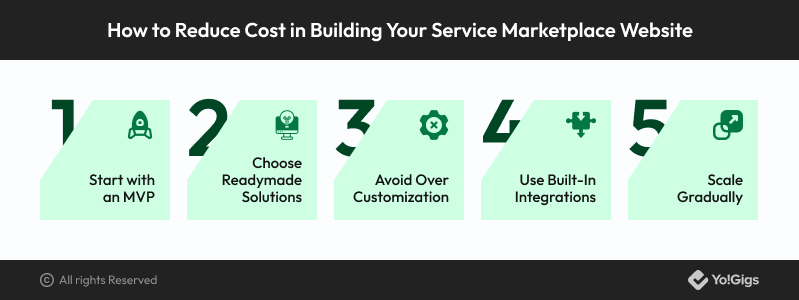
1. Start with an MVP
Launch with essential features and expand based on user feedback instead of building everything at once.
2. Choose Readymade Software Solutions
Using a proven solution helps you build a service marketplace website like Thumbtack faster and at a fraction of the cost of custom development.
3. Avoid Over-Customization Initially
Focus on core functionalities and branding rather than complex custom features in the early stage.
4. Use Built-In Integrations
Pre-integrated payment gateways, messaging systems, and dashboards save both time and money.
5. Scale Gradually
Expand features, regions, and service categories as your marketplace gains traction and revenue.
By opting for a self-hosted, readymade marketplace solution, entrepreneurs can drastically reduce the cost to build a service marketplace website like Thumbtack while still launching a competitive platform.
Yo!Gigs: A Readymade Service Marketplace Software Solution
Yo!Gigs is a robust, self-hosted service marketplace software built to help entrepreneurs and businesses quickly launch platforms similar to Thumbtack. Instead of investing months and a large budget into custom development, Yo!Gigs offers a ready-made foundation that significantly reduces the cost to build a service marketplace website.
Built specifically for service-based marketplaces, Yo!Gigs supports multiple service categories, user roles, and monetization models from day one. It includes essential features such as job posting and bidding, advanced search, in-platform communication, secure payment processing, commission and subscription management, and detailed admin controls.
Key Benefits of Yo!Gigs
a. One-time license cost (no recurring SaaS fees)
b. Dedicated dashboards for admin, service providers, and customers
c. Built-in job posting and bidding system
d. Commission and subscription management
e. Secure payments and payout management
f. Scalable and customizable architecture
g. Faster time to market
Yo!Gigs is ideal for startups and businesses looking to create a service marketplace website like Thumbtack without the high costs and long timelines of custom development.
Discover How Yo!Gigs Powers Service Marketplaces
Conclusion
Building a service marketplace website like Thumbtack is a promising business opportunity, but the cost can vary widely depending on the development approach you choose, feature set, and long-term growth strategy.
While custom development offers flexibility, it comes with high costs and extended timelines. SaaS solutions lower the entry barrier but introduce recurring expenses and limitations. In contrast, self-hosted readymade software like Yo!Gigs strikes the right balance, offering affordability, control, scalability, and faster launch.
By selecting the right approach, prioritizing essential features, and planning for gradual growth, you can significantly reduce the cost to build a service marketplace website and bring your platform to market with confidence. Moreover, if your goal is to launch quickly, stay cost-efficient, and retain ownership, investing in a proven solution like Yo!Gigs are the smart and sustainable path forward.
FAQs
Q 1. How long does it take to create a service marketplace website like Thumbtack?
Ans. The time to create a fully custom-built service marketplace can take 6 to 12 months to design, build, and test. In contrast, using a thumbtack clone allows you to launch your service platform within a few weeks, depending on customization and setup requirements.
Q 2. What are the main features required to build a service marketplace website?
Ans. Essential features to build a service marketplace website include:
- User registration
- Service listings
- Job posting and bidding
- Location-based search
- Secure payments
- Messaging
- Reviews and ratings
- Commission management
- Admin dashboard.
Q 3. Is it better to choose SaaS or self-hosted marketplace software?
Ans. SaaS solutions are suitable for quick launches with low upfront costs but involve recurring monthly fees and limited customization. On the other hand, self-hosted solutions offer full ownership, greater flexibility, and a one-time payment model, making them more cost-efficient in the long run.
Q 4. Can I build a service marketplace website without technical knowledge?
Ans. Yes, you can build a service marketplace website without technical knowledge. Readymade service marketplace software like Yo!Gigs allows you to create and manage a service marketplace website equipped with the most essential features and provide technical support for seamless management of the platform.
Q 5. How do service marketplace platforms make money?
Ans. Service marketplaces generate revenue through multiple streams, such as:
- Commissions on transactions
- Subscription plans for service providers
- Lead generation fees
- Featured listings
- Advertising placements.
Q 6. Is it possible to scale a service marketplace website after launch?
Ans. Yes, you can scale your service marketplace website after launch. Most of the modern marketplace software is highly scalable and allows you to expand by adding new service categories, onboarding more professionals, entering new locations, and introducing advanced features as your platform grows.
Q 7. What factors impact the cost of building a service marketplace website?
Ans. Development cost depends on various factors, including:
- Feature complexity
- UI/UX design
- Development approach
- Third-party integrations
- Security requirements
- Post-launch maintenance and support.
Q 8. Can Yo!Gigs be customized to fit my business model?
Ans. Yes, Yo!Gigs is a flexible, self-hosted solution that supports customization across multiple service categories, monetization models, workflows, and branding needs, allowing businesses to align the marketplace with their specific niche and long-term growth strategy.
