

The US has a deep, diverse pool of independent talent across technology, creative, professional services, and local gigs. Launching a marketplace here means addressing regulation, trust, payments, and go-to-market with precision—while moving fast enough to win your niche.
Table of Contents
- Why Start a Freelance Marketplace in the US?
- Legal and Compliance Basics (US)
- Must-Have Features for US-Ready Marketplaces
- Cost of Building a Freelance Marketplace in the US
- Steps to Build a Freelance Marketplace in the US
- Differentiation & Monetization
- How to Launch Your Freelance Marketplace Successfully
- Challenges You’ll Face—and How to Solve Them
- Why Choose Yo!Gigs for Your Freelance Marketplace in the US?
- Conclusion
- FAQs
Why Start a Freelance Marketplace in the US?
The independent workforce is large and resilient. In 2023, 64 million Americans—38% of the workforce—did some freelancing, contributing $1.27T to the economy. In 2024, broader “independent work” participation reached about 72.7 million adults.
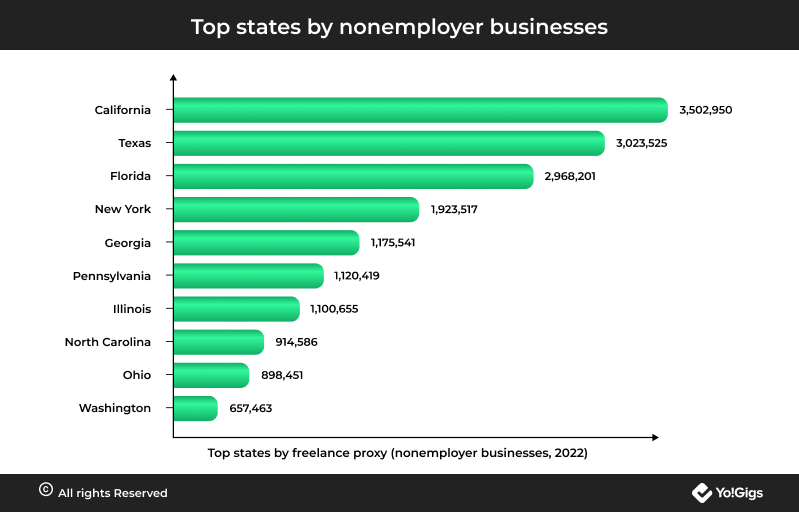
Across states, the addressable talent base is evident in nonemployer business counts (a common proxy for solo operators/freelancers). Top states by nonemployer businesses (2022) include California (3,502,950), Texas (3,023,525), Florida (2,968,201), and New York (1,923,517).
Top states by freelance proxy (nonemployer businesses, 2022)
Legal and Compliance Basics (US)
Incorporate appropriately (LLC/C-Corp), set clear Terms/Privacy, handle worker classification risks, and use a payment partnerscape that supports US KYC, AML, and tax reporting (e.g., 1099 forms via your PSP). Consult a US attorney/CPA for state-level nuances; some states have stricter rules for marketplace facilitators and consumer protection.
Must-Have Features for US-Ready Marketplaces
1. Verified User Profiles & Portfolios
- Freelancers should be able to showcase skills, certifications, past projects, and reviews.
- For US clients, credibility and proven track records are crucial to winning projects.
2. Advanced Job Posting & Bidding System
- Clients should be able to post projects with budgets, timelines, and requirements.
- Freelancers can bid, send proposals, or accept instant projects.
- A transparent bidding system builds trust between parties.
3. Secure & Escrow-Based Payment System
- Escrow ensures that clients deposit money upfront before freelancers begin work.
- Protects both sides against fraud or disputes.
- US freelancers strongly prefer platforms with guaranteed payment safety.
4. Multiple Payment Gateways & Payout Options
- Must integrate popular US gateways like PayPal, Stripe, and ACH transfers.
- Weekly/monthly payout cycles add flexibility for freelancers.
5. Dispute Management & Resolution Tools
- Built-in system for reporting, reviewing, and resolving disputes.
- Helps maintain platform credibility and minimizes churn.
6. Ratings & Reviews for Both Clients and Freelancers
- A two-way rating system ensures accountability.
- Builds marketplace transparency and helps users choose the right partners.
7. Robust Admin Dashboard
- Allows marketplace owners to monitor transactions, manage commissions, resolve disputes, and analyze activity.
- Essential for scaling in the competitive US market.
8. Compliance & Legal Safeguards
- Built-in tax compliance (1099 for freelancers).
- Features for contract agreements, NDAs, and terms aligned with US labor policies.
9. Smart Matching & Search Filters
- AI/algorithmic matching based on skills, ratings, location, and budget.
- Advanced filters help clients quickly find the right freelancer.
10. Mobile-Friendly Platform
- Over 60% of US freelancers use mobile devices to manage work.
- Responsive UI and dedicated mobile apps improve adoption.
11. Integrated Communication Tools
- In-app chat, file sharing, and video conferencing options.
- Reduces dependency on third-party apps like Zoom or Slack.
12. Analytics & Reporting
- Freelancers can track earnings, time logs, and client engagement.
- Clients get insights on project costs and freelancer performance.
- Marketplace owners can measure revenue, user activity, and growth trends.
13. Subscription & Membership Options
- Tiered memberships (basic, premium, enterprise) allow different revenue streams.
- Freelancers may pay for additional bids, higher visibility, or marketing support.
14. Local & Niche Support
- Ability to filter freelancers by state or city in the US.
- Beneficial for projects requiring local presence (e.g., photography, field work).
15. Scalable Infrastructure
- Cloud-based architecture that supports high traffic and transactions.
- Prepares the marketplace for national expansion across the US.
Cost of Building a Freelance Marketplace in the US
The cost to build a freelance website in the US varies by region because developer wages differ across states. As a reference, the median US software developer wage was ~$133k in May 2025. Agency billable rates are typically higher due to overhead and margins, so MVP costs can vary widely.
Indicative ranges (MVP for 6–9 months; ~2–3 FTE blended; excludes performance marketing):
These are estimates based on prevailing US rates and typical scope; local agency quotes will vary.
| State | Custom development (6–9 months) | White-label setup + customization |
| California | $300k–$600k | $40k–$100k |
| New York | $300k–$580k | $40k–$95k |
| Washington | $280k–$560k | $35k–$90k |
| Texas | $220k–$480k | $30k–$80k |
| Florida | $220k–$460k | $30k–$75k |
| Illinois | $220k–$480k | $30k–$80k |
| Georgia | $210k–$450k | $28k–$75k |
| North Carolina | $180k–$420k | $25k–$70k |
| Ohio | $180k–$420k | $25k–$70k |
| Pennsylvania | $180k–$420k | $25k–$70k |
Want to build your US freelance marketplace faster
Steps to Build a Freelance Marketplace in the US
1. Define the niche and job-to-be-done
Pick a clear vertical (e.g., construction subs, legal freelancers, healthcare coders, creative pods). Scope your “10X better” vs. generic platforms: faster hiring, vetted talent, bundled compliance, or guaranteed SLAs.
2. Design supply/demand value props
For clients: predictable outcomes, SLAs, escrow safety, and compliant onboarding. For freelancers: fair fees, fast payouts, reputation building, and high-intent leads.
3. Map the core workflows
Detail every click: client brief → requirements → shortlist → proposal → acceptance → contract/NDA → milestone funding (escrow) → delivery → acceptance → revision → payout → rating → re-hire. Do this per category to handle differences (hourly vs. fixed-price, local vs. remote).
4. Choose your build path
Custom (full control, higher cost/time) vs. white-label (faster, cheaper, still customizable). For custom, document an SRS with epics (Auth, Profiles, Listings, Search, Cart/Escrow, Messaging, Disputes, Payouts, Analytics). For white-label, validate module coverage and extension points.
5. Plan the technical architecture
Modular services (auth, catalog, pricing, payments, payouts), role-based access, event logs, audit trails, and API-first extensions. Prioritize performance (search, feed, messaging) and observability (metrics, tracing).
6. Select payments & tax stack
Use a marketplace PSP (e.g., a solution that supports split payments/escrow, KYC, and year-end tax reporting). Confirm US ID verification, TIN collection, and state tax nuances for services/marketplace facilitation.
7. Trust & safety by design
Implement KYC/KYB, optional background checks, portfolio verification, watermarking, IP transfer templates, and clear dispute stages. Add rate limits, anomaly detection, and holdbacks for fraud-prone categories.
8. Content, SEO, and schema
Enforce structured service pages (FAQ, deliverables, timelines), add Product/Service and Review schema, build location pages for priority metros, and maintain topic clusters for your niche.
9. Recruit the first 500 freelancers and 100 buyers
Use targeted lists, associations, LinkedIn groups, and category newsletters. Offer zero fees for early cohorts, featured placement, and referral bonuses. Create a concierge desk to hand-match the first deals.
10. Pilot, measure, iterate
Soft-launch in 1–2 states or 1–2 subcategories. Track time-to-first-hire, proposal-to-win rate, cancellation rate, on-time milestone %, dispute rate, LTV/CAC, and repeat-hire %. Optimize UX and policies before scaling nationally.
Differentiation & Monetization
Monetize with a take rate (10–20% common), buyer fees, seller subscriptions, featured listings, and SaaS add-ons (team seats, compliance bundles, faster payouts). Differentiate with verified talent pools, AI-assisted briefs, outcome-based packages, insurance add-ons, and category-specific SLAs.
How to Launch Your Freelance Marketplace Successfully
1. Pick a beachhead
Start with one state/metro or a tight vertical where you can build density fast (e.g., Austin tech contractors or Florida home-services pros).
2. Seed the right supply
Recruit 100–500 vetted freelancers with guaranteed first leads, zero launch fees, a success playbook, and a showcase page for each.
3. Create buyer confidence
Offer brief templates, curated shortlists, and a concierge to hand-match first deals; publish SLAs and refund windows.
4. Instrument the funnel
Track activation (profile completeness, proposal quality), liquidity (time-to-first-hire), quality (on-time delivery, dispute rate), and growth (repeat-hire %, referral rate).
5. Run targeted demand campaigns
ABM to SMBs in your niche, city-level Google Ads with lead magnets, partnerships with trade associations, and case-study-driven LinkedIn ads.
6. Operational excellence
Enforce milestone funding, on-platform messaging, and delivery through your system; escalate with structured playbooks; publish trust metrics.
7. Iterate pricing and incentives
Start with promotional take rates and raise as value is proven; add subscriptions/featured listings for pros; reward repeat-hire behavior.
8. Expand deliberately
After PMF, add adjacent categories or new metros. Localize policies (e.g., state consumer rules) and reuse playbooks.
Challenges You’ll Face—and How to Solve Them
1. Cold start (chicken-and-egg)
- Problem: No buyers without supply; no supply without buyers.
- Solution: Constrain the market (one city/vertical), seed with pre-vetted freelancers, guarantee first jobs, and run a concierge model for the first 50–100 matches.
2. Trust, safety, and quality control
- Problem: Low-quality work, fake profiles, and disputes erode confidence.
- Solution: KYC/KYB, optional background checks, portfolio verification, structured deliverables, milestone escrows, satisfaction windows, tiered talent badges, and transparent dispute playbooks.
3. Payments, fraud, and chargebacks
- Problem: Split payouts, clawbacks, and compliance overhead.
- Solution: Use marketplace-grade PSPs with KYC, fraud screening, 3-D Secure, rolling reserves for risky categories, and automated 1099 support; adopt clear cancellation/holdback policies.
4. Regulatory and tax complexity
- Problem: State-by-state differences, worker classification risk, and document retention.
- Solution: Provide clear contractor agreements, W-9/TIN collection, privacy policies, SOC-ready practices, and maintain counsel/CPA review for target states.
5. Unit economics
- Problem: Fees too low starve growth; too high push users off-platform.
- Solution: Model LTV/CAC, tier fees by category and repeat business, add subscriptions for power users, and incentivize on-platform rehires.
6. Scalability and uptime
- Problem: Search, messaging, and file exchange can bottleneck.
- Solution: CDN, queues for heavy jobs, background media processing, read replicas for search/feed, and SLOs with dashboards and alerting.
7. Support and operations
- Problem: Disputes and escalations drain time.
- Solution: Route with SLAs, canned responses, templated settlements, and an internal case tool with evidence uploads and audit trails.
Why Choose Yo!Gigs for Your Freelance Marketplace in the US?
Yo!Gigs is a ready-made freelance marketplace software that helps you launch a full-featured, scalable platform similar to Upwork or Fiverr. It includes job postings, bidding, service packages, milestone-based payments, agency accounts, messaging, reviews, and advanced admin controls. The solution is fully customizable, self-hosted, and scalable, allowing you to shape the marketplace around your niche. With SEO tools and a one-time license, Yo!Gigs makes launching a professional freelance website fast and cost-effective.
Schedule your free Yo!Gigs demo to build your US freelance marketplace
Conclusion
The US freelance economy is massive and still growing, but only marketplaces that are niche-focused, operationally strong, and trusted stand out. To succeed, you need to build seamless workflows, establish early liquidity in your niche, and scale strategically. The fastest way to get there is by choosing the right foundation—Yo!Gigs, a white-label freelance marketplace software built to meet US compliance, payments, and growth requirements. With Yo!Gigs, you can move faster, reduce risks, and launch a platform that attracts both freelancers and businesses.
FAQs
Q 1. What’s the fastest route to MVP for a freelance marketplace in the US?
Ans. Using a white-label solution like Yo!Gigs, tailored to your niche and workflows, helps you launch an MVP quickly while keeping costs manageable.
Q 2. How long does it take to launch a freelance marketplace with Yo!Gigs?
Ans. With Yo!Gigs, a focused MVP can be live in 6–12 days, whereas fully custom builds often take several months due to added complexity around security, payments, and compliance.
Q 3. Which payment methods should I support in a US freelance marketplace?
Ans. At minimum, support cards and ACH bank transfers. Yo!Gigs also integrates with PayPal, Stripe, and escrow-based split payouts, ensuring compliance with US KYC and tax reporting.
