
The gig economy has evolved rapidly, transforming from a niche labor market into a central pillar of global business strategy. While general platforms like Upwork and Fiverr cater to volume, a new, more lucrative opportunity has emerged: the specialized freelance marketplace. Leading this charge is Toptal, a platform that not only connects clients with freelancers but with the top 3% of global talent, commanding premium rates and delivering enterprise-grade quality.
For ambitious entrepreneurs, the question is no longer if they should build a freelance marketplace, but how to build a freelance marketplace like Toptal that focuses on quality, specialization, and rigorous vetting. Further, this comprehensive guide will dissect the Toptal model and provide a strategic blueprint, including the essential features and the best technological path to launch your specialized platform.
Table of Contents
- What is a Specialized Freelance Marketplace?
- Toptal Business Model: How it Works
- How Does Toptal Make Money?
- Must-Have Features in a Specialized Freelance Marketplace Like Toptal
- How to Build a Specialized Freelance Marketplace (4-Step Blueprint)
- Yo!Gigs: A Freelance Marketplace Software to Build a Specialized Freelance Marketplace Like Toptal
- Conclusion
- FAQs
What is a Specialized Freelance Marketplace?
A specialized freelance marketplace is a focused talent platform designed to connect businesses with highly vetted professionals in specific, high-value skill areas. Unlike general freelance platforms that cater to a broad range of services and experience levels, specialized marketplaces prioritize quality, expertise, and reliability over volume. Further, the table given below describes how a specialized marketplace differs from a general marketplace:
| Feature | General Marketplace (e.g., Upwork/Fiverr) | Specialized Marketplace (e.g., Toptal) |
| Talent Pool | Massive, diverse, all skill levels (beginner to expert) | Highly curated, vetted top-tier talent (often top 1-3%) |
| Pricing | Low to highly variable (competitive bidding) | Premium, high-rate (value-based pricing) |
| Target Client | Individuals, small businesses, and general projects | Mid-to-large enterprises, CTOs, VPs of Engineering/Finance |
| Focus | Volume, variety, and affordability | Quality, reliability, and risk mitigation |
| Skill Set | Broad categories (writing, design, data entry, coding) | Deep verticals (Senior JavaScript Engineers, Interim CFOs, Product Managers) |
A specialized marketplace focuses on one or two high-value verticals, such as blockchain developers, fractional Chief Marketing Officers, or AI/ML engineers, and implements a harsh, multi-stage screening process. This scarcity of pre-vetted, high-caliber talent is the primary magnet that attracts high-paying, enterprise-level clients.
Toptal Business Model: How it Works
Models like Toptal demonstrate how focusing on elite talent, rigorous vetting, and curated matching can deliver enterprise-grade outcomes while commanding premium value. Moreover, Toptal’s success stems from redefining the relationship between quality, speed, and trust in remote hiring. Their operating model is built on three core pillars:
1. The Rigorous Vetting Process
Toptal’s key differentiator is its highly selective, multi-stage vetting process, which results in an acceptance rate of around 3% of all applicants. This structured evaluation is designed to assess not only technical ability, but also communication, professionalism, and real-world performance. This process typically includes:
- Step 1: Language & Personality Screening: An initial assessment focused on communication skills, clarity of thoughts, and professionalism.
- Step 2: Timed Skill Test: A role-specific technical test to evaluate core knowledge and problem-solving abilities within the freelancer’s niche, such as a coding challenge or a financial modeling test.
- Step 3: Live Interview & Screening: A one-on-one interview with Toptal experts to assess depth of knowledge and ability to discuss complex topics.
- Step 4: Real-World Test Project: A practical, multi-week project designed to evaluate professional discipline, adherence to deadlines, and real-world quality of work.
This comprehensive filtering ensures that only genuinely elite professionals are accepted into the network.
2. The Matching Service
Toptal is not a self-service bidding platform. Instead, once a client submits a project request, Toptal employs a dedicated team of “matchers” personally hand-select the best one to three candidates from their network.
- Personalized Matching: Matchers analyze project requirements, seniority expectations, and industry context before shortlisting one to three best-fit candidates, based on the client’s specific needs, required seniority, and industry experience.
- Speed: Toptal’s team typically connects clients with a suitable candidate within 48 hours.
- Risk-Free Trial: Every contract starts with a risk-free trial period (typically two weeks). If the client is not satisfied for any reason, they do not pay for the work, mitigating client risk entirely.
This hands-on approach prioritizes fit and trust over speed-driven volume.
3. Focus on Long-Term, High-Value Engagements
Unlike micro-task platforms, Toptal focuses on placing freelancers into long-term, full-time, or part-time arrangements. This focus drives high lifetime value (LTV) for both the platform and the talent, reinforcing its premium positioning in the freelance economy.
Ready to Enter the Premium Freelance Marketspace?
How Does Toptal Make Money?
Toptal’s revenue model is simple but highly effective, generating high-margin income from the spread between the client’s bill rate and the freelancer’s pay rate. Given below are the revenue streams by which Toptal generates revenue:
1. The Mark-up
Toptal’s main source of revenue comes from a confidential markup applied to the freelancer’s agreed hourly rate. Clients are billed a higher hourly rate, while freelancers receive their negotiated pay.
- Example: If a freelancer sets their rate at $60 per hour, Toptal might bill the client at $120 per hour. The platform’s revenue is the $60 difference.
- Value Justification: Clients are willing to pay this substantial premium because they are effectively paying for Toptal’s rigorous vetting, the speed of placement, the risk-free trial, and the platform’s comprehensive management of contracts, payments, and billing infrastructure.
2. Upfront Deposit
To ensure client commitment and reduce placement risk, Toptal typically requires a $500 to $1,000 deposit from the client upon project initiation.
- Purpose: This deposit serves as a pre-payment for the first week of work and ensures client commitment.
- Handling: If a match is successful, the deposit is applied to the first invoice. If Toptal fails to find a suitable match, the deposit is fully refundable, maintaining a high-trust environment.
3. Long-Term Contracts
Toptal prioritizes long-term engagements over short-term gigs. Moreover, many placements last six months, a year, or longer, positioning freelancers as extended members of client teams.
- Revenue Impact: This focus on sustained contracts creates predictable, recurring commission revenue and significantly increases the lifetime value of each client, making the business model both stable and highly profitable.
Must-Have Features in a Specialized Freelance Marketplace Like Toptal
To successfully build a freelance marketplace like Toptal, your platform must be engineered to support the three pillars: Quality, Speed, and Trust.
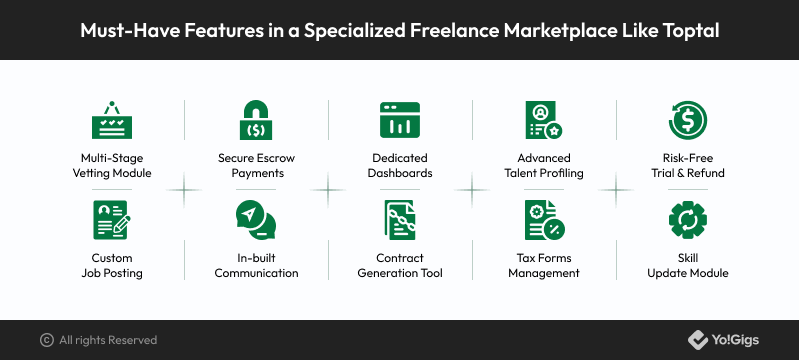
Here are the essential features:
- Multi-Stage Vetting Module: This is the core differentiator of Toptal. It provides the digital workflows needed to manage the rigorous screening process, including application, skill test, live interview, test project, and is crucial for tracking pass/fail rates and scoring to maintain elite talent quality.
- Secure Escrow & Milestone Payments: Guarantees transactional trust between clients and freelancers. It ensures freelancers are paid only upon successful completion and client approval of milestones, allowing clients to hold funds securely until the work is satisfactory.
- Dedicated Client and Freelancer Dashboards: Provides separate, role-specific professional interfaces tailored to each user type. Client dashboards focus on invoicing and budget tracking, while freelancer dashboards prioritize earnings, project pipelines, and vetting progress.
- Advanced Talent Profiling & Search: Enables the “matcher” to quickly find the perfect candidate. Profiles must showcase detailed, specific technical skills and past project data, supporting ultra-specific, non-public searches for rapid placement.
- Risk-Free Trial & Refund Logic: Directly supports the marketplace’s value proposition. The system must automatically track the initial trial period, typically 14 days, and manage the refund or credit process if the client is dissatisfied and cancels the contract.
- Custom Job Posting & Direct Invitation: Allows admin to submit detailed project briefs, while giving Admin/Matchers the ability to directly invite only a small, curated list of pre-selected, high-fit talent to the job.
- In-built Communication & Time Tracking: Offers a unified collaboration space. This includes a robust messaging system with file sharing, often integrated with optional time tracking, including screenshotted work diaries for accurate billing on hourly contracts.
- NDA & Contract Generation Tool: Essential for enterprise trust, this feature allows both clients and freelancers to easily generate and digitally sign Non-Disclosure Agreements (NDAs) and custom service contracts directly within the platform.
- Global Compliance & Tax Forms Management: Since talent is often international, the platform needs tools to handle international payroll, manage local tax forms, such as W-9s, W-8BENs, and ensure compliance across different jurisdictions.
- Talent Re-engagement and Skill Update Module: To maintain quality, the system must prompt freelancers to update their skills, complete new certifications, and undergo periodic re-vetting to ensure their expertise remains current and relevant.
Create a Toptal-Like Feature-Rich Freelance Marketplace
How to Build a Specialized Freelance Marketplace (4-Step Blueprint)
Building a specialized freelance marketplace requires far more than replicating the surface features of existing platforms. Unlike general marketplaces that compete on volume, a specialized platform must be engineered to deliver consistent, high-value outcomes for both clients and freelancers.
This five-step blueprint outlines a practical, execution-focused approach to building a specialized freelance marketplace modeled on premium networks like Toptal.
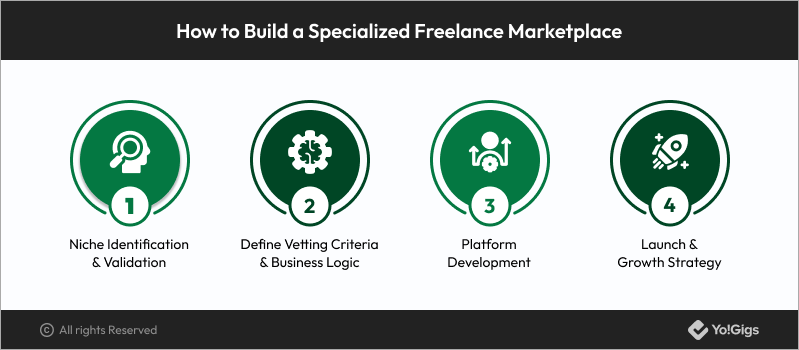
Let’s have a look at them:
Step 1: Niche Identification and Validation
This is the most critical decision in the entire process. Since you cannot compete directly with general giants, you must target a highly focused, lucrative niche. You need to select a specific vertical, such as fractional Chief Marketing Officers (CMOs) for Fintech startups or highly specialized data scientists in the pharmaceutical industry. The goal is to confirm that both the enterprise clients, who are willing to pay premium rates, and the elite talent, who deliver high-quality work, exist and are willing to transact on your focused, quality-driven platform.
Step 2: Define Vetting Criteria and Business Logic
Once the niche is defined, the next step is to translate Toptal’s concept of quality into practical, measurable steps for your chosen niche. This involves designing a rigorous, multi-stage screening process, for example, the four key tests a specialized engineer must pass. At the same time, core business rules must be clearly established, including the exact commission structure, the rules governing the “risk-free trial” period, and the up-front deposit required from clients to ensure commitment.
Step 3: Platform Development (Custom vs. Readymade)
This stage determines both your time-to-market and overall investment. You can either build the platform from the ground up or leverage a ready-made marketplace solution. Let’s explore both of them:
- Custom Development: Building the entire platform from scratch offers total control but requires a large initial investment, upwards of $150,000 to $400,000+, and a long launch timeline, typically 9-18 months, carrying significant risk.
- Readymade Software: Utilizing a dedicated freelance marketplace software solution, like Yo!Gigs drastically reduces upfront costs, as most of the readymade solutions are available below $5,000 and accelerates launch time to a few weeks. This provides a tested, scalable foundation with all core features, including dashboards, payments, etc., allowing you to focus your limited resources on customizing the unique vetting module and matching logic.
Step 4: Launch and Growth Strategy
After the deployment of the platform, the priority is not to scale rapidly, but quality and market validation. Onboard an initial cohort of 50 to 100 thoroughly vetted freelancers within your niche, ensuring your quality standards are firmly established. In parallel, execute targeted marketing and outreach to attract a small set of enterprise or high-intent clients. This go-to-market phase allows you to validate assumptions, fine-tune operational workflows, test pricing and vetting logic, and begin generating early revenue based on real customer feedback.
Yo!Gigs: A Freelance Marketplace Software to Build a Specialized Freelance Marketplace Like Toptal
For entrepreneurs aiming to build a premium, Toptal-style freelance marketplace without the heavy investment and time of custom coding, leveraging a robust, purpose-built solution is the most strategic path. Yo!Gigs stands out as an excellent choice of freelance marketplace software for this model.
Yo!Gigs is a white-label, self-hosted software that offers a framework designed to launch and scale on-demand service and freelance platforms. Its core architecture already supports the essential mechanics required for a curated, enterprise-focused marketplace, allowing you to focus on what truly differentiates your platform.
- Multi-User Dashboards: Dedicated dashboards for the Admin/s, Clients, and Freelancers, giving each party the tailored tools they need, such as job tracking for Clients, earnings reports for Freelancers.
- Multiple Job Types & Bidding Module: Supports various engagement models, including fixed-price, biddable, hourly, etc., giving you the flexibility needed to cater to enterprise contracts.
- Advanced Job Posting & Direct Invitation: Allows clients to upload detailed requirements and enables the Admin (or your specialized “matcher”) to manually invite pre-vetted talent, replicating the curated matching service.
- Commission Management & Escrow: Built-in features to manage the revenue model, automatically levying your commission on every transaction and using a secure payment system to hold funds until work is approved.
- Booking Calendar: The booking calendar allows clients to view freelancer availability and hire them directly on an hourly basis. It prevents double bookings and helps freelancers manage work hours.
- Built-In Reporting and Analytics: Provides actionable insights into platform performance, revenue, engagement, and user activity, helping marketplace owners make informed decisions and optimize growth strategies.
Why Choose Yo!Gigs for a Specialized Marketplace?
When your core value proposition is quality and speed, choosing the right development platform is paramount. Yo!Gigs offer distinct advantages over building from scratch:
1. Lower Cost, Faster Launch: A ready-to-deploy solution significantly reduces the initial investment and cuts the time-to-market from over a year to mere weeks. This capital efficiency is vital for investing more in marketing and talent acquisition.
2. Proven Stability and Reduced Risk: The core eCommerce and transaction logic, such as user registration, payment processing, security, and database, is pre-tested and reliable. You avoid the high risk and extended QA process associated with custom software development.
3. Focus on Customizing the Core Differentiator: Instead of wasting budget building generic tools, you allocate development resources only to the features that make your platform unique. Yo!Gigs provides the robust base for these crucial customizations.
4. Lifetime License & Ownership: Unlike subscription-based SaaS solutions, solutions like Yo!Gigs often offer a lifetime license, meaning you own the customizable source code outright, providing complete control and eliminating recurring monthly software fees as you scale.
By choosing smart, powerful freelance marketplace software, you can bypass the build-vs-buy dilemma and concentrate on the one thing that matters: curating the best talent in your niche to deliver superior client outcomes and
achieve market dominance.
Request a Personalized Yo!Gigs Demo
Conclusion
The future of the freelance economy favors specialized platforms offering meticulously vetted, high-quality talent, as exemplified by Toptal’s premium model. To replicate this success, entrepreneurs must focus on a high-value niche and enforce a rigorous, multi-stage vetting process. Moreover, by strategically choosing dedicated freelance marketplace software like Yo!Gigs, you gain a scalable foundation, allowing resources to be efficiently channeled into customizing the core differentiators, such as the specialized vetting and matching logic for high-margin success and rapid market dominance.
FAQs
Q 1: Does using a readymade platform limit our ability to scale later?
Ans: No, using a readymade platform does not limit our ability to scale later. Modern, self-hosted, ready-made solutions like Yo!Gigs are built on scalable frameworks. Since you acquire the customizable source code, you have full control. You can scale the underlying infrastructure, such as servers, database, and continuously integrate new, highly complex features like AI-powered matching or global compliance tools without being constrained by the platform’s initial design.
Q 2: How is a freelancer clone different from building a marketplace from scratch?
Ans: A freelancer clone offers a ready-to-use foundation with proven workflows for hiring, vetting, project management, and payments. Unlike building a platform from scratch, a freelancer clone significantly reduces development time, cost, and technical risk. It allows businesses to launch faster, validate their niche, and then customize features, user experience, and integrations as the marketplace grows—making it a practical choice for entrepreneurs building a specialized freelance marketplace.
Q 3: What are the main challenges in the talent acquisition phase for a specialized marketplace?
Ans: The biggest challenge is the chicken-and-egg problem, coupled with the difficulty of convincing elite talent (who already have high-paying jobs) to undergo a rigorous vetting process.
- Solution: Offer a compelling value proposition: promise of high-paying, long-term contracts without the hassle of marketing, invoicing, or collections. Make the vetting process itself feel exclusive and prestigious.
Q 4: Besides the commission, what other monetization strategies can we use to boost revenue?
Ans: Besides commission, you can use the following written strategies to boost the revenue:
- Client Subscription Tiers: Offering enterprise clients a monthly subscription for dedicated account management or faster matching service.
- Featured Listings: Charging clients a small fee to highlight urgent job postings.
- Value-Added Services: Offering premium services like compliance assistance, team integration workshops, or specialized payroll services for an extra fee.
