
The “on-demand” economy has fundamentally reshaped how consumers tackle their to-do lists. At the forefront of this revolution is the home service marketplace, a digital hub connecting busy individuals with skilled local freelancers. Leading the charge is TaskRabbit, a platform that has proven the massive market appetite for outsourced errands, repairs, and general handyman work.
If you are an entrepreneur looking to tap into this multi-billion-dollar gig economy, the central question is not if you should launch a home service marketplace website, but what it costs to build a home service marketplace like TaskRabbit, and how to do it efficiently.
This blog is crafted for such entrepreneurs, it breaks down the true investment, feature by feature, and outlines the most cost-effective development path.
Table of Contents
- What is the TaskRabbit Marketplace?
- How a Home Service Marketplace Like TaskRabbit Works?
- Top Home Services Marketplace Websites Like TaskRabbit
- Key Features in a TaskRabbit-Like Marketplace
- Factors Affecting the Cost to Build a Home Service Marketplace Like TaskRabbit
- Cost Breakdown: Scratch Build vs. Readymade Solution
- Tips to Reduce the Development Cost
- Yo!Gigs: A Cost-Effective Solution to Build Your Home Service Marketplace Like TaskRabbit
- Conclusion
- FAQs
What is the TaskRabbit Marketplace?
TaskRabbit is an American online marketplace that facilitates the matching of local freelance labor (known as “Taskers”) with consumer demand for local services. Founded in 2008 by Leah Busque and acquired by the Ingka Group (IKEA) in 2017, it is a classic example of a successful P2P (peer-to-peer) service platform accessible via its website and companion mobile applications.
The TaskRabbit marketplace allows users to quickly book vetted professionals for a wide range of services, including:
- Furniture Assembly (a key feature tied to its IKEA ownership)
- Minor Home Repairs (handyman work)
- Mounting and Installation
- Cleaning and Housekeeping
- Moving Help and Delivery
- Personal Assistance and Errands
However, TaskRabbit’s success lies in its rigorous vetting process for Taskers, its seamless in-platform payment system, and its robust technology infrastructure that makes booking help on its marketplace website as easy as any other online transaction.
How a Home Service Marketplace Like TaskRabbit Works?
A home service marketplace operates on a three-sided model: the User (or Client), the Service Provider (Tasker/Freelancer), and the Admin Panel (the Platform Owner). This ecosystem is managed centrally by the marketplace website.
| Stakeholder | Role in the Platform | Key Interactions on the Marketplace Website |
| User (Client) | Needs a task completed at home or in the local area. | Posts a task on the website, reviews Tasker profiles, selects a provider, communicates details, pays via the platform, and leaves a rating. |
| Service Provider (Tasker) | A vetted freelancer with specific skills (e.g., plumbing, cleaning, assembly). | Creates a detailed profile, sets rates and availability, views incoming jobs, communicates with clients, completes tasks, and receives payment. |
| Admin Panel (Platform Owner) | Manages the entire ecosystem, ensuring quality and revenue. | Manages users and Taskers, controls categories and pricing, monitors transactions, resolves disputes, and runs marketing campaigns. |
The Workflow in Four Steps:
- Task Posting/Service Booking: The client navigates the home service marketplace website, selects a service category, provides task details (location, scope, time), and a preference (e.g., Fixed Price or Hourly Rate).
- Matching and Selection: The platform uses location and skill-based algorithms to match the task with relevant, available Taskers. The client is presented with a list of Tasker profiles on the website, allowing them to compare rates, read reviews, and view qualifications.
- Confirmation and Communication: The client selects a Tasker and confirms the booking. Additionally, an in-platform chat feature (accessible on the website and apps) allows both parties to discuss final details before the service begins.
- Completion and Payout: Once the Tasker marks the job as complete, the pre-authorized payment is released from the escrow account, deducting the platform’s commission and applicable fees, before the remainder is paid out to the Tasker. The client then rates the service via the marketplace.
Top Home Services Marketplace Websites Like TaskRabbit
The market for on-demand services is highly competitive and globally diverse. To carve out a niche, it is essential to study the major players who have successfully replicated or specialized in the TaskRabbit marketplace model. Let’s begin:

- Airtasker: Originating in Australia, Airtasker is a direct peer-to-peer competitor with a strong community focus. Unlike TaskRabbit’s fixed prices, Airtasker allows users to post a task with an offer, and Taskers bid for the job, often resulting in a bidding war. All interactions are driven by the central marketplace website.
- Handy (Now part of Angi): Focuses heavily on routine services like cleaning and handyman work, utilizing a more streamlined, fixed-price booking model. Their primary interface is a highly optimized booking website.
- Thumbtack: A broader professional marketplace website that covers over 1,000 services, ranging from home repairs to photography. It often operates on a lead-generation model where professionals pay to connect with potential clients.
Suggested Read: Discover How to Build a Home Service Marketplace like Thumbtack
- Urban Company (formerly Urban Clap): Dominates the Asian market, offering a high-quality, standardized service experience by training and vetting all its service professionals rigorously, operating as a full-stack home service marketplace.
To thrive in the industry, a successful new marketplace website must find its unique angle: perhaps specializing in one vertical (e.g., only moving and delivery) or optimizing the user experience for a specific demographic.
Key Features in a TaskRabbit-Like Marketplace
A robust home service marketplace website requires a minimum of three distinct components (customer website/app, tasker website/app, and admin panel), each with its own set of essential features. While mobile apps are important, the core logic and management reside in the web platforms. Let’s explore their key features:
1. Customer-Side Features
| Feature Category | Core Features |
| Booking & Matching | Service Category Selection, Detailed Task Description Form, Advanced Geo-Location Search (Taskers Near Me), Schedule Selector, Real-Time Tasker Comparison (Ratings/Rates). |
| Trust & Security | Verified Tasker Profiles, Ratings and Reviews (for Tasker), Booking History, Guarantee Display. |
| Transaction | In-Platform Payment Gateway Integration (Stripe, PayPal), Payment History, E-Wallet, Tip Feature. |
| Communication | In-Platform Chat/Messaging with Tasker, Push Notifications (Booking confirmation, Tasker en route, Completion). |
2. Features for Service Providers
| Feature Category | Core Features |
| Profile & Onboarding | Easy Registration on the website, Multi-Step Verification (Background Check Docs Upload), Service & Skill Selection, Set Hourly Rates/Pricing. |
| Job Management | New Job Request Alerts, Availability Management/Calendar Sync, Accept/Reject Task Button, Task Status Updates (Start/Arrive/Complete). |
| Finance | Earnings Dashboard, Automated Payouts, Transaction History. |
| Navigation | In-App Map/Navigation to Client Location (primarily mobile feature, but managed on the website dashboard). |
3. Admin Panel
| Feature Category | Core Features |
| Management | User & Tasker Management (Verification/Suspension), Service Category Management, Content Management System (CMS) for the website. |
| Finance & Revenue | Commission Management Engine (Set different fees per service), Automated Payout Management, Financial Reporting & Analytics. |
| Monitoring | Real-Time Job Tracking (All active/pending tasks), Dispute Resolution System. |
Build a Feature-Rich Home Service Marketplace Like TaskRabbit
Factors Affecting the Cost to Build a Home Service Marketplace Like TaskRabbit
The cost to build a home service marketplace like TaskRabbit is highly variable, dictated by three primary factors: features, technology, and development approach, particularly focusing on the central marketplace website. Let’s study these three factors for better understanding:
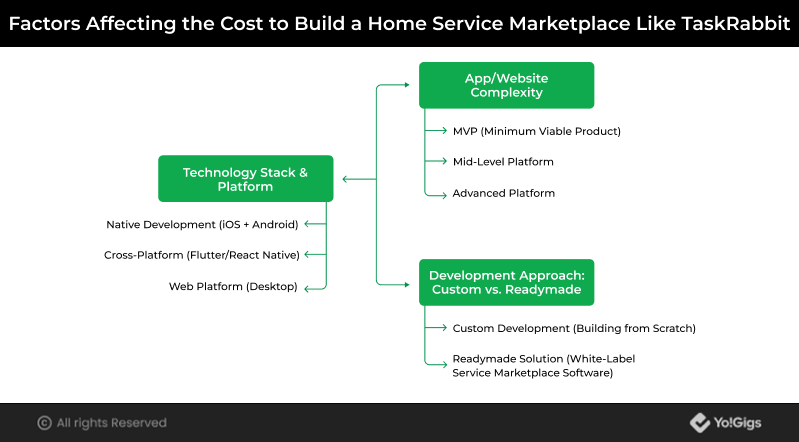
1. App/Website Complexity (Features)
- MVP (Minimum Viable Product): Includes basic User/Tasker web platforms and features, such as simple task posting, basic search, in-platform messaging, and a single payment gateway. MVP is usually launched to validate the idea.
- Mid-Level Platform: Adds advanced features like GPS tracking (via mobile), recurring bookings, dynamic pricing, advanced filters on the website, multiple payment options, and detailed analytics for the Admin. Mainly, it focuses on functionality and user experience.
- Advanced Platform: Includes features like AI-based matching, in-platform video consultation, dispute resolution modules, localized language support, Tasker insurance integration, and complex loyalty programs. An advanced enterprise-level platform allows easy scalability and offers a competitive edge.
2. Technology Stack and Platform
- Native Development (iOS + Android): Building separate codebases for the companion mobile apps ensures the best performance, but significantly increases the cost.
- Cross-Platform (Flutter/React Native): In comparison, using a single codebase for both mobile apps can reduce initial cost and time-to-market while still relying on a robust web-based backend for the core marketplace operations.
- Web Platform (Desktop): A fully functional, mobile-responsive marketplace website is the non-negotiable core, consuming a significant portion of the backend and frontend development budget.
3. Development Approach: Custom vs. Readymade
This is the most critical cost-determining factor when planning the cost to build a home service marketplace like TaskRabbit.
A. Custom Development (Building from Scratch)
This involves hiring a team of developers to write every line of code for the central marketplace website and its companion applications. The process typically includes extensive planning, UI/UX design, backend architecture setup, API development, and creating fully custom front-end interfaces for all user roles. Other than that, it requires testing cycles, infrastructure configuration, security hardening, and continuous iterations to ensure the platform meets your exact requirements.
- Pros: Total control, unique features possible.
- Cons:
- Highest cost
- Longest timeline (10–18+ months)
- High risk of bugs
- Mandatory long-term maintenance team to support all three platforms (User, Tasker, Admin).
B. Readymade Solution (White-Label Service Marketplace Software)
This involves leveraging a pre-built, market-tested, and proven home service marketplace software (e.g., Yo!Gigs) designed specifically for the service industry. These solution comes equipped with the core architecture of the marketplace website and multi-vendor functionality, including features such as payment integrations and dashboards.
- Pros:
- Significantly lower cost
- Rapid launch (weeks/months)
- Reliable and tested core
Allows you to focus the budget on customization and marketing.
- Cons: Requires minimum server specifications to handle traffic efficiently.
Strategic Advantage: For 90% of entrepreneurs, a high-quality readymade solution is the superior approach. It de-risks the venture, allows for immediate market entry via a fully functional marketplace website, and conserves capital to focus on the essential, acquiring users and Taskers.
Leverage Our Robust Readymade Solution to Launch Your Home Service Marketplace Today
Cost Breakdown: Scratch Build vs. Readymade Solution
Here is a generalized cost estimation based on the volume of work hours needed to develop the entire TaskRabbit-like ecosystem, including the core marketplace website and its features.
| Component | Total Estimated Development Hours (Web + 2 Mobile) | Custom Build Cost Estimate (Total) | Readymade Solution Estimate (Total/Both Platforms) |
| Discovery, Design & Core Backend | 1,500 – 2,500 hours | $75,000 – $125,000 | Included |
| Marketplace Website (User/Tasker/Admin) | 1,200 – 1,800 hours | $60,000 – $90,000 | Included |
| Mobile App Development (iOS + Android) | 1,000 – 1,500 hours | $50,000 – $75,000 | Included |
| Key Integrations (Payment, Geo-location, Notifications) | 300 – 500 hours | $15,000 – $25,000 | Included |
| QA/Testing & Deployment | 400 – 600 hours | $20,000 – $30,000 | Included |
| TOTAL INITIAL DEV COST | ~4,400 – 6,900 Hours | $220,000 – $345,000+ | $1,000 – $10,000 (One-time license) |
Note: Cost estimates based on a conservative average developer rate of $50/hour.
This illustrates that by choosing a pre-built, high-quality solution, you can launch a competitive home service marketplace website for a small fraction of the cost, making the venture viable for independent entrepreneurs.
Tips to Reduce the Development Cost
To minimize your upfront investment in your home service marketplace without compromising quality, you must consider the following things:
- Prioritize the Marketplace Website MVP: Ensure the core booking, payment, and Tasker management functions are flawless on the web platform first. Mobile app development can follow if resources are constrained.
- Choose a Reliable Readymade Solution: This single decision can slash 80% of your development costs. The core service marketplace software is sound, and the features are tested.
- Use Cross-Platform Technologies for Mobile: If mobile apps are a requirement, use frameworks like Flutter or React Native to cut the development time for mobile by building a single codebase.
- Simplify Tasker Onboarding: Initially, limit the number of service categories and automate only the basic identity checks, postponing complex, multi-stage skill verification for later stages.
Further, let’s explore how Yo!Gigs can help you launch your own home service marketplace.
Yo!Gigs: A Cost-Effective Solution to Build Your Home Service Marketplace Like TaskRabbit
Launching a sophisticated, multi-vendor service platform demands a specialized solution. This is where an enterprise-grade, ready-made solution like Yo!Gigs provides a significant competitive edge over costly, time-consuming custom development.
Yo!Gigs is a purpose-built, highly scalable home service marketplace software designed to facilitate complex multi-vendor operations. It comes equipped with all the essential features required, making it an ideal foundation for your TaskRabbit marketplace website. Additionally, it has many other advantages, such as:
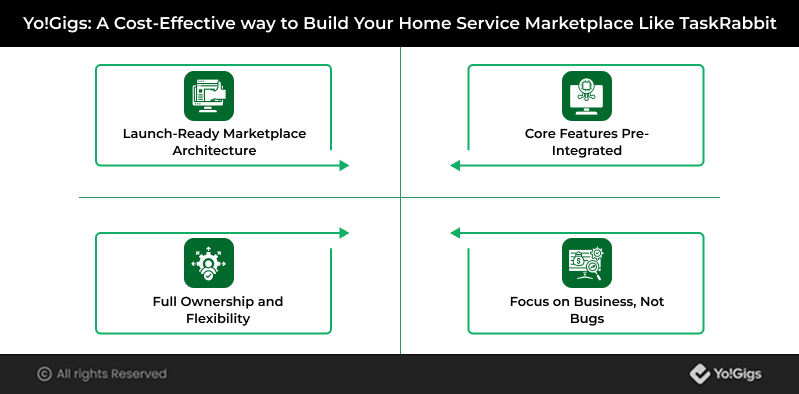
- Launch-Ready Marketplace Architecture: Yo!Gigs provides the pre-built, robust architecture necessary for a service marketplace, including dedicated, secure web panels for the User, Service Provider, and Admin.
- Core Features Pre-Integrated: Essential functionalities like geolocation-based search, in-platform chat, secure payment gateways, and a detailed review/rating system are included on the marketplace website.
- Full Ownership and Flexibility: Yo!Gigs often provide the source code with a one-time payment, granting you complete ownership. This is crucial for customizing your home service marketplace to support unique business rules, complex licensing, or niche service verticals.
- Focus on Business, Not Bugs: By leveraging a pre-tested platform, you redirect your resources and budget away from debugging basic functionality and toward the essential elements of success, such as marketing, Tasker recruitment, and building a trusted community.
Henceforth, by choosing a solution like Yo!Gigs, you can launch a professional, feature-rich home service marketplace website within weeks, putting you directly on the path to competing in the gig economy.
Explore Cutting-Edge Capabilities of Yo!Gigs
Conclusion
The opportunity in the home services marketplace is vast and growing, driven by consumer demand for convenience and the rise of the freelance “gig” worker. While the cost to build a home service marketplace like TaskRabbit from scratch is often well over $200,000, leveraging a professional, ready-made solution like Yo!Gigs significantly lower the barrier to entry.
The smart investment today is not in endless hours of basic coding, but in a proven platform that lets you focus on your unique value proposition, recruit high-quality service providers, and effectively market your brand to a hungry customer base via a professional marketplace website.
FAQs
Q 1. How to build a TaskRabbit clone marketplace?
Ans. Building a TaskRabbit clone marketplace is best achieved via a high-quality, ready-made solution like Yo!Gigs. This white-label approach allows you to acquire the pre-built, tested core architecture (User/Tasker/Admin web panels and optional mobile apps) and customize the branding and specific features for your niche, enabling launch in weeks rather than months.
Q 2. Are clone scripts scalable or a profitable solution to build TaskRabbit?
Ans. “Clone scripts” built on robust, enterprise-grade architecture (like the white-label platforms) are highly scalable and profitable. They are essentially service marketplace software that is optimized as per the on-demand service model. They offer:
- Profitability: The lower initial investment means a much faster path to break-even.
- Scalability: They are architected to handle high user loads and thousands of concurrent transactions on the marketplace website.
Q 3. How long does it take to develop a service marketplace like TaskRabbit?
Ans. The time taken to develop a service marketplace like TaskRabbit primarily depends on the development approach you select.
- Custom Development: Takes 10 to 18+ months for a full-featured marketplace (Website + Apps + Admin).
- Readymade Solution (Yo!Gigs): A working marketplace website MVP can be launched in 2-3 working days, with core customizations deployed within 1-2 months.
Q 4. What advanced features should be added in a TaskRabbit-like marketplace to beat competitors?
Ans. To gain a competitive edge on your home service marketplace website, focus on:
- AI-Powered Matching: Use machine learning to improve Tasker-to-Job matching accuracy beyond simple geography.
- In-Platform Video Consultations: Allows users to show the scope of work (e.g., a broken sink) to the Tasker before booking for a more accurate quote.
- Insurance & Guarantee Integration: Clearly display that all tasks booked on the marketplace website are covered by platform-level liability insurance to drastically increase user trust.
Q 5. How do service marketplaces make money?
Ans. Home service marketplace websites primarily use a combination of these revenue models:
- Commission Fees: Taking a percentage cut (typically 15% to 30%) of the Tasker’s fee for every completed job.
- Service Fees / Trust & Safety Fees: Charging the client a small fee (e.g., 5-10%) on top of the task price for the convenience and vetting services.
- Subscription/Featured Listings: Allowing Taskers to pay a small monthly fee for higher visibility in search results on the marketplace website
