Every successful service marketplace, whether it’s for hiring freelancers, booking a handyman, or finding a tutor, starts with one critical decision: choosing the right software. That decision shapes nearly everything that follows. It determines how fast you can launch, how much of your budget goes toward development versus marketing, whether you own your technology or rent it indefinitely, and how easily your platform can scale as your business grows.
For entrepreneurs and founders entering the service marketplace industry, the challenge isn’t recognizing the massive opportunity; it’s selecting the right platforms that align with their long-term vision. While many software platforms look similar on the surface, they differ enormously in ownership model, customization depth, pricing structure, and long-term cost. Choosing the wrong platform can lead to recurring subscription costs, limited flexibility, and expensive migrations down the road. In contrast, the right platform enables you to launch faster, retain full control over your platform, and build a marketplace that can grow alongside your business.
Table of Contents
What is a Service Marketplace Platform?
A service marketplace platform is an online software platform that connects customers seeking services with the professionals or businesses offering those services. Unlike a traditional eCommerce platform that facilitates the sale of physical products, a service marketplace is designed to manage the discovery, booking, delivery, and payment of services. They serve as a centralized hub where users can search for service providers, schedule appointments, communicate, make secure payments, and manage transactions through a seamless digital experience.
As consumers increasingly prefer the convenience of booking services online, the demand for digital service marketplaces continues to grow across industries. From home services and healthcare to education, consulting, and freelance work, investing in service marketplace development enables entrepreneurs to capitalize on this growing demand while building a scalable business with multiple revenue opportunities.
Must-Have Features in a Service Marketplace Platform
Selecting the right marketplace software goes beyond comparing pricing or deployment models. The platform’s built-in capabilities directly influence your ability to deliver a seamless user experience, streamline operations, and scale your business. While some software requires extensive custom development to support essential functionality, a feature-rich platform enables you to launch faster and reduce long-term development costs. Here are the features every modern service marketplace platform should offer:
1. User-Friendly Interface
A clean, intuitive interface encourages visitors to browse services, compare providers, and complete bookings effortlessly. Easy navigation directly improves customer retention and reduces abandonment at checkout or booking.
2. Multi-Vendor Management
The platform should allow unlimited service providers to register, manage their own profiles, upload service listings, set their own pricing, and track their orders independently, without requiring constant intervention from the marketplace admin.
Power Your Marketplace with Smart Vendor Management
3. Advanced Search and Filters
Users need to find relevant services quickly using filters such as location, category, price, availability, ratings, experience level, and distance. A marketplace with weak search functionality tends to lose users before they ever complete a booking.
4. Online Booking and Scheduling
Integrated booking calendars simplify appointment management for both customers and service providers, while eliminating double-bookings and scheduling conflicts that erode trust in the platform.
5. Commission Management
Marketplace owners need the flexibility to configure percentage-based commissions, flat commissions, subscription plans, or membership packages, depending on what makes sense for their specific business model and category.
6. Ratings and Reviews
Verified customer reviews improve transparency for future customers and encourage service providers to maintain consistently high-quality standards. Additionally, it helps build trust within the marketplace.
7. Real-Time Messaging
Built-in chat functionality allows customers and professionals to communicate directly before and after a booking, reducing the friction and risk of off-platform deals that come from forcing users elsewhere to coordinate.
8. Mobile Responsiveness
With mobile traffic dominating how people browse and book services, a responsive design across smartphones, tablets, and desktops is non-negotiable, not a nice-to-have.
A platform that includes most of these features can save founders months of development time and tens of thousands of dollars compared to building each capability from scratch. More importantly, it provides a strong technological foundation that supports sustainable growth as your service marketplace evolves.
Top 10 Service Marketplace Platforms in the USA
The platforms below represent some of the strongest software platforms available for entrepreneurs looking to launch their own service marketplace in 2026. The list spans self-hosted, one-time-license platforms; subscription-based SaaS builders; open-source frameworks; and enterprise-grade platforms, so the right fit depends heavily on your budget, technical resources, and long-term ownership goals.
1. Yo!Gigs
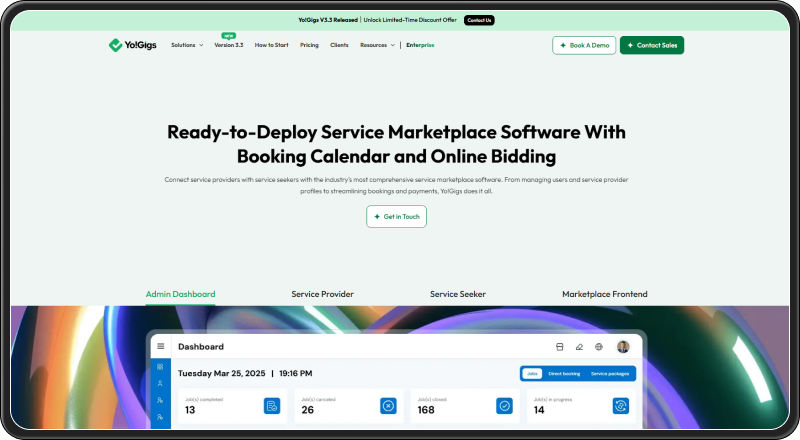
Yo!Gigs, developed by FATbit Technologies, is one of the most comprehensive self-hosted service marketplace software solutions available today. Designed for startups, SMBs, and enterprises, it enables entrepreneurs to launch scalable service marketplaces, similar to platforms like TaskRabbit, Upwork, Thumbtack, or Fiverr, without building everything from scratch. The platform supports multiple business models, including freelance marketplaces, home services, consulting, education, healthcare, and beauty, among others.
What sets Yo!Gigs apart is its one-time licensing model paired with customizable source code. No recurring software fees are cutting into margins as the business scales, and the platform comes equipped with:
- An advanced job-posting module
- Support private jobs, public jobs, fixed-price jobs, and biddable jobs
- A booking calendar
- Multi-tiered service packages
- Stripe Connect integration for secure split payments
| Pros | Cons |
| One-time payment with lifetime ownership | Requires hosting setup and initial technical deployment compared to plug-and-play SaaS platforms |
| Fully self-hosted with complete source code access | — |
| Highly customizable across different service industries | — |
| Built-in booking, commission, payments, messaging, and reviews | — |
| Includes 1 year of free technical support | — |
Best For: Startups, SMEs, enterprises, agencies, and entrepreneurs looking to build a scalable, fully customizable service marketplace with complete ownership and no recurring software subscription fees.
Schedule a One-on-One Personalized Demo to See Yo!Gigs in Action
2. Sharetribe
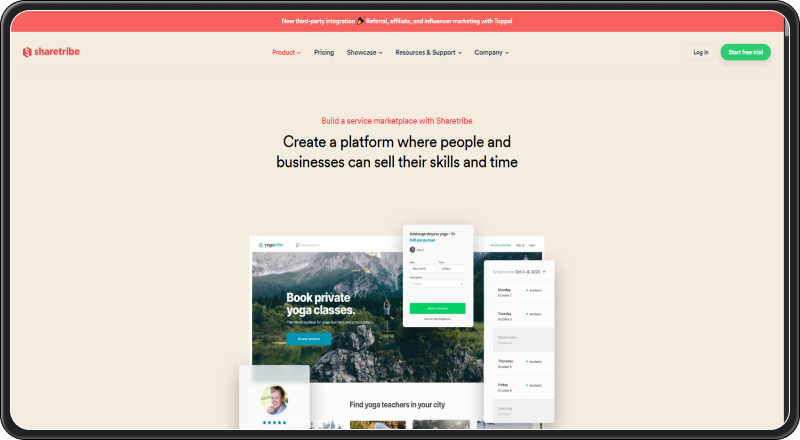
Sharetribe is one of the longest-standing and most widely recognized SaaS marketplace builders, founded in 2011 in Finland. It enables entrepreneurs to launch service marketplaces without writing code, making it a popular choice for businesses that want to validate a marketplace idea quickly before committing to heavier custom development. Sharetribe offers two main tiers: Sharetribe Lite, a no-code option priced around $99 to $139 per month, and Sharetribe Extend (formerly Flex), which allows deeper, API-driven customization for around $259 to $389 per month plus transaction-based fees.
| Pros | Cons |
| Fast marketplace deployment | Monthly subscription costs can become expensive at scale |
| Beginner-friendly dashboard, especially on the Lite tier | Limited customization compared to self-hosted solutions |
| Cloud hosting included | No complete source code ownership |
| Regular software updates | Advanced features require API/developer work |
| Secure payment integrations | Vendor-specific customization is restricted on lower tiers |
Best For: Entrepreneurs looking for a quick, no-code SaaS-based marketplace launch to validate a business idea.
3. Arcadier
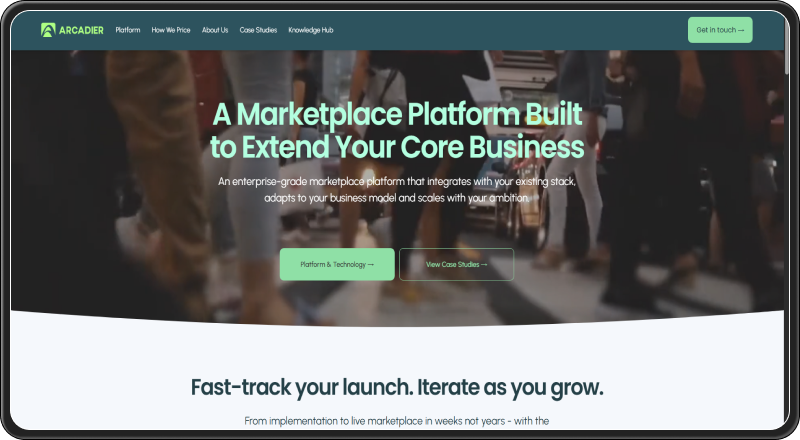
Arcadier provides a cloud-based, API-driven marketplace solution supporting service, product, rental, and hybrid marketplace models across more than 100 countries. While it once served early-stage founders through a self-serve tier, Arcadier has since pivoted to focus primarily on enterprise customers, with on-premises plans ranging from roughly $1,450 to $7,500+ per year, alongside no-code plans for smaller deployments.
| Pros | Cons |
| Supports multiple marketplace models (B2C, B2B, P2P) | Subscription pricing increases significantly at enterprise tiers |
| Cloud-hosted infrastructure | Limited source code access |
| Robust API for deep integrations | Heavy customization requires developer resources |
| Pre-integrated payment gateways (Stripe, PayPal, Omise) | Premium features cost extra |
| Strong B2B and service marketplace functionality | Increasingly priced and positioned for larger businesses |
Best For: Funded startups and enterprises needing a flexible, API-first marketplace backend with room to scale.
4. Cocorico
Cocorico is an open-source marketplace framework built on the Symfony PHP framework, designed for development teams that want complete control and flexibility while building a custom service marketplace. Unlike the ready-to-launch platforms on this list, Cocorico is best understood as a strong starting point for a major custom build rather than a turnkey solution.
| Pros | Cons |
| Open-source architecture | Requires experienced developers |
| Highly customizable | Not a ready-to-launch marketplace |
| Developer-friendly, built on a robust Symfony framework | Higher implementation cost overall |
| Flexible marketplace workflows | Ongoing technical maintenance required |
| No licensing fee for the core framework | Hosting must be managed separately |
Best For: Development teams with strong technical resources building a highly customized rental or service marketplace from the ground up.
5. JungleWorks Yelo
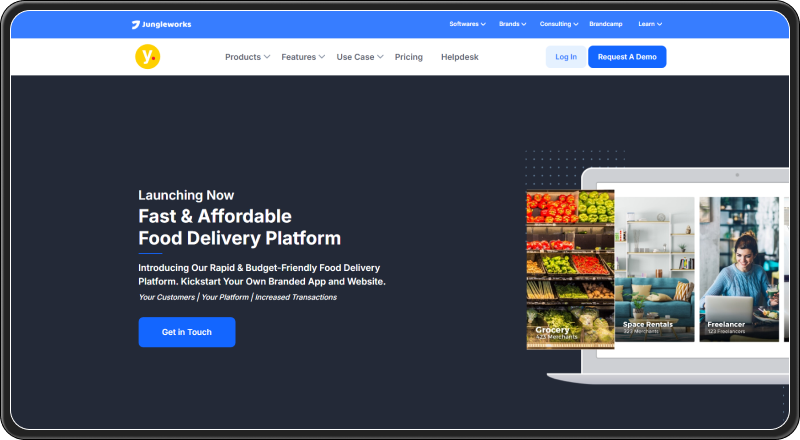
Yelo, by JungleWorks, helps businesses launch hyperlocal and service marketplaces with integrated delivery, booking, and vendor management features. It primarily targets local service businesses and on-demand platforms such as food, grocery, pharmacy, and home services, with pricing starting around $499 per month (billed annually) and additional features available on higher-priced plans.
| Pros | Cons |
| Strong hyperlocal marketplace support | Recurring subscription fees |
| Native mobile applications available | Premium features cost extra |
| Built-in vendor management system | Limited source code ownership |
| Supports 75+ payment gateways and 80+ languages | Customization depends on higher-tier plans |
| Includes delivery tracking and driver apps | Enterprise pricing can become expensive at scale |
Best For: Businesses building hyperlocal, delivery-adjacent service marketplaces needing fast deployment.
6. Kreezalid
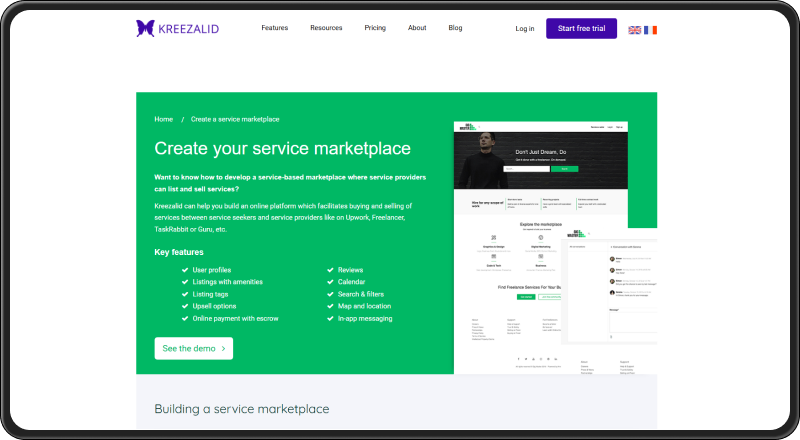
Kreezalid is a no-code, theme-based SaaS marketplace builder that lets entrepreneurs launch a marketplace for physical products, digital goods, services, or rentals without any coding knowledge. It’s positioned as a direct alternative to Sharetribe, with a stronger emphasis on visual themes and design flexibility. Pricing runs roughly $249 to $379 per month, depending on the tier.
| Pros | Cons |
| Intuitive no-code, drag-and-drop builder | One of the pricier no-code options on the market |
| Strong theme store for visual customization | Limited ability to adapt features without developer support |
| Built-in escrow and commission management | Some users report slow customer support response times |
| Mobile-responsive design and built-in SEO tools | Custom feature requests can be costly and time-consuming |
Best For: Non-technical founders who want a visually distinct, branded marketplace live within days.
7. CS-Cart Multi-Vendor
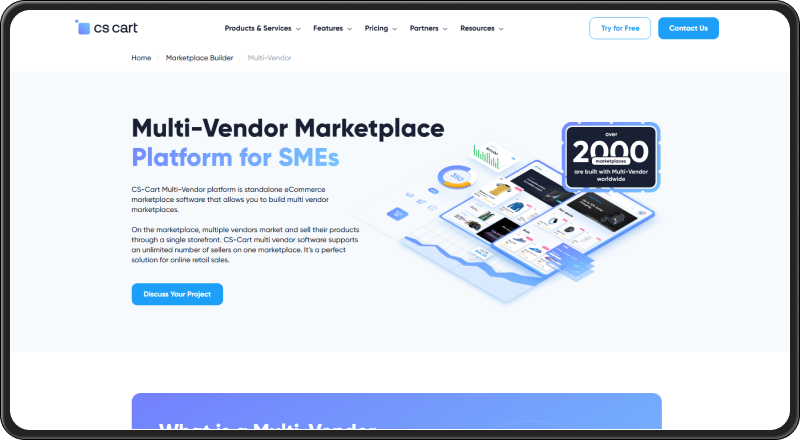
CS-Cart Multi-Vendor is a self-hosted, PHP-based marketplace platform offering hundreds of built-in features for retail, service, booking, and B2B/C2C business models. It operates on a one-time license model (roughly $1,300 to $3,600+, depending on the package) with optional yearly renewal for continued updates and support, and the company claims more than 1,300 live marketplaces are currently running on the platform.
| Pros | Cons |
| Feature-rich out of the box | Initial setup can feel overwhelming without a technical background |
| Large add-on marketplace and active developer community | Many advanced features require paid add-ons |
| One-time licensing avoids ongoing subscription costs | Yearly license renewal still applies for updates |
| Strong documentation, tutorials, and support forums | Self-hosting means the marketplace owner manages the infrastructure |
Best For: Businesses wanting a self-hosted, budget-conscious platform backed by a large developer community.
8. Marketplacer
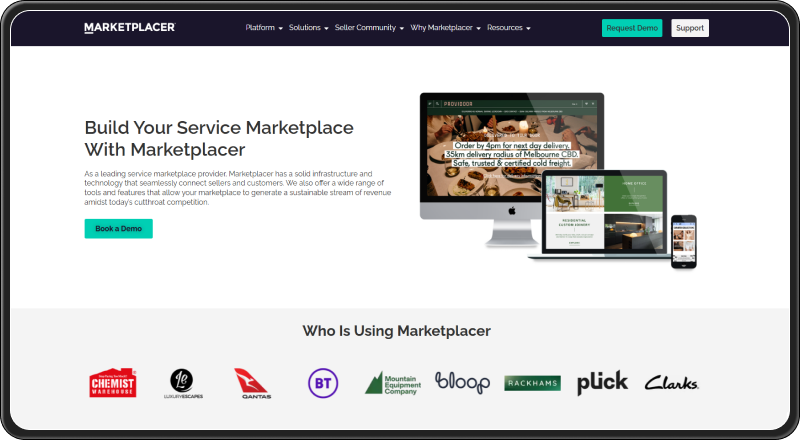
Marketplacer is an enterprise-grade marketplace platform used by major retail brands, including Officeworks and Temple & Webster, to build, launch, and scale multi-vendor online marketplaces. It handles complex operations such as seller onboarding, catalog management, inventory synchronization across channels, order fulfillment, and payments, and offers a “Rapid Marketplace Launch” program capable of deploying a functional marketplace in as little as six to eight weeks.
| Pros | Cons |
| Highly scalable for enterprise-level traffic and seller volume | Enterprise-only pricing, often $50,000+ per year |
| Deep integrations with ERPs, PIMs, and logistics providers | Significant overkill for early-stage or bootstrapped startups |
| Proven track record with large, established retail brands | Implementation can take months due to integration complexity |
| Strong inventory and channel synchronization tools |
Best For: Large retailers or established enterprises converting an existing e-commerce operation into a full marketplace model.
Leverage a Robust Service Marketplace Platform
9. Bubble
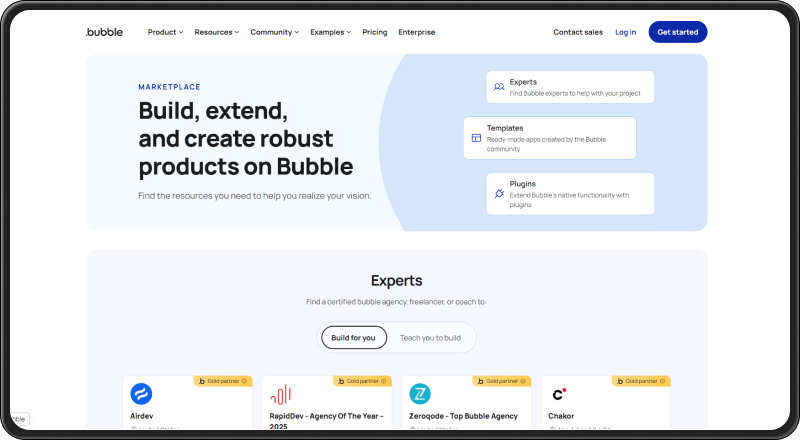
Bubble is a general-purpose, no-code visual application builder that can be used to construct a fully custom marketplace from the ground up, rather than offering a dedicated, pre-built marketplace product like the other platforms on this list. Its strength is unlimited flexibility; its weakness is that none of the marketplace-specific functionality, vendor management, booking logic, and commission splits.
| Pros | Cons |
| Extremely flexible, can be used for nearly any marketplace type | No out-of-the-box marketplace functionality |
| Affordable entry point compared to dedicated marketplace SaaS tools | Everything (vendor management, payments, booking) must be built manually |
| Full design freedom over the platform’s look and logic | Steep learning curve; complex marketplaces can take hundreds of hours to build |
| Strong for founders comfortable with visual programming | Not recommended for non-technical founders wanting a fast launch |
Best For: Technically resourceful founders willing to build their marketplace’s logic visually, piece by piece, in exchange for maximum flexibility.
10. My Marketplace Builder
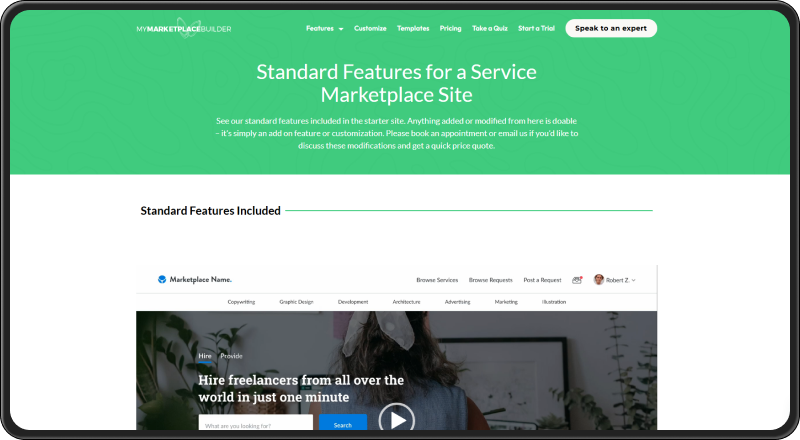
My Marketplace Builder is a white-label, budget-friendly multi-type marketplace platform positioned as a more affordable alternative to larger players like Arcadier and Sharetribe, with code customization options available for businesses that eventually need enterprise-level flexibility.
| Pros | Cons |
| One of the more affordable white-label marketplace options available | Smaller ecosystem and community compared to larger competitors |
| Supports multiple marketplace types (B2C, B2B, P2P) | Less brand recognition and fewer third-party integrations |
| Offers a path to custom code development as the business scales | Documentation and support resources are less extensive |
Best For: Budget-conscious founders wanting white-label flexibility without paying enterprise-level prices.
Comparison Table: Top 10 Service Marketplace Platforms
| Platform | Deployment Model | Ownership | Starting Price | Best For |
| Yo!Gigs | Self-hosted | Customizable source code, one-time license | One-time fee, no recurring costs | Startups & enterprises wanting full ownership and no subscription fees |
| Sharetribe | Cloud SaaS | No source code ownership | ~$99–139/mo (Lite); ~$299–389/mo (Extend) | Fast no-code validation of a marketplace idea |
| Arcadier | Cloud SaaS/API | Limited; primarily enterprise-licensed | ~$1,450–$7,500+/year (on-premises) | Enterprises needing API-first flexibility |
| Cocorico | Open-source/self-hosted | Full ownership (open-source framework) | Free framework; high implementation cost | Developer teams building highly customized marketplaces |
| JungleWorks Yelo | Cloud SaaS | No source code ownership | ~$208/mo+ | Hyperlocal and on-demand service marketplaces |
| Kreezalid | Cloud SaaS, no-code | No source code ownership | ~$249–379/mo | Non-technical founders wanting fast, visual setup |
| CS-Cart Multi-Vendor | Self-hosted | Full ownership (one-time license + renewal) | ~$1,300–$3,600+ | Budget-conscious, self-hosted marketplaces |
| Marketplacer | Cloud SaaS, enterprise | No source code ownership | $50,000+/year | Large retailers and enterprise-scale marketplaces |
| Bubble | No-code app builder | Full ownership of what you build | Affordable entry tier | Technical founders building fully custom logic |
| My Marketplace Builder | White-label SaaS | Limited; some custom-code paths available | Budget-friendly | Founders wanting affordable white-label flexibility |
Which is the Best Service Marketplace Platform?
There is not a one-size-fits all answer to the best service marketplace platform. The right choice depends heavily on your budget, technical resources, and how much control you want over your platform long-term.
However, based on the comparison above, certain platforms stand out for different business requirements:
- Want to launch fast without writing code? Yo!Gigs, Sharetribe and Kreezalid are strong, well-established choices, ideal if you don’t mind paying a recurring subscription in exchange for speed.
- Building at enterprise scale? Yo!Gigs, Marketplacer, and Arcadier offer the infrastructure, integrations, and scalability that smaller platforms simply can’t match.
- Have a technical team and want maximum control? Cocorico and Bubble offer that flexibility, though at the cost of a significantly longer build process.
For the majority of entrepreneurs and SMBs entering the service marketplace space, particularly those who want to avoid the long-term financial drain of recurring software fees, Yo!Gigs stands out as the strongest overall choice.
Here’s why Yo!Gigs consistently come out ahead:
- No recurring costs: Its one-time licensing model with customizable source code means there’s no subscription cost compounding month after month as the business scales, a meaningful financial advantage that platforms like Sharetribe, Yelo, and Kreezalid simply can’t offer.
- Built for the job from day one: It comes pre-built with the core features a service marketplace actually needs, including job posting, bidding, booking calendars, secure split payments, messaging, and reviews.
- Flexible across industries: The platform is highly customizable across freelance, home services, consulting, healthcare, and other verticals, so it isn’t locked into a single niche.
- Lower launch risk: One year of free technical support and dedicated onboarding training reduces the operational risk that typically comes with launching a new platform.
This flexibility is reflected in the range of real businesses built on Yo!Gigs across different countries and niches, including:
- Impact Maker (Germany): An enterprise-grade marketplace connecting climate action and sustainability experts with clients.
- Bauherr.Digital (Germany): A platform connecting real estate builders with sustainable energy consultants.
- Micro Workspace (Zimbabwe): A global freelance platform spanning over 700 service categories.
- Mechanic Bids (USA): A marketplace connecting local mechanics with vehicle owners in Texas.
- KDPeeps (UK): A niche platform connecting authors and self-publishers with vetted creative professionals.
- PrideLink (Germany): A hybrid marketplace combining local home service professionals and global freelancers, built with inclusive community features.
This spread, from enterprise-grade sustainability platforms to niche freelance and home-service marketplaces across four continents, illustrates exactly why Yo!Gigs work for founders with very different business models, not just a single use case. Combined with its affordability and genuine technology ownership, this track record makes it a particularly strong fit for first-time marketplace founders.
Launch Your Service Marketplace with Yo!Gigs
Conclusion
Choosing a service marketplace platform is one of the most consequential decisions a founder will make before launch. It influences everything from initial cost and time-to-market to how much control the business retains over its own technology in the years that follow. The platforms covered in this guide span the full spectrum, from fully self-hosted, one-time-license solutions like Yo!Gigs and CS-Cart, to flexible SaaS builders like Sharetribe and Kreezalid, to open-source frameworks and enterprise-grade systems built for established retailers.
The right decision ultimately comes down to matching the platform’s strengths to your specific stage and goals. Founders who prioritize long-term cost efficiency and full ownership will find self-hosted, one-time license platforms like Yo!Gigs particularly compelling, while those who simply want to validate an idea quickly may find more value in a no-code SaaS builder. Whichever path you choose, understanding the genuine trade-offs between ownership, cost, and customization, rather than focusing on price alone, is what separates a service marketplace that scales sustainably from one that quietly drains its margins through recurring software fees as it grows.
