
Fiverr has transformed freelance hiring by creating a marketplace where businesses can quickly purchase digital services across hundreds of categories. This blog explains how the platform generates revenue through service fees, seller commissions, promoted listings, subscriptions, and value-added services. It also highlights the marketplace strategies that have contributed to Fiverr’s continued global growth and popularity.
In a world increasingly defined by flexibility and remote work, the freelance marketplace has emerged as a cornerstone of the modern economy. At the forefront of this digital revolution is Fiverr, a platform that has not only connected millions of freelancers globally but has also perfected a robust and highly profitable Fiverr Business Model.
Fiverr’s business model has played a crucial role in its success, offering a streamlined, user-friendly experience that makes freelancing accessible to both individual entrepreneurs and large enterprises. By simplifying the process of hiring freelancers, Fiverr has reduced friction, increased trust, and driven massive growth.
This comprehensive blog delves into the core mechanics of this model, answering the critical question: How does Fiverr make money? Further, you will explore its origins, its success secrets, its various revenue streams, and even provide a roadmap for entrepreneurs looking to build a similar venture using a powerful white-label solution like Yo!Gigs.
Table of Contents
About Fiverr: How It Transformed From A Startup Into A Global Platform
Fiverr was founded in 2010 by Micha Kaufman and Shai Wininger with a simple, yet revolutionary, concept: a marketplace for digital services that all started at a fixed price of $5. The name “Fiverr” came from this pricing model, symbolizing the accessibility and affordability of services in the digital age. This idea was grounded in the belief that freelance work, which was traditionally seen as fragmented and often complicated, could be streamlined and made more accessible.
The idea was to turn high-cost, high-friction freelance hiring into a quick, low-cost, eCommerce-like transaction. Instead of lengthy proposals and negotiations, buyers could purchase a “Gig”, a predefined service, with a single click, much like buying a product on Amazon.
The Success Journey:
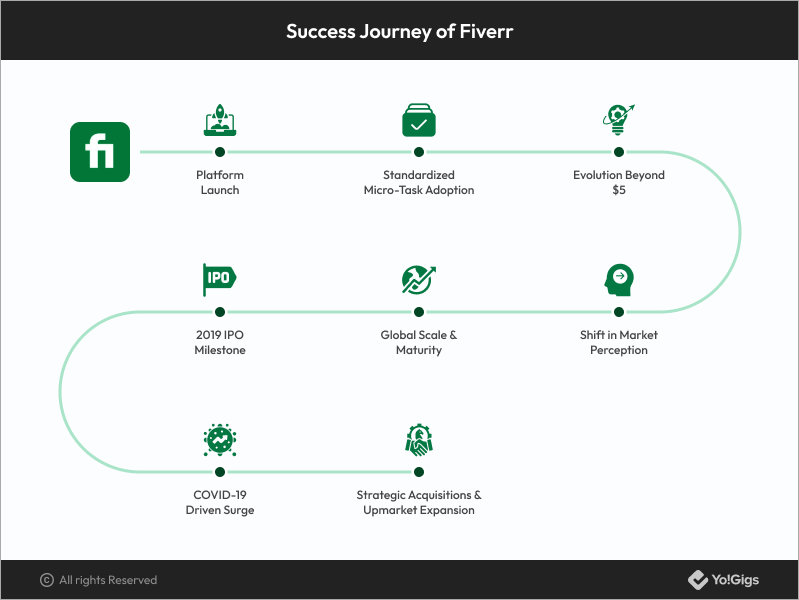
- 2010 Launch: The initial fixed price of $5 standardized outsourcing, attracting a massive, diverse user base looking for micro-tasks.
- Expansion Beyond $5: While the name stuck, the platform quickly evolved, allowing sellers to offer “Gig Extras” and packages that could push the total order value into the hundreds and even thousands of dollars, fundamentally changing the perception of the platform from a ‘cheap’ micro-job site to a full-fledged freelance destination.
- Going Public: Fiverr International Ltd. (NYSE: FVRR) had its Initial Public Offering (IPO) in 2019, cementing its status as a major global tech company.
- The COVID-19 Boom: The global COVID-19 pandemic acted as a major growth stimulus for Fiverr. With the shift to remote work during the pandemic and digital-first operations, businesses of all sizes turned to digital freelancers, leading to massive spikes in user adoption and revenue.
- Acquisitions and Expansion: Strategic acquisitions, such as Working Not Working (a creative talent marketplace) and Stoke Talent (a freelance management platform), have allowed Fiverr to move upmarket, target larger businesses, and offer more comprehensive solutions to its users.
Noticeable Facts About Fiverr:
- The Gig-Based Model: Fiverr’s core innovation is its productized service approach. Freelancers, or “Sellers,” list specific, packaged services with clear deliverables and fixed prices, a clear departure from the traditional job-posting and bidding model.
- Global Reach: The platform operates worldwide, connecting freelancers and businesses from an estimated 160 countries.
- Fiverr Business: Launched to cater to larger companies, Fiverr Business provides tools for team collaboration, budget management, and access to a curated pool of top-tier talent.
How Fiverr Works: Business Model
The Fiverr business model operates as a classic two-sided digital marketplace, acting as a trusted intermediary that facilitates the transaction between a buyer and a seller. The platform’s simplicity, low friction, and trust-building mechanisms make it a popular choice for both freelancers looking to monetize their skills and businesses in need of affordable, high-quality services. Let’s take a closer look at how Fiverr’s business model works and how it benefits both buyers and sellers:
1. For the Seller (Freelancer):
- Creating Gigs: A freelancer creates a “Gig,” which is a productized service offering. This includes a clear title, description, price (starting at $5), and a defined delivery time. They can offer three tiers (Basic, Standard, Premium) and add “Gig Extras” (e.g., faster delivery, source files) to increase the order value.
- Order Fulfillment: Once a buyer purchases a Gig, the seller is notified and begins the work.
- Payment: Upon completion, the buyer approves the work, and the payment (held in escrow by Fiverr) is released to the seller’s account, after the deduction of Fiverr’s commission.
2. For the Buyer (Client):
- Searching and Discovery: A client, or “Buyer,” searches the marketplace using categories and keywords to find the specific service they need, such as “logo design” or “SEO audit”.
- Direct Purchase: The buyer reviews the seller’s profile, portfolio, reviews, and Gigs. They can purchase a predefined Gig package directly or contact the seller for a custom offer.
- Secure Transaction: The buyer pays upfront, and Fiverr holds the funds in escrow, assuring the seller they will be paid upon successful delivery and providing the buyer with security.
- Review and Rating: After the service is delivered, the buyer approves the work and leaves a public rating and review, which is crucial for the seller’s success.
The platform’s value proposition is clear for both parties:
- For Buyers: Speed, transparency (fixed price), and low friction.
- For Sellers: A massive, built-in global customer base and a streamlined process for selling their services.
Turn Your Freelance Platform Vision into Reality
How Does Fiverr Make Money?
The simple question, “How does Fiverr make money?” reveals a sophisticated, multi-stream revenue model designed for high margins and scalability. The model is transaction-driven, meaning Fiverr earns a cut from nearly every interaction on the platform, incentivizing it to maximize the volume and value of transactions.
Further, Fiverr’s revenue streams can be broken down into the following key components:
1. The Core Transaction Fees (Commission-Based Model)
This is the largest source of Fiverr’s revenue and is essentially a “double-dip” strategy, charging both the buyer and the seller.
| Fee Type | Charged To | Structure | Details |
| Seller Commission | Freelancer (Seller) | 20% flat fee | Fiverr takes a fixed 20% commission on every completed Gig, ensuring a significant cut from all earnings. |
| Buyer Service Fee | Client (Buyer) | Fixed percentage/amount | Buyers are charged a service fee, usually a percentage (e.g., 5.5%) or a flat rate (e.g., $2.50) for smaller orders. |
Example:
- A client purchases a Gig for $100.
- The client pays: $100 (Gig Price) + $5.50 (5.5% Buyer Fee) = $105.50 total.
- The seller earns: $100 (Gig Price) – $20 (20% Commission) = $80.00 net.
- Fiverr’s Gross Revenue: $20 (Seller Cut) + $5.50 (Buyer Fee) = $25.50 per $100 transaction.
2. Value-Added Service Streams
Fiverr has successfully layered premium services on top of its core marketplace to increase the Average Order Value (AOV) and attract higher-spending clients.
a) Fiverr Pro
This premium tier features a highly vetted pool of top-quality, experienced freelancers.
- Higher Fees: While the exact commission structure is often customized, these projects typically involve higher service fees and are aimed at enterprise-level clients willing to pay a premium for guaranteed quality and reliability.
- Subscription Benefits: Buyers in the Pro tier get dedicated account management and priority customer support.
b) Fiverr Business
A dedicated platform for larger organizations and teams, helping them manage their freelance workforce efficiently.
- Team Collaboration: Provides tools for shared projects, centralized budget management, and easy contractor payment.
- Revenue: It likely includes higher fees or an annual/monthly subscription fee for the business client, moving beyond a simple transactional model.
c) Course and Education Offerings (e.g., Fiverr Learn)
Fiverr monetizes its community by offering online courses to help freelancers improve their skills and better sell on the platform.
- Revenue: Direct sales of courses and educational content. This also serves a dual purpose: it improves the overall quality of sellers on the marketplace, which in turn increases buyer satisfaction and transaction value.
d) Promoted Gigs (Advertising)
Sellers can pay to boost their Gig’s visibility in search results and category pages.
- Revenue: Auction-based advertising fees, where sellers bid on keywords to ensure their services appear at the top of a buyer’s search. This is a highly profitable stream with near-zero marginal cost.
3. Financial and Operational Fees
These are smaller, necessary fees related to the financial side of running a global marketplace.
- Withdrawal Fees: Fees charged to the seller when they withdraw their earnings from the Fiverr platform to their bank account, PayPal, or other services.
- Currency Conversion Fees: Fees applied when transactions or withdrawals involve converting one currency to another.
In summary, Fiverr is a Marketplace Model combined with a Freemium Model (free to join, paid premium features/tiers) and an Advertising Model, all anchored by a powerful, high-commission transaction engine.
Suggested Read: Learn How to Build a Profitable Website Like Fiverr
Revenue from the Last Few Years Stats to Showcase
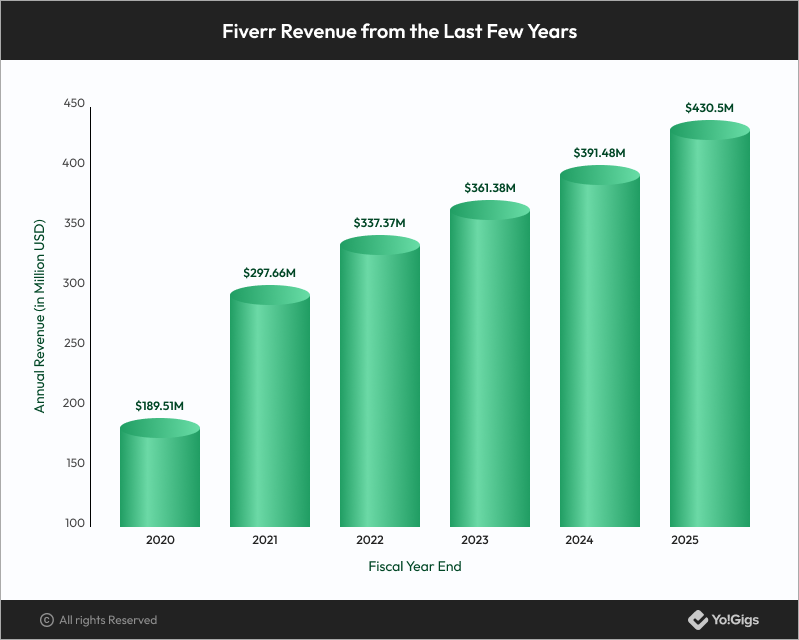
Fiverr has demonstrated impressive growth, especially driven by the global shift towards remote work and the gig economy. The revenue figures illustrate the scalability of its business model.
How Fiverr Became So Successful?
Fiverr’s dominance in the gig economy is not accidental. It’s the result of several strategic advantages built into its DNA:

- Low Friction and Speed (The Gig Model): The productized “Gig” model eliminated the biggest pain points of traditional freelancing, the lengthy bidding, negotiation, and vetting process. A buyer can purchase a service in minutes, not days.
- Focus on Digital Services: By concentrating primarily on digital, non-location-specific tasks, such as design, writing, coding, and marketing, the platform maximized its global talent pool and addressable market.
- Price Anchor and Upselling: The original $5 price tag was an incredible marketing hook, drawing in millions of users. Once on the platform, the structured upsells (Gig Extras, tiered packages) ensured that the Average Order Value (AOV) grew significantly over time, moving the platform beyond micro-tasks.
- Escrow System for Trust: By holding the buyer’s payment in escrow until the work is approved, Fiverr built immediate trust. Sellers are assured of payment, and buyers are protected from poor quality or non-delivery.
- Community and Education: Investment in the seller community and educational platforms like Fiverr Learn fostered loyalty and continuously elevated the quality of the services offered, which is critical for long-term customer retention.
Now that you’ve studied the revenue model and how Fiverr became successful, you can leverage these insights to capitalize on this growing demand and to build a successful freelance marketplace without much financial investment and in less time. Additionally, to launch your marketplace quickly, you can start with Yo!Gigs.
Introducing Yo!Gigs: Your White-Label Freelance Marketplace Software
The success of the Fiverr Business Model has naturally inspired a new generation of entrepreneurs to launch their own specialized freelance marketplaces. Furthermore, the global gig economy is vast, and there is significant room for platforms that focus on niche industries, specific geographic regions, or a highly curated talent pool.
However, instead of spending millions and years on custom development, which carries high risk and long timelines, savvy entrepreneurs are turning to white-label freelance marketplace software like Yo!Gigs.
Yo!Gigs is a ready-to-launch solution that provides the full technological framework needed to build a website like Fiverr or Upwork, allowing you to bypass the initial development phase and focus purely on your go-to-market strategy. Additionally, Yo!Gigs provides many key advantages to its users. Let’s have a look at them.
Why Choose Yo!Gigs?
- Speed to Market: You can launch a fully functional platform in a fraction of the time compared to building from scratch. This allows you to capitalize on market opportunities immediately.
- Flexible Business Models: Yo!Gigs is engineered to support both the Gig-Based (Fiverr-style) model and the Bid-Based (Upwork-style) model, giving you the flexibility to adapt your marketplace to your unique niche.
- Fully Customizable and Scalable: As a white-label solution, you get the source code, allowing for unlimited customization to fit your brand identity and specialized feature requirements. It is built to scale from a small startup to a global enterprise, handling unlimited listings and transactions.
- One-Time Cost: Yo!Gigs offers a lifetime license for a one-time cost, eliminating recurring subscription fees and making it a highly cost-effective solution for long-term growth.
Discover the Power of Yo!Gigs
Conclusion
The Fiverr Business Model is a masterclass in monetizing the digital gig economy. By turning services into products and optimizing for speed and trust, Fiverr created a massive, transaction-rich ecosystem where its high-commission revenue streams flourish. Its success proves that the freelance marketplace is not a zero-sum game; specialization and smart technology are the keys to growth.
For the entrepreneur looking to build a freelance platform like Fiverr in 2026, the opportunity lies in carving out a niche with a superior, specialized platform. Utilizing a robust, customizable white-label freelance marketplace software like Yo!Gigs provides the perfect technological foundation to replicate the most profitable aspects of the model without the heavy upfront burden of custom development.
Frequently Asked Questions:
Q 1. How does Fiverr’s business model differ from Upwork’s?
Ans. The fundamental difference lies in their approach to the transaction and their primary target market:
| Feature | Fiverr Business Model | Upwork Business Model |
| Transaction Style | Productized Gigs: Services are predefined, fixed-price packages purchased directly. | Project/Bid-Based: Clients post a job and freelancers submit proposals. |
| Primary Goal | Speed, simplicity, and affordable one-off tasks. | Long-term contracts, complex/custom projects, and ongoing client relationships. |
| Freelancer Fees | Flat 20% on all earnings. | Tiered Commission (starts at 20% and drops for long-term/high-value work). |
| Buyer Fees | Service fee (~5.5%) added to order price. | No standard transaction fee; may include processing or subscription fees. |
Fiverr is built like an eCommerce store for services, optimizing for rapid, short-term transactions. Whereas, Upwork is built like a talent agency and project management suite, optimizing for longer, more complex engagements.
Q 2. Is building a freelance platform like Fiverr profitable in 2026?
Ans. Yes, the market is highly profitable, provided you find a viable niche.
The global freelance market is massive (with estimates of over a billion people freelancing globally) and continues to grow, fueled by the remote work trend and the need for specialized skills. The key to profitability in 2026 is differentiation. Hence, you should:
- Niche Focus: Instead of competing with Fiverr’s broad categories, focus on a high-value niche (e.g., AI Prompt Engineering, Webflow Development, Legal Transcription for the medical industry). A vertical marketplace attracts higher-quality talent and higher-paying clients.
- The High-Margin Model: The core commission model (20% from sellers + buyer fees) is inherently high-margin. By leveraging a low-cost, white-label solution like Yo!Gigs, you can launch quickly and achieve profitability faster than a custom-developed platform.
- Value-Added Services: Implementing premium tiers, in-platform advertising, and educational content (following Fiverr’s lead) creates lucrative passive revenue streams on top of the transaction fees.
Q 3. How much time does it take to launch a freelance platform with Yo!Gigs?
Ans. By leveraging top Fiverr clone script like Yo!Gigs, you can launch your freelance platform in a few days to two weeks. With pre-built features such as user profiles, messaging, and payments, Fiverr Clone Scripts significantly speed up the development process, allowing for a quick and efficient launch.
Q 4. What are must-have features when building a platform similar to Fiverr?
Ans. To succeed with a Fiverr-like model, your platform must prioritize trust, ease of use, and transaction security:
- Core Marketplace:
- “Gig” Creation Module: An intuitive interface for sellers to package their services with tiers, extras, and clear deliverables.
- Advanced Search & Filter: Must allow buyers to easily filter by category, price, seller level, delivery time, and rating.
- Transaction & Security:
- Built-in Escrow System: Crucial for holding buyer funds until service delivery is approved, protecting both parties.
- Multiple Payment Gateways: Integration with major international processors (Stripe, PayPal, etc.) to facilitate global transactions.
- Dispute Resolution System: A clear, unbiased process for handling disagreements between buyers and sellers.
- Communication & Collaboration:
- In-Platform Chat/Messaging: All communication must be kept on the platform for safety, tracking, and dispute mediation.
- Order Management Dashboard: Separate dashboards for buyers and sellers to track order progress, revisions, and deadlines.
- Trust & Quality:
- User Rating and Review System: Mandatory public reviews are the foundation of trust and quality control.
- Seller Levels/Badges: A system to reward and promote top-performing sellers (e.g., Fiverr’s Level 1, Level 2, Top-Rated Seller system).
