Cleaning Business Software vs. Cleaning Marketplace Software: Which Software Drives Higher Growth?

Cleaning businesses are recession-proof. Even during the pandemic, the demand for cleaning and sanitation services boomed. They are so essential that in the everyday life of consumers, cleaning services are required for various occasions, including routine cleaning, house gatherings, during house repair and maintenance, and festivals.
However, along with the demand, the competition in the cleaning industry is also fierce and evergreen. To leave a strong impression within the industry, it is essential to go digital in today’s modern world. By adopting technology, cleaning businesses can reach out to wider audiences, establish a solid brand, and unlock new opportunities for business growth.
There exist two popular online business models for cleaning businesses. The first one is simply taking your existing business online with the help of a cleaning business software, and the second option is the aggregate business model, where you build a network of cleaning professionals and help the entire industry grow. For the latter, strategic investment in a cleaning marketplace software is required.
In this blog, we have pitted the two against each other to help you figure out which software drives higher growth and which one is more suitable for your business.
Table of Contents
- Cleaning Business Software and Cleaning Marketplace Software
- Difference in Workflows
- Primary Differences to Note in the Workflow
- Difference in Revenue Generation Channels
- Which is More Profitable for You?
- Verdict
- What is Yo!Gigs and How it Helps?
- More Reasons to Select Yo!Gigs to Power Your Cleaning Business
- Conclusion
Cleaning Business Software and Cleaning Marketplace Software
Both software solutions are easily available in the market, and they help cleaning businesses go online and manage backend operations. They bring next-level automation to the work, ensuring timely service delivery, payment collection, taxes, and more. Despite these similarities, there also exist numerous differences between the two.
1. What is a Cleaning Business Software?
It can be thought of as a field-management solution that lets a cleaning business manage and assign jobs to its in-house team of cleaning service professionals. Basically, it is a single-vendor solution where only a single cleaning company can manage its operations and generate revenue via the service charges. Most of the time, cleaning business software is available as a SaaS solution and comes with a monthly recurring cost.
2. What is a Cleaning Marketplace Software?
A cleaning marketplace software is a complete solution to help you connect cleaning service professionals with customers. It helps you launch a marketplace platform from scratch where independent professionals and private cleaning companies can sign up and offer their services. Customers either post a job or directly hire a service provider. While the cleaning service provider gets to keep the service charges, the owner or admin of the marketplace platform earns primarily through service commission.
Difference in Workflows
The operational workflows of both cleaning business software and marketplace software also vastly differ. The number of user types and steps also differs between the two software. Find a detailed comparison below:
1. Workflow of Cleaning Business Software
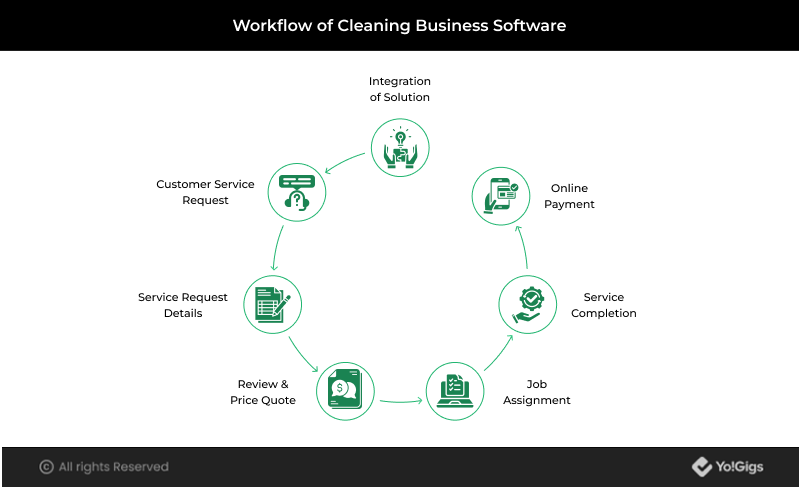
User Types:
- Cleaning business owner
- Employees or associated service providers
- Customers
Workflow:
- The business owner integrates the solution into his primary website
- Customers visit the website and select the option to request service
- They fill in the Request a Quote form, mentioning all the details of the required service, including date, time, location, description, etc.
- The business owner reviews the request and provides a price quote
- Once both parties agree upon a single price, the business owner assigns the job to an associated service provider and books their slot on the backend calendar
- The service provider visits the customer and completes the job
- The customer directly pays the business through an online payment mode
2. Workflow of a Cleaning Marketplace Software
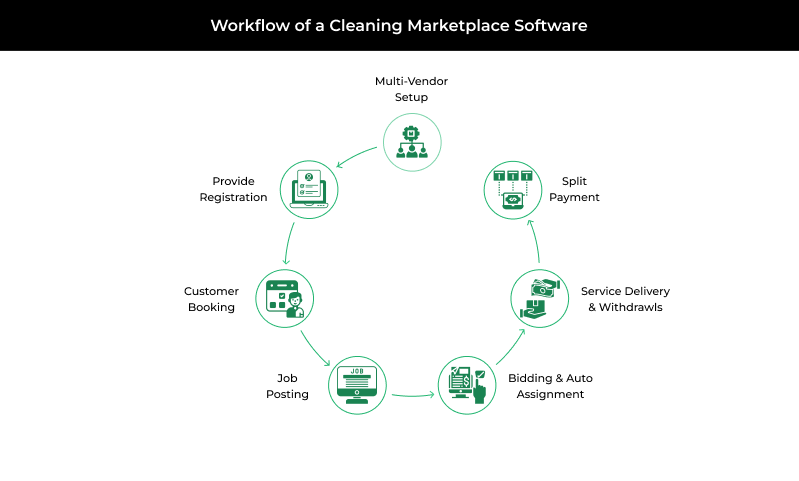
User Types:
- Marketplace owner or the admin
- Independent service providers or private cleaning companies
- Customers
Workflow:
- The marketplace software will set up a multi-vendor website for the admin
- Independent service providers register on the marketplace and create detailed profiles, listing their services, spoken languages, price rates, service packages, and more.
- Customers can browse service provider profiles and directly hire a cleaning service provider with the help of a front-end booking calendar.
- Alternatively, customers can also post a job or purchase service packages.
- Service providers review the job and place their bids. The admin is not required to do any manual job assignments and the winning job proposal takes the bid
- Service providers deliver the job and can withdraw their earnings after reaching the withdrawal threshold limit set by the admin
- Some cleaning marketplace software also has an in-built split-payment module, which directly splits the payment into service provider charges and admin commission
Primary Differences to Note in the Workflow
| Cleaning Business Software | Cleaning Marketplace Software |
| Preferred for managing on-field operations | Preferred for managing marketplace operations |
| Needs to be integrated into a pre-existing website | Can help entrepreneurs build a service-based marketplace website without coding |
| A booking calendar is provided on the backend so that the business owner can manage on-field operations | Every cleaning service provider works independently, and thus, the booking calendar is provided on the front-end to help customers place their bookings |
| The business owner manually assigns a job to every employee | Manual job assignment is not required. Every cleaning service provider works on their own separate jobs |
| The business owner gets to keep the service charges while the cleaning service providers earn a fixed salary. | Individual cleaning service providers keep the service charge, while the marketplace owner primarily earns through commission. |
Go Online with a Cleaning Marketplace Software
Difference in Revenue Generation Channels
In the workflow section, we talked about the primary revenue generation channels of both cleaning service software and marketplace software. Let us discuss these revenue streams in a little more detail.
Revenue Streams Supported by Cleaning Business Software
1. Service Charges: Cleaning service software is mostly integrated into a pre-existing cleaning business website and adapts its revenue channel. In most cases, service charges are the only revenue generation channel present for the business owner, however, the owner can also sell cleaning supplies to generate money.
By Cleaning Marketplace Software
1. Service Commission: On a cleaning service marketplace, the admin can levy fixed or percentage-based service commission on the marketplace. Every time a customer books a cleaning expert, a part of the booking fee goes to the admin as commission. The commission charges can be kept the same across the marketplace, or differ across categories or service providers.
2. Paid Listings: The admin of a cleaning service marketplace can also charge service providers for displaying their profiles and services in the most highlighted sections of the website. This helps them get more views and helps in revenue generation.
3. Vendor Packages: For onboarding more cleaning service professionals, admins need to incentivize them. For this purpose, they can create different vendor packages with varying incentives, such as lower commission fees and free mentions on the cleaning marketplace software, and sell them to service providers.
4. Display Ads: Marketplace admins can charge third-party companies for displaying their ads on the marketplace. They either sign up for direct deals or join big ad networks such as Google Ads, AdsTerra, and Propeller Ads.
5. Product Sales: Along with providing service providers on the marketplace, admins can also sell cleaning materials and earn from them.
6. Service Charges: Lastly, cleaning marketplace admins can themselves register as service providers on the marketplace and earn through service charges.
Which is More Profitable for You?
Both cleaning business software and marketplace software can help you drive revenue. To find out which one is more profitable, we have done a little analysis.
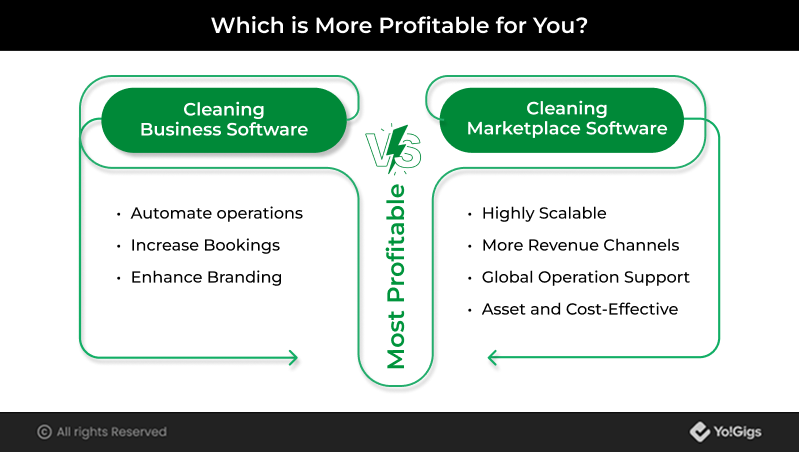
Cleaning Business Software
Cleaning business software is mostly an assistance tool at its best. Meaning, you should already have a cleaning business and online presence to some extent to benefit from cleaning business software. After integrating the software on your website, it can help you be more profitable in various ways:
- Automate operations: Cleaning business software will automate key operations, unlocking new levels of productivity for you. It will eliminate manual efforts on taxes, invoicing, inventory tracking, and more, so that you can spend your resources in better places.
- Increase Bookings: The software will enable 24/7 bookings and increase the overall number of bookings, gaining customers from both local and tourist audiences.
- Enhance Branding: With an online checkout option added to your website, you can stand out amongst online brands that provide complete functionalities and online support.
Cleaning Marketplace Software
Cleaning marketplace software primarily helps you develop a marketplace platform without the need to code. Its growth depends on scale, and the platform in itself is highly scalable. The more cleaning services you can onboard, the more customers will come. Additionally, the operations on a cleaning services marketplace aren’t limited to any particular region. You can easily operate a global cleaning service marketplace, where service providers, irrespective of their region and background, can sign up to offer cleaning services. Lastly, each independent cleaning service provider also does indirect marketing of your platform by creating a detailed profile and uploading user-generated content.
- Highly Scalable: Cleaning marketplaces are highly scalable. They can help you establish a proper enterprise by onboarding thousands of cleaning professionals who find work through your marketplace.
- More Revenue Channels: In comparison to single-vendor cleaning businesses, cleaning marketplaces have more revenue generation channels, enabling you to diversify your income and reach the breakeven point faster.
- Support Multi-National Operations: Cleaning marketplaces are capable of serving global audiences without any extra expenditure on software. Make sure that your cleaning marketplace software has multilingual and multi-currency features for targeting multiple countries.
- Asset-Light and Cost-Effective: Unlike in a cleaning service business, you aren’t required to own any cleaning supplies, company vehicles or hire cleaning professionals. This immensely reduces the startup costs, making the entire business proposition asset-light and cost-effective.
View the Industry’s Most Advanced Cleaning Marketplace Software
Verdict
Cleaning marketplace software is more scalable and thus more profitable for entering the cleaning services industry. It provides all essential features included in the business software, plus vendor management and commission settings. Along with this, unlike a cleaning business software, marketplace software do not require you to pre-own a website. They can help you develop one without custom development. Complemented with multiple revenue streams, cleaning marketplaces are easy to monetize.
| Cleaning Business Software | Cleaning Marketplace Software |
| Suitable for single-vendor operations | Suitable for marketplace operations |
| Limited to a specific geographic location and less scalable | Can be operated globally without additional technology investments, making it highly scalable |
| Cleaning charges remain the primary revenue generation method | Supports many revenue-generating methods |
| Business owners still need to invest in cleaning equipment and hiring | Investment in cleaning equipment hiring is not required |
| Customers can only book services | Customers can book a service provider, post jobs, and also buy service packages |
| Business owners can start earning money from day 1 | Onboarding vendors and business scaling can take time. Optionally, business owners can onboard their own team and start operations |
What is Yo!Gigs and How it Helps?
Yo!Gigs is a cleaning marketplace software that helps founders build state-of-the-art marketplaces to establish a network of cleaning service providers. Homeowners and service seekers can visit this platform and post a job, buy a cleaning service package, or directly hire a cleaning service provider. With thousands of hours of research and development, Yo!Gigs helps entrepreneurs deal with numerous service marketplace platforms, including:
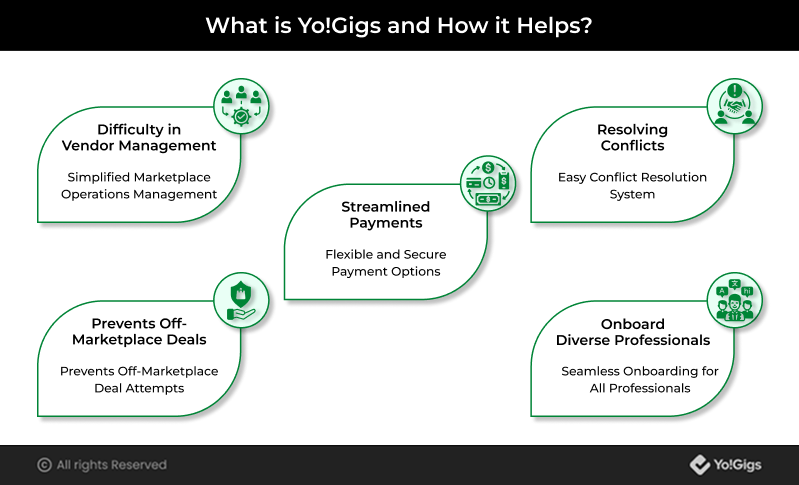
1. Difficulty in Vendor Management: Unlike simple websites, marketplaces are very complex. Without dedicated support for the marketplace operations, it is difficult to connect service providers. Yo!Gigs streamlines vendor management with advanced functions, including admin approval on verification, commission settings management, custom registration form, dual payout method, and more.
2. Prevents Off-Marketplace Deals: To avoid paying admin commission, certain users also tend to strike off-marketplace deals. Yo!Gigs has built-in cancellation management functionalities, such as the late cancellation window and late cancellation charges to prevent this.
3. Streamlined Payments: To ensure timely payment to all registered cleaning service providers, Yo!Gigs has both e-wallet and split payment options. Under the eWallet option, the admin can set a minimum withdrawal amount and withdrawal interval to prevent misuse.
4. Resolving Conflicts: Due to the sheer number of users on a marketplace, the admin may have to see various conflicts. These conflicts arise because of poor quality of work or due to payment issues. Yo!Gigs helps you resolve all such issues with the help of the conflict resolution module.
5. Onboard Diverse Professionals: Yo!Gigs’ custom registration forms also help you create a welcoming onboarding experience for all professionals. Additionally, being a multi-lingual solution, Yo!Gigs helps you onboard diverse service providers from different geographical regions and backgrounds.
Key Features of Yo!Gigs
- Multiple Job Types
- Bidding Module
- Advanced Job Posting
- Direct Invitation
- Custom Registration Fields
- Custom Task Categories
- Manually Add Freelancers
- Dual-Search
- Company Listing
- Multi-Currency Support
- eWallet Management
- Commission Management
- Earnings Withdrawal Settings
- Discounts & Rewards
- Banner Promotions
- Built-in SEO Optimization
- Reports & Analytics
- User Management
- Order Management
- CMS (Content Management)
- Admin Approval for Registration
- Issue Resolution System
- Knowledge Center
- Discussion Forums
- Shared Admin/Sub-admin Access
- Job Cancellation Window
- Reviews & Ratings
- Messaging Functionality
- Multiple Payment Gateways
- Analytics & Reports (Service Insights)
- Mobile-Friendly Design
See All Yo!Gigs Features in Action
More Reasons to Select Yo!Gigs to Power Your Cleaning Business
- Fully Customizable: Yo!Gigs is a fully customizable solution, allowing you to add more features and third-party integrations as per your business requirements.
- Fully Scalable: It is also fully scalable in terms of supporting extended business models and limitless growth with unlimited listings and transactions.
- Available at a One-Time Cost: Unlike other marketplace solutions, Yo!Gigs’ lifetime license is available at a one-time cost, making it highly cost-effective for long-term operations.
- Multi-Lingual & Multi-Currency: Yo!Gigs is a multilingual and multi-currency solution that comes with numerous payment gateways to help you target a diverse audience and onboard cleaning service providers from all backgrounds. Additionally, it allows you to conduct seamless global-level marketplace operations.
- 1-Year Free Technical Support: To ensure you have complete peace of mind and uninterrupted cleaning service marketplace operations, Yo!Gigs comes with 1 year of free technical support, which includes free bug fixes and other source code-related issues.
- Tried and Tested: Unlike other marketplace solutions, Yo!Gigs is tried and tested for the market. From streamlining bookings and payments to managing orders and preventing fraudulent cancellations, Yo!Gigs caters to various use cases.
Conclusion
Both cleaning business software and marketplace software are solid ways to proceed in the cleaning industry. However, as discussed above, cleaning business software is suitable for cleaning businesses that are already in the industry and primarily help streamline existing operations. On the other hand, cleaning marketplace software is more scalable and helps founders enter into the marketplace model. From building a new and feature-packed website to onboarding and empowering cleaning service professionals from various backgrounds, cleaning marketplace software can help with all. The final decision remains with the business owners, whether they want to streamline and grow their existing business or go after the more scalable and enterprise-level cleaning marketplace model.
