
The construction industry is undergoing a digital shift, reshaping how contractors and clients connect, collaborate, and complete projects. Traditionally, hiring a contractor involved referrals, manual verification, and a lack of pricing transparency. But today users expect speed, transparency, and convenience, and that is exactly what a well-structured contractor service marketplace delivers.
However, building such a platform goes far beyond just launching a simple website. It is about creating a scalable ecosystem where demand meets supply efficiently, trust is built through verified interactions, and transactions happen effortlessly. The real challenge lies in understanding how these marketplaces function, what drives user engagement, and which revenue models ensure long-term sustainability.
In this blog, you will discover a practical roadmap to plan, build, and successfully launch a contractor marketplace.
Table of Contents
What is a Contractor Service Marketplace?
A contractor service marketplace is an online platform that connects contractors and clients in one place, making it easier to discover, compare, and hire service providers. Instead of relying on referrals or scattered listings, users can manage the entire process within a single, streamlined system.
What sets these platforms apart is their ability to handle the complete service lifecycle. From searching and shortlisting contractors to communication, booking, and payments, everything happens in a structured and transparent environment.
For clients, this enables better decision-making through verified profiles, past project insights, and authentic reviews. For contractors, it provides access to a broader audience and more consistent work opportunities. In an otherwise fragmented construction industry, such marketplaces bring much-needed efficiency, trust, and scalability for all participants.
How Contractor Marketplaces Work?
A contractor marketplace functions as an intermediary that streamlines interactions between contractors and clients. The workflow typically follows a structured, step-by-step process:
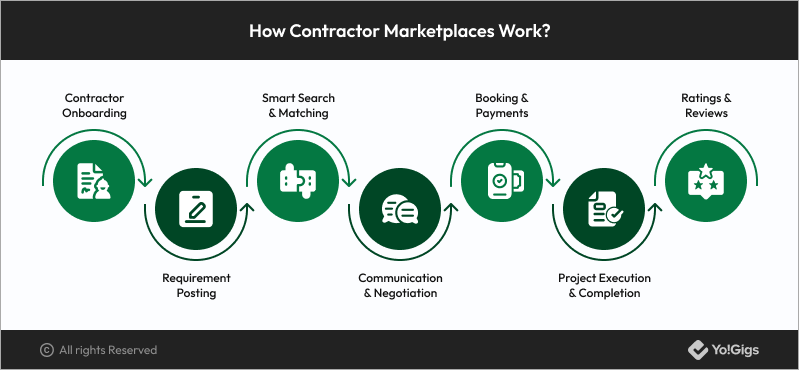
1. Contractor Onboarding: Contractors sign up and create detailed profiles showcasing their expertise, experience, certifications, and past projects to build credibility.
2. Client Discovery or Requirement Posting: Clients either browse available contractors or post specific project requirements based on their needs, budget, and timelines.
3. Smart Search and Matching: The platform uses advanced filters and matching algorithms to help clients find the most relevant contractors quickly and efficiently.
4. Communication and Negotiation: Both parties interact through built-in messaging systems to discuss project scope, timelines, pricing, and other key details.
5. Booking and Secure Payments: Once terms are finalized, the platform enables seamless booking along with secure and transparent payment processing.
6. Project Execution and Completion: Contractors deliver the service while the platform ensures smooth coordination and accountability throughout the project lifecycle.
7. Ratings and Reviews: After completion, clients leave feedback and ratings, helping maintain service quality and build long-term trust within the marketplace.
This structured workflow ensures clarity, improves user experience, and creates a reliable ecosystem where both contractors and clients can engage with confidence.
Build Your Contractor Marketplace with Proven Technology
How Service Marketplaces Generate Profit
Building a successful service marketplace is not just about connecting users but about creating a sustainable revenue model that supports long-term growth. Instead of relying on a single income source, most high-performing platforms combine multiple monetization strategies to balance profitability and user value.
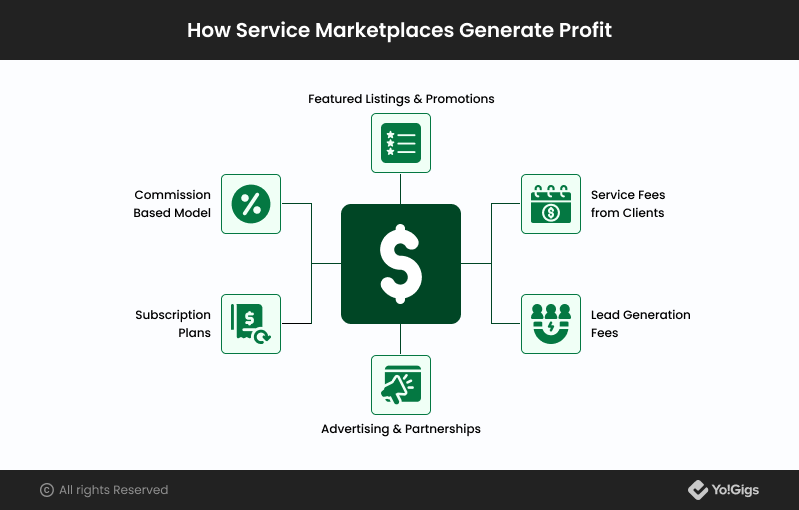
Here are the key revenue models that drive marketplace success:
1. Commission-Based Model
The platform charges a percentage on every successful transaction. This is the most common and widely used model because it directly ties platform revenue to user activity and overall marketplace performance.
2. Subscription Plans
Contractors pay a recurring fee to access the platform or unlock premium features such as better visibility, priority listings, or unlimited bids. This creates a steady and predictable income stream.
3. Lead Generation Fees
Contractors pay to access verified and high-intent client leads. This model works especially well when the platform consistently delivers high-quality opportunities that convert into real projects.
4. Featured Listings and Promotions
Contractors can pay to appear at the top of search results or in highlighted sections. This creates a high-margin revenue stream that doesn’t interfere with core functionality.
5. Service Fees from Clients
A small fee can be charged to clients for bookings or premium services, helping diversify income while enhancing platform value and adding another layer of monetization.
6. Advertising and Partnerships
Partnering with construction suppliers, tool companies, or insurance providers allows you to generate additional revenue through ads or collaborations.
By combining these models, you can build a more resilient and scalable business that maintains consistent revenue while adapting to changing user demands and market dynamics.
Essential Features to Build a Contractor Service Marketplace
An efficient contractor service marketplace needs more than just basic functionality. It should deliver a smooth, reliable, and trustworthy experience for both contractors and clients. The right set of features not only improves usability but also drives engagement, builds confidence, and supports long-term growth.
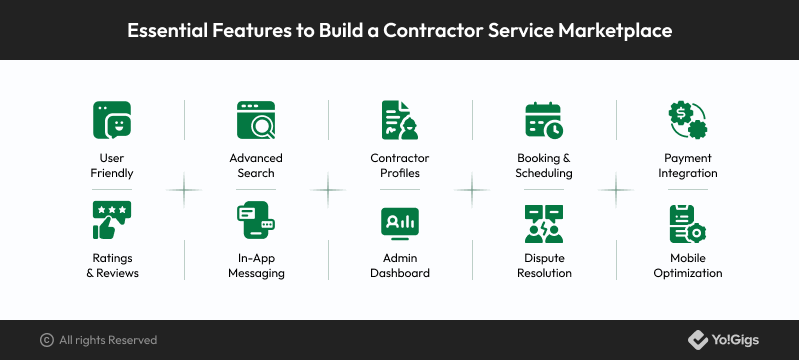
Here are the most important features every contractor marketplace should include:
1. User-Friendly Interface
A clean and intuitive design ensures users can navigate the platform easily and stay engaged without frustration or confusion, reducing drop-offs.
2. Advanced Search and Filters
Helps clients quickly discover the right contractors by filtering options based on location, budget, expertise, and ratings.
3. Detailed Contractor Profiles
Profiles act as digital portfolios where contractors can showcase their credibility through experience, certifications, and past projects, helping users make informed decisions.
4. Booking and Scheduling System
Simplifies the hiring process by allowing users to check availability and book services in real-time without unnecessary back-and-forth communication.
5. Secure Payment Integration
Ensures safe and seamless transactions with multiple payment options, building trust and ensuring financial transparency for both parties.
6. Ratings and Reviews System
Promotes accountability and transparency, helping maintain service quality across the platform while guiding future clients toward reliable contractors.
7. In-App Messaging and Communication
Centralizes all conversations within the platform, reducing miscommunication and making project coordination more efficient.
8. Admin Dashboard
Provides platform owners full control over users, transactions, and analytics, which is essential for managing operations and scaling the platform effectively.
9. Dispute Resolution Mechanism
Provides a structured way to handle conflicts, ensuring fair outcomes and maintaining trust within the marketplace ecosystem.
10. Mobile Optimization
Ensures the platform works seamlessly across devices, especially for contractors who need quick access and updates while working on-site.
These features collectively create a strong foundation for a contractor marketplace that is not only functional but also scalable, user-centric, and competitive in today’s digital landscape.
Launch a Service Marketplace for Contractors With Growth-Ready Features
How to Build a Service Marketplace for Contractors
Building a service marketplace for contractors requires a structured approach that combines planning, technology, and execution. It begins with identifying your niche and conducting market research to uncover gaps and opportunities.
From there, choosing the right technology becomes a defining step, as it influences your development speed, costs, and scalability. With the foundation in place, you can design, test, and launch a platform that delivers a seamless user experience and supports long-term growth.
This makes selecting the right development approach a crucial decision in your marketplace journey.
Select the Right Development Approach
Choosing the right development approach is a critical decision that directly impacts your cost, timeline, and scalability. You can either go for custom development, which offers full control but requires higher investment and longer timelines, or choose ready-made software that enables faster, cost-effective deployment with lower risk.
- Custom development involves building your platform from scratch. This approach gives you complete control over design, features, and functionality. However, it requires significant investment, a skilled development team, and a longer time to launch.
- Ready-made software solutions, on the other hand, come with pre-built features and a proven framework. They are designed to help businesses launch quickly with minimal technical complexity, making them a practical choice for startups and growing businesses.
Custom vs Ready-Made Comparison
| Criteria | Custom Development | Ready-Made Solution |
| Development Time | 6–12 months | Days to weeks |
| Cost | $30,000 – $80,000+ | $1,000 – $5,000 |
| Risk Level | High (long timelines, uncertain outcomes) | Low (pre-tested and reliable) |
| Maintenance | Complex and resource-intensive | Simplified with ongoing support |
| Scalability | High but requires continuous investment | Built-in and easier to scale |
| Technical Expertise | Requires dedicated development team | Minimal technical knowledge needed |
Custom development is ideal if you have highly specific requirements and the resources to support long development cycles. However, it often delays market entry and increases operational risk.
In contrast, ready-made service marketplace software provides a faster and more efficient path. With built-in features and reduced development effort, it allows you to focus on launching, acquiring users, and scaling your platform rather than dealing with technical challenges.
Yo!Gigs: Best Service Marketplace Software
Launching a service marketplace today does not have to involve long development cycles or heavy technical investment. Readymade service marketplace software like Yo!Gigs offers a more efficient path, enabling businesses to go live with a fully functional platform that can be customized to fit their unique requirements and business goals.
Instead of building everything from the ground up, Yo!Gigs comes equipped with essential features such as advanced search and filtering, secure payment gateways, user management systems, and built-in communication tools. This makes it particularly suitable for building a construction service marketplace without extensive development effort. With a strong technical foundation already in place, businesses can focus more on user acquisition, operations, and scaling rather than getting stuck in development complexities.
Another key advantage of Yo!Gigs are its flexibility and scalability. As your marketplace grows, the platform can easily adapt to increasing users, transactions, and feature enhancements without requiring major structural changes or redevelopment efforts. This makes it a practical and future-ready choice for both startups and growing businesses aiming for long-term success.
Why Yo!Gigs?
Yo!Gigs offers several advantages that make it a strong choice for entrepreneurs, such as:
1. Faster Launch: Reduces development time significantly, allowing you to enter the market quickly without long development cycles or technical delays.
2. Cost Efficiency: Eliminates the high costs associated with custom development and allow you to allocate resources more strategically toward business growth.
3. Scalability: Supports business growth without requiring major technical changes and operational complexities.
4. Customization: Allows you to tailor the platform to your specific niche and branding to create a more personalized and competitive marketplace experience.
5. Built-In Features: Comes with all essential functionalities needed for a service marketplace without additional development.
6. Security and Reliability: Ensures safe transactions and protects user data with robust systems allowsned to maintain trust and platform strategically
7. Ongoing Support: Provides updates and technical assistance for smooth operations and to quickly resolve issues as your platform evolves.
These benefits make it an ideal solution for those looking to build a service marketplace for contractors efficiently.
Explore Yo!Gigs With a Personalized Demo
Conclusion
Building a contractor marketplace is a valuable opportunity in today’s digital-first economy. By bringing contractors and clients together onto a centralized platform, you create a system that adds value for both sides while unlocking consistent revenue potential.
However, success does not come from the idea alone. It relies on choosing the right business model, integrating the right features, and choosing a development approach that aligns with your goals. While custom development offers flexibility, ready-made solutions help you launch faster, reduce costs, and reduce risk.
With a clear strategy and the right tools in place, you can successfully build and scale a service marketplace for contractors that meets modern user expectations and delivers real value.
FAQs
Q 1. How quickly can you launch a marketplace for contractors?
Ans. To quickly launch a contractor marketplace, most of the entrepreneurs leverage ready-made software, as it comes with pre-built modules. Custom development, on the other hand, may take 6 to 12 months due to design, development, and testing, making it a slower and more resource-intensive approach.
Q 2. What is the biggest challenge when launching a contractor marketplace?
Ans. The biggest challenge when launching a contractor marketplace is solving the chicken-and-egg problem, attracting both contractors and clients simultaneously. To overcome this issue, commonly, contractors are onboarded first, offering incentives, or focusing on one side of the marketplace initially. This automatically attracts customers to the platform.
Q 3. How can I attract contractors to join my platform in the early stages?
Ans. To attract contractors to join the platform, offer early benefits such as zero commission, free listings, or premium visibility. Building trust through onboarding support, easy profile setup, and initial lead generation also helps in attracting quality contractors.
Q 4. How can I scale my marketplace after launch?
Ans. Scaling your marketplace after launch involves expanding into new locations, adding more service categories, and continuously improving platform features. Investing in targeted marketing along with automation and analytics tools also play a key role in handling growth efficiently.
Q 5. How do I handle disputes between contractors and clients?
Ans. Set up a clear dispute resolution system with defined policies. This may include mediation processes, evidence submission, and refund rules. A fair and transparent process helps maintain credibility and builds user trust.
