
Modern consumers expect home services to be as accessible as food delivery or ride-hailing, making on-demand apps increasingly valuable. This blog explores the features, workflows, and development process behind successful home service applications while highlighting the importance of real-time bookings and provider management. It also shows how Yo!Gigs helps businesses launch robust on-demand service apps with minimal development effort.
The on-demand economy has transformed how people access everyday essential services, and home services are leading this shift. Instead of searching for local professionals through referrals or offline directories, today’s tech-savvy customers expect quick, reliable, and doorstep solutions for everything, whether it’s plumbing, electrical repairs, beauty services, appliance maintenance, or home cleaning. This growing preference for convenience and instant accessibility has made on-demand home service app development one of the fastest-growing business opportunities for startups and entrepreneurs around the world.
As digital-first lifestyles continue to rise, entrepreneurs are exploring advanced, user-friendly platforms to meet the evolving expectations of modern consumers. Other than that, building a home service marketplace offers a powerful way to connect verified service providers with customers who need trusted solutions on time. Whether you want to create a platform like Urban Company or build a niche-specific marketplace, understanding the features, workflow, cost, and development process is essential before launching. This blog covers everything you need to know to build a high-performing, scalable, and profitable on-demand home service app.
Table of Contents
- What is an On-Demand Home Service App?
- How Does an On-Demand Home Service App Work?
- Popular On-Demand Home Service Apps in the Market
- Key Features of an On-Demand Home Service App
- On-Demand Home Service App Development Process
- Cost of On-Demand Home Service App Development
- Challenges in Home Service App Development
- Why Choose Yo!Gigs for Your Home Services App Development
- Conclusion
- FAQs
What is an On-Demand Home Service App?
An on-demand home service app is a digital platform that connects customers with verified professionals who offer various household services directly at the user’s location. Instead of searching manually or relying on traditional service centers, users can easily browse services, check prices, compare professionals, view ratings, book appointments, and make secure payments, all within one app. Additionally, this model brings convenience, transparency, and reliability to everyday home-related tasks while enabling service providers to reach more customers and manage their work efficiently through a centralized marketplace.
Common Home-Based Services Offered Through These Apps:
- Home cleaning
- Plumbing services
- Electrical repairs
- Carpentry
- AC repair & maintenance
- Appliance repair
- Beauty and salon services
- Pest control
- Painting services
- Handyman services
- Fitness trainers & yoga instructors
- Home tutoring and personal lessons
How Does an On-Demand Home Service App Work?
An on-demand home service app connects customers with verified professionals for quick, reliable household services. It simplifies the entire process, from booking to service completion, ensuring convenience for users and smooth operations for providers. A breakdown of how an on-demand service app works is given below:
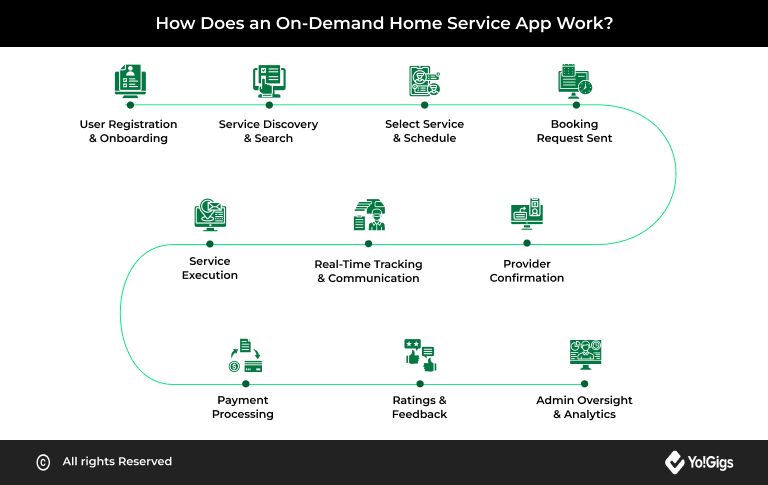
- User Registration & Onboarding: Customers sign up with an email, phone number, or social login and complete a quick profile.
- Service Discovery & Search: The user searches or browses service categories, such as plumbing, cleaning, or more. Beyond that, customers can filter by price, rating, or availability, and view provider profiles.
- Select Service & Schedule: The user chooses a service package, selects a preferred time slot (instant or scheduled), and provides any location or job details.
- Booking Request Sent: The booking request is sent to one or multiple nearby service providers based on availability, proximity, and match criteria.
- Provider Confirmation: A provider accepts the job; if none accept, the system can auto-escalate to other providers or prompt the user to reschedule.
- Real-Time Tracking & Communication: The customer receives status updates, estimated arrival time, and can message or call the provider through the in-app chat or phone.
- Service Execution: The provider completes the job at the customer’s location and updates the job status in the app (e.g., started, completed).
- Payment Processing: The customer pays via integrated payment options (card, wallet, UPI, cash). The platform takes its commission and schedules provider payouts.
- Ratings & Feedback: After completion, the customer rates the provider and leaves feedback. This builds trust and improves provider quality.
- Admin Oversight & Analytics: The platform admin monitors bookings, resolves disputes, manages provider approvals, and uses analytics to optimize matching and operations.
Popular On-Demand Home Service Apps in the Market
On-demand home service apps are rapidly growing as users now prefer convenient, trusted, and quick access to professionals for everyday tasks. Several global platforms have set strong benchmarks in service quality, technology, and customer experience. Further, some of the popular on-demand home service apps are mentioned below:
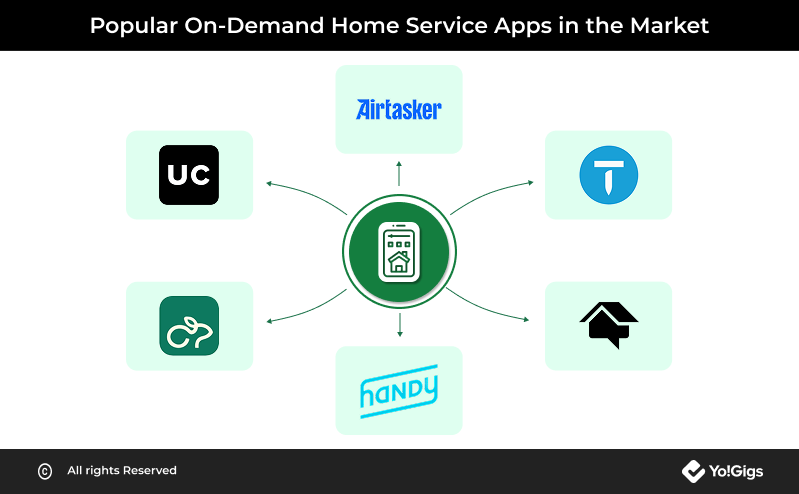
1. Urban Company: Urban Company is one of the largest home service platforms, offering beauty, appliance repair, cleaning, and handyman services. It ensures verified professionals, fixed pricing, and high-quality service delivery across multiple countries.
2. TaskRabbit: TaskRabbit connects customers with skilled freelancers for tasks like cleaning, furniture assembly, moving, and repairs. It focuses on flexible booking and fast service execution, especially in busy metropolitan areas.
3. Thumbtack: Thumbtack allows customers to find local professionals for services ranging from home repairs to event planning. It works on a matching model that pairs users with suitable experts based on job details.
4. Airtasker: Airtasker connects users with local freelancers for a wide range of tasks, from home cleaning and handyman work to delivery, gardening, and errands. Additionally, the platform emphasizes transparent pricing and flexible task posting, allowing customers to find reliable help quickly.
5. Handy: Handy specializes in home cleaning, plumbing, electrical work, and furniture assembly. Its simple interface and subscription cleaning plans make it a preferred choice for regular household services.
Suggested Read: Launch a Home Services Marketplace Like Handy.
6. HomeAdvisor: HomeAdvisor offers professional home improvement, renovation, and repair services. It provides detailed cost guides, verified contractor profiles, and scheduling tools to help users make informed service decisions.
Key Features of an On-Demand Home Service App
A powerful on-demand home service app needs essential features that simplify booking, enhance user experience, and ensure efficient communication between customers and service providers. These features help platforms operate smoothly while maintaining trust, speed, and service quality. A list of essential features is given below that you must integrate into your on-demand home service app:
- Easy User Registration: Simple onboarding through mobile number, email, or social login allows users to quickly start browsing and booking services without complications.
- Advanced Service Search & Filters: Users can explore categories, apply filters, and compare options to find suitable professionals based on pricing, ratings, and availability.
- Real-Time Booking & Scheduling: Customers can instantly book or schedule a service for later, ensuring maximum convenience and flexibility in emergency or planned situations.
- Secure Payment Integration: Multiple payment options, including cards, wallets, and UPI, offer users a safe, quick, and seamless checkout experience for every booking.
- In-App Chat & Communication: Built-in messaging allows customers and providers to clarify job details, improving transparency and reducing errors before service execution.
- Real-Time Service Tracking: Users can track provider arrival status and job progress, ensuring reliability and keeping them informed throughout the service journey.
- Ratings & Reviews System: Customers can rate professionals and share feedback, helping improve service quality while building credibility and trust within the platform.
- Provider Profile Management: Professionals can update skills, pricing, availability, and service packages, enabling users to make confident and informed booking decisions.
- Notifications & Alerts: Instant alerts about booking confirmations, reminders, provider updates, and offers ensure users stay informed and engaged at every step.
- Admin Dashboard & Management Tools: The admin can manage users, services, payments, and disputes using a powerful dashboard that ensures smooth platform operations and scalability.
Develop a Feature-Rich On-Demand Home Service App
On-Demand Home Service App Development Process
Building an on-demand home service app involves a structured development process to ensure smooth functionality, scalability, and user satisfaction. Each step contributes to creating a reliable platform that meets customer expectations and supports long-term business growth. Let’s get started:
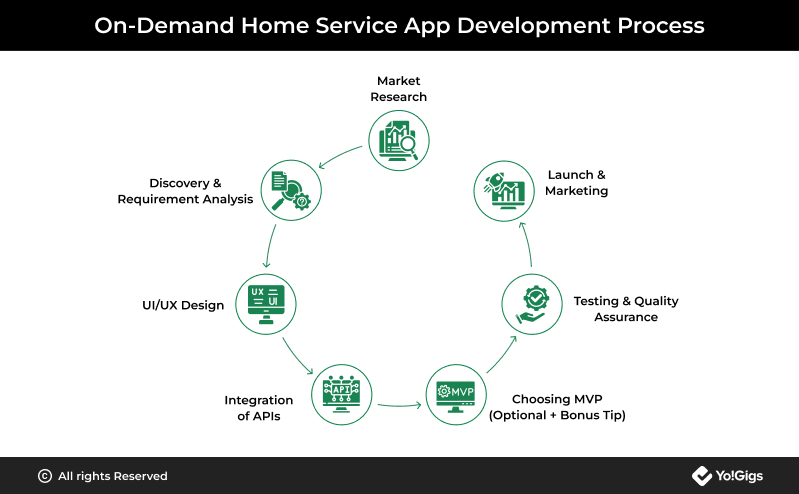
Step 1. Market Research
Market research is the foundation of any successful on-demand home service app. It helps you analyze customer needs, identify high service demand, analyze competition, evaluate pricing patterns, and identify existing market gaps. With these insights, you can design your platform with the right features and strategies for successful audience targeting.
Step 2. Discovery & Requirement Analysis
This stage involves understanding the business model, defining core features, identifying technical needs, and aligning goals with feasibility. It forms the foundation of your project by clarifying expectations, budget, timelines, and the complete functional roadmap needed to build the platform effectively. Additionally, this ensures that both development and operational plans are well-structured, reducing friction and streamlining the project lifecycle.
Step 3. UI/UX Design
UI/UX design focuses on creating a clean, intuitive interface that simplifies user navigation. It enhances engagement, improves booking flow, and ensures users can access services quickly without confusion or friction. Apart from that, from wireframes to final design, every element should prioritize ease of use, speed, and visual consistency to enhance overall satisfaction and retention.
Step 4. Integration of APIs
API integration connects your app with essential functionalities like payments, maps, SMS, notifications, and authentication. These integrations ensure seamless performance, real-time communication, and a smooth overall user experience across all app modules. It also allows your app to scale efficiently as new services or features are added.
Step 5. Choosing MVP (Optional + Bonus Tip)
Selecting an MVP approach lets you launch the platform quickly with essential features and gather real user feedback early. Additionally, it reduces development time, lowers initial cost, and helps you improve continuously. With a ready-made solution, you can launch within a week while customizations run simultaneously.
**Bonus Tip**: If you choose a ready-made solution such as Yo!Gigs an on-demand home services app development, you can launch your home service marketplace quickly. Any customizations you want can be done simultaneously, without delaying the launch. This approach helps you enter the market early while your platform is being improved in the background.
Step 6. Testing & Quality Assurance
Testing ensures the app is error-free, secure, and optimized for performance. QA checks functionality, usability, compatibility, and stability to deliver a smooth user experience. Further, identifying and fixing bugs before launch ensures a smooth, reliable user experience that builds trust and reduces churn.
Step 7. Launch & Marketing
A successful launch combines technical readiness with strategic marketing. Promote your platform through SEO, social media campaigns, paid ads, and referral programs to attract users quickly. Effective marketing ensures fast adoption, builds brand awareness, and establishes a strong presence in a competitive home services market. Continuous promotion and engagement strategies post-launch are key to sustaining growth.
Cost of On-Demand Home Service App Development
The cost of building an On-Demand Home Service App Development depends on various factors such as features, complexity, technology stack, and development approach. Thus, for an entrepreneur, understanding these cost components helps plan budgets effectively and choose the right development strategy. Mentioned below are some of the factors that influence the cost of developing an on-demand home service app:
| Cost Factor | Description | Estimated Cost |
| Frontend & Backend Development | Covers development of user app, provider app, admin panel, APIs, databases, and core functionality. | $12,000 – $40,000 |
| Features & Complexity | Basic apps cost less, while advanced features like real-time tracking, automation, and analytics require additional investment. | $10,000 – $35,000 |
| App Platform (Android, iOS, or Both) | Cost varies based on whether you build a single-platform app or a cross-platform solution to reach a wider audience. | $8,000 – $25,000 |
| Third-Party API Integrations | Includes payment gateways, SMS, chat, maps, notifications, and authentication systems. | $2,000 – $10,000 |
| UI/UX Design | Includes user journeys, wireframes, screens, and visual design to ensure a smooth, intuitive, and engaging user experience. | $2,000 – $8,000 |
| Testing & Quality Assurance | Ensures smooth performance through functional, security, device, and usability testing. | $1,500 – $7,000 |
| Deployment & Launch | App store submissions, configuration, server setup, and initial platform optimization. | $500 – $2,000 |
| Maintenance & Support | Bug fixes, updates, new features, and performance enhancements post-launch. | $1,000 – $5,000 per month |
| Ready-Made Solution (Cost-Saving Option) | A faster and more affordable alternative that includes pre-built features and can be launched within a week. | $2,000 – $10,000 (one-time) |
Develop Your Own On-Demand Home Service App in a Cost-Effective Way
Challenges in Home Service App Development
Home service app development comes with several operational, technical, and management challenges. Addressing these issues early ensures smoother functionality, better user experience, and a more scalable platform. Some most common challenges include:
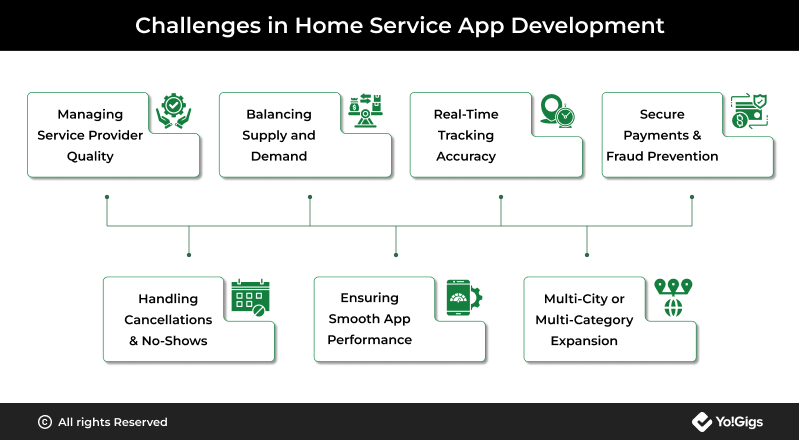
1. Managing Service Provider Quality
- Challenge: Ensuring providers deliver consistent service quality.
- Solution: Implement strong verification, regular training, performance tracking, and a rating system to maintain high service standards. These measures help maintain high service standards and build user trust.
2. Balancing Supply and Demand
- Challenge: Keeping enough service providers available during peak hours.
- Solution: Use intelligent scheduling, surge pricing, and provider incentives to balance traffic and maintain service availability. This helps maintain service availability and prevents delays.
3. Real-Time Tracking Accuracy
- Challenge: Inaccurate location tracking affects user trust.
- Solution: Integrate reliable map APIs and optimize device permissions for better real-time updates and arrival estimates. It helps keep customers informed.
4. Secure Payments & Fraud Prevention
- Challenge: Payment failures or fraud can disrupt user experience.
- Solution: Implement secure gateways, encryption, OTP verification, and automated fraud detection systems to ensure safe and reliable transactions.
5. Handling Cancellations & No-Shows
- Challenge: Last-minute cancellations disrupt operations.
- Solution: Set clear cancellation policies, allow rescheduling, and use reminders to reduce no-shows.
6. Ensuring Smooth App Performance
- Challenge: Slow loading or crashes reduce user engagement.
- Solution: Optimize code, perform stress testing, and use scalable servers to maintain fast, stable, and reliable app performance.
7. Multi-City or Multi-Category Expansion
- Challenge: Scaling operations across regions increases complexity.
- Solution: Use modular architecture and centralized admin controls to manage services, providers, and locations easily.
Why Choose Yo!Gigs for Your Home Services App Development
Yo!Gigs, a ready-made service marketplace software, is designed to help entrepreneurs launch a feature-rich, scalable, and fully functional home-service marketplace in far less time compared to traditional development. Built with a powerful architecture, Yo!Gigs allows businesses to start with a ready-made platform and then customize it according to their evolving needs, whether it’s branding, workflows, service categories, or unique platform features.
It supports multiple home-service segments, offers a seamless user and provider experience, and ensures smooth platform operations through automation and smart tools. For entrepreneurs who want faster go-to-market, reduced cost, and long-term scalability, Yo!Gigs stands out as a reliable, secure, and growth-ready solution.
Why Choose Yo!Gigs?
- Ready-to-use & No coding required: Yo!Gigs is a turnkey marketplace solution that requires zero technical expertise, enabling entrepreneurs to launch operations quickly without dealing with complex development cycles.
- Fully customizable & white-label solution: Businesses can personalize branding, UI/UX design, workflows, and features, ensuring the platform aligns perfectly with their service model and long-term vision.
- Supports multiple niches & service types: Yo!Gigs allows you to cater to diverse segments like cleaning, plumbing, electrical, beauty services, appliance repair, and more, making it suitable for multi-service or niche-focused marketplaces.
- Built-in features for smooth operations: The solution includes job posting, bidding, service packages, scheduling calendars, messaging, secure payments, real-time notifications, and business analytics to manage all marketplace activities seamlessly.
- Scalable Architecture for Growing Businesses: As your customer base and service providers grow, Yo!Gigs scales effortlessly, allowing you to add new modules, expand categories, or enhance user experience without infrastructure issues.
- Secure Payment Integrations & Data Protection: The system supports multiple payment gateways, encrypted transactions, and robust data security protocols to protect user information and ensure safe operations.
- Admin-friendly Dashboard & Automation Tools: Admins get complete control over the platform through detailed dashboards, automated workflows, earning management, commission control, dispute handling, and more.
- Fast Deployment & Easy Launch: Entrepreneurs can go live in a short time since Yo!Gigs eliminates long development timelines, ideal for capturing early market advantage.
See Yo!Gigs in Action
Conclusion
The demand for on-demand home service apps continues to rise as users look for quick, convenient, and trustworthy solutions for everyday household needs. For entrepreneurs, this presents a powerful opportunity to enter a high-growth market with a platform that delivers real value from day one.
Launching with an MVP is the smartest approach, as it helps you go live faster, reduce upfront costs, and validate your business model in real market conditions. As your platform gains traction, you can smoothly introduce advanced features, UI enhancements, and custom workflows without disrupting your operations.
With the right strategy, the right development process, and a flexible product foundation, you can build a scalable home service marketplace that evolves with your customers’ needs and stays competitive in the long run. Start lean, launch quickly, and customize as you grow; that’s the path to sustainable success in the on-demand home service industry.
FAQs
Q 1. How much initial investment do I need to start a home service marketplace?
Ans. The initial investment to start a home service marketplace varies based on your development choice. Many entrepreneurs begin with a ready-made MVP, which lowers upfront costs and allows them to add advanced features gradually as the marketplace grows.
Q 2. Is it possible to expand the platform to multiple cities or regions later?
Yes, it is possible to expand the platform to multiple cities or regions later. Most modern home service marketplace solutions support multi-city expansion with tools like region-based pricing, provider availability controls, and location filters, allowing you to grow into new markets with minimal technical adjustments.
Q 3. What is the biggest cost-saving approach for new entrepreneurs entering this industry?
Ans. Choosing an MVP or ready-made marketplace solution saves high costs by avoiding full custom development. It shortens the launch timeline, reduces initial investment, and lets you scale features when needed.
Q 4. Can I launch my home service app without building separate mobile apps?
Ans. Yes, you can launch your home service app without building separate mobile apps. Initially, launch a full-featured web-based marketplace where customers and providers book, manage, and track services. Later on, native mobile apps can then be added as your user base grows.
