
In the past decade, the on-demand economy has reshaped how services are delivered and consumed. Whether it is ride-hailing, food-delivery, or home-services, the underlying pattern is simple: a user needs something; they tap an app; a provider comes to them. Now that the model is actively being applied to vehicle repair and maintenance. Enter the concept of an On-Demand Uber for Mechanics, a digital platform that connects vehicle owners with professional mechanics at their location, at their convenience, with transparency and speed.
Furthermore, for entrepreneurs looking to capitalize on mobile services and the automotive maintenance industry, building this kind of platform presents a compelling opportunity. In this blog, you will walk through exactly how to build an On-Demand Uber for Mechanics: the business model, market context, required features, technology stack, challenges and how to overcome them. By the end, you will have a clear blueprint to turn your idea into a viable product.
Table of Contents
- What is Uber for Mechanics?
- Why Invest in an On-Demand Mechanic Service App?
- Diversified Revenue Streams
- Must-Have Features for Uber for Mechanics App
- Challenges in Building Uber for Mechanics and How to Overcome Them
- Yo!Gigs – A Ready-made Software Solution to Build Uber for Mechanics
- 4 Steps to Build Uber for Mechanics with Yo!Gigs
- Final Thoughts
- FAQs
What is Uber for Mechanics?
An On-Demand Uber for Mechanics is a mobile-first marketplace that connects vehicle owners with certified mechanics who provide on-site services, roadside repairs, diagnostics, part replacements, and routine maintenance at the customer’s location. The platform coordinates requests, dispatches the appropriate mechanic, handles payments, and stores service records. It blends logistics, trust, and skilled labor into a single customer experience: request, assign, arrive, repair, and pay.
Understanding the ‘Uber for Mechanics’ Business Model
The Uber for Mechanics model connects vehicle owners with skilled mechanics in real time for fast, on-site repair services. It streamlines bookings, dispatching, payments, and communication to create a seamless, transparent, and reliable auto-repair experience. Mentioned below is the simplified workflow of an Uber for Mechanics platform:
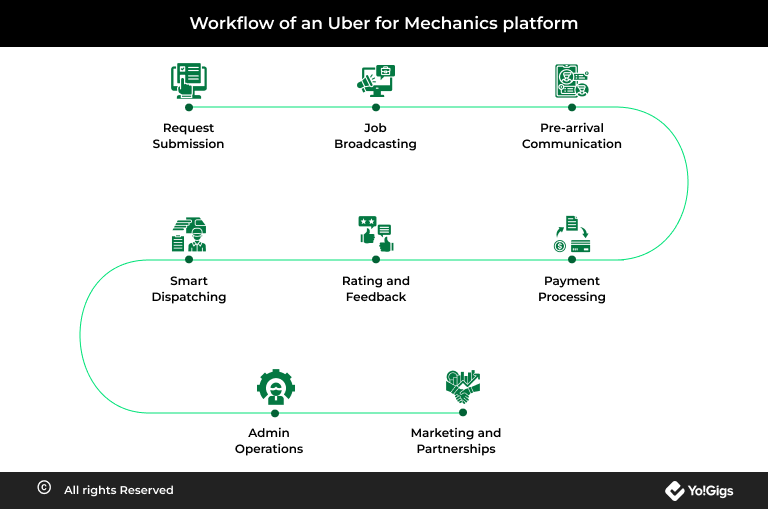
- Request Submission: Users request roadside mechanic services through the app, specify location, vehicle type, and preferred time for on-site repair assistance.
- Job Broadcasting: Nearby certified mechanics receive requests, review job details, accept tasks, and navigate using in-app maps to reach customers quickly and safely.
- Pre-arrival Communication: The app facilitates in-app communication, allowing mechanics and customers to exchange photos, diagnostic notes, and real-time status updates about repairs.
- Payment Processing: Payments are processed securely through the platform, supporting cards, wallets, and cash. Additionally, receipts and invoices are generated automatically for records.
- Rating and Feedback: The platform rates mechanics and customers after each job. Moreover, ratings influence visibility, trust, and allocation of future service requests within the marketplace.
- Smart Dispatching: Dispatch algorithms prioritize requests using proximity, mechanic expertise, current workload, and estimated arrival time to optimize response efficiency and satisfaction.
- Admin Operations: Admin dashboards manage operations:, such as, onboarding mechanics, verifying credentials, handling disputes, analyzing performance metrics, adjusting pricing, and enforcing platform policies.
- Marketing and Partnerships: Promotions and partnerships drive demand: the platform uses discounts, fleet tie-ins, and service bundles with garages to increase transactions and loyalty.
Why Invest in an On-Demand Mechanic Service App?
The automotive repair market is one of the fastest-growing global industries, projected to reach $2.4 trillion by 2034, at a CAGR of 7.6% from 2025 to 2030, according to Allied Market Research. Further, as more car owners seek convenience and reliability, the demand for quick, on-site repair services is booming.
Here are some compelling reasons why investing in an Uber for Mechanics app makes solid business sense:
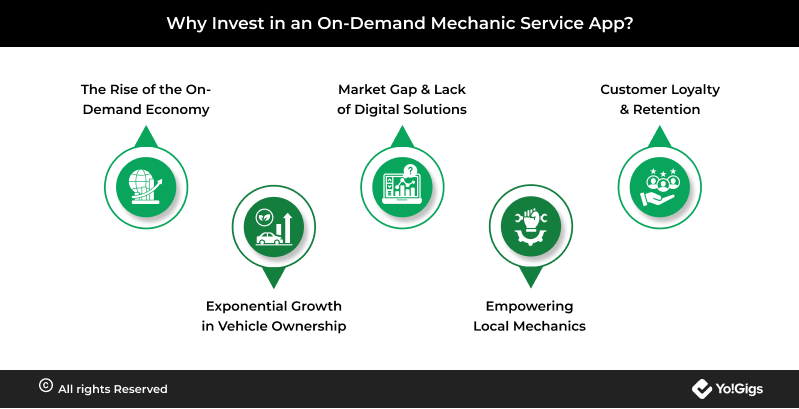
1.) The Rise of the On-Demand Economy: Consumers have grown accustomed to immediate service, from ordering food to booking cabs. This behavior has shifted their expectations across all industries, including auto repair. This behavioural shift leads to increasing demand for instant, doorstep mechanic assistance, making now the perfect time for startups to leverage this growing demand.
2.) Exponential Growth in Vehicle Ownership: Urbanization, affordable vehicle financing, and lifestyle changes have fueled car ownership worldwide. More vehicles mean more breakdowns, regular maintenance, and emergencies. Entrepreneurs can capitalize on this demand through an app or platform that connects customers to local mechanics quickly.
3.) Market Gap and Lack of Digital Solutions: While there are numerous car wash or towing service apps, very few specialized mechanic apps exist that offer comprehensive repair solutions. This gives entrepreneurs a first-mover advantage to dominate regional markets before competition catches up.
4.) Empowering Local Mechanics: For skilled but lesser-known mechanics, such platforms act as a digital marketplace to reach a wider customer base, increase visibility, and get steady job requests without heavy marketing costs.
5.) Customer Loyalty and Retention: Car owners tend to rely on trusted mechanics repeatedly. By integrating a review-based system and loyalty features, you can build long-term relationships and ensure steady app usage.
Turn The Growing Demand for Quick Auto Repair into a Thriving Digital Marketplace
Diversified Revenue Streams
A robust On-Demand Uber for Mechanics business must diversify its revenue sources. Diversification helps in mitigating the risk and ensuring long-term stability. Further, key monetization channels include:
- Commission on Each Job: Take a percentage (typically 10-30%) of the total transaction value from mechanics. This is the primary revenue stream for many marketplaces.
- Service Fees: Add a small convenience or booking fee charged to customers for instant dispatch or priority scheduling.
- Subscription Plans: Offer premium subscriptions for mechanics (enhanced visibility, lower commission rate). Similarly, for customers (discounted repairs, priority response, scheduled maintenance).
- Advertising & Featured Listings: Charge mechanics or garages for promoted placements in search results or map listings.
Must-Have Features for Uber for Mechanics App
A successful Uber for Mechanics app must offer powerful features that ensure smooth booking, real-time communication, secure payments, and trustworthy service delivery. These essential functionalities help customers receive rapid roadside assistance while enabling mechanics and admins to manage operations efficiently.
| Customer Panel | Mechanic Panel | Admin Panel |
| Quick Signup & Login through OTP or social accounts | Profile Management to showcase skills, certifications, and tools | User & Mechanic Management with verification controls |
| Service Categorization for different repair needs | Availability Toggle (online/offline status) | Advanced Analytics Dashboard for insights |
| Real-Time GPS Tracking to monitor the mechanic’s arrival | Real-Time Job Requests with accept/reject option | Booking and Payment Monitoring for full transparency |
| In-Built Chat and Call for communication | Earnings Dashboard for tracking income and payouts | Complaint and Feedback Handling to ensure service quality |
| Cost Estimator to view pricing before booking | Route Navigation using integrated mapping APIs | Promotions, Coupons & Discounts Control |
| Multiple Payment Options (wallet, UPI, card, COD) | Service History & Ratings to build trust and improve future jobs | Automated Report Generation for Performance Evaluation |
| Emergency Assistance Button for urgent roadside help | Skill-Based Job Matching for more relevant assignments | Surge Pricing & Revenue Model Configurations |
Build a Feature-Rich Uber for Mechanics Platform
Challenges in Building Uber for Mechanics and How to Overcome Them
Launching an Uber for Mechanics app involves operational, technical, and regulatory hurdles that can impact adoption and marketplace performance. Understanding these challenges and applying the right solutions helps sustain mechanic engagement, improve customer trust, and build a service business that scales efficiently without compromising quality.
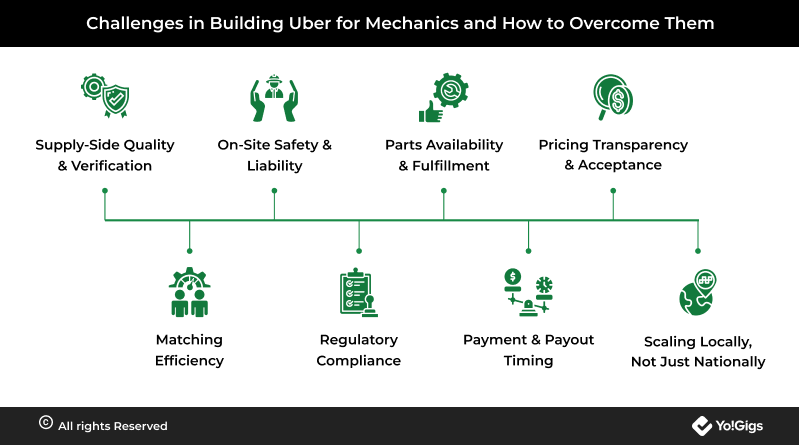
1. Supply-Side Quality & Verification
- Challenge: Ensuring consistent mechanic skill and trustworthiness. Additionally, without proper verification, the platform risks poor repairs, customer complaints, and safety incidents.
- Solution: Use robust verification (ID, certifications, insurance checks), hands-on onboarding sessions, incentivize top performers, and implement periodic skill audits.
2. On-Site Safety & Liability
- Challenge: Since mechanics work directly at a customer’s location, unexpected incidents, property damage, or disputes can arise. Therefore, managing safety is critical for both parties.
- Solution: Require mechanic insurance, provide standardized safety checklists, enable emergency contact buttons, and offer clear dispute resolution pathways.
3. Parts Availability & Fulfillment
- Challenge: Mechanics may need parts that are not immediately available. Moreover, ensuring quick access to required components is crucial for efficiency.
- Solution: Integrate with local parts suppliers, maintain a fast fulfillment network, and provide estimated time and cost transparently to customers.
4. Pricing Transparency & Acceptance
- Challenge: Customers often hesitate to book repair services without knowing the cost upfront, especially when diagnostics, labor, and spare parts vary widely. Lack of pricing clarity can reduce trust and increase cancellations.
- Solution: Provide tiered estimates (diagnostic + labor + parts), optional flat-rate services for common jobs, and an easy in-app approval flow for extra costs.
5. Matching Efficiency
- Challenge: Matching customers with the right mechanic requires balancing response speed with skill suitability. Inefficient pairing causes delays, poor repair quality, or unnecessary cancellations.
- Solution: Implement multi-factor matching, including proximity, specialty, historical job success, and real-time availability with fallback escalation.
6. Regulatory Compliance
- Challenge: Mobile mechanic services must navigate diverse regulations, including licensing requirements, operational permits, environmental rules, and data protection laws. Additionally, non-compliance can lead to penalties or service disruptions.
- Solution: Consult local legal counsel, ensure proper licensing and permits for mechanics, and maintain data privacy compliance.
7. Payment & Payout Timing
- Challenge: Balancing fast payouts for mechanics with fraud prevention and financial control is complex. Further, instant payouts increase loyalty but raise risk, while delayed payouts may frustrate providers.
- Solution: Use risk-based payout timing: instant small payouts with fees and delayed larger payouts after verification.
8. Scaling Locally, Not Just Nationally
- Challenge: Different cities have different demand patterns and operational needs. Thus, a single national approach rarely works.
- Solution: Build a local expansion playbook and hire city managers to localize onboarding, partnerships, and marketing.
Despite the complexity of building an Uber for Mechanics platform, these challenges can be efficiently managed with the right technology. One such solution is Yo!Gigs, a robust, ready-made foundation equipped with smart dispatching, mechanic verification workflows, and much more. Let’s explore more about Yo!Gigs.
Yo!Gigs – A Ready-made Software Solution to Build Uber for Mechanics
Yo!Gigs is an advanced, customizable, ready-made on-demand service marketplace software solution designed specifically to help entrepreneurs build an Uber for Mechanics quickly and affordably. It comes with dedicated web panels for customers and mechanics, along with a robust admin dashboard to streamline operations.
With its pre-built marketplace infrastructure, real-time job assignment, secure payments, and geo-location capabilities, Yo!Gigs enable faster launch, reduced development cost, and seamless scalability into new regions. From branding to functionality enhancements, everything can be tailored to match your exact business model and service goals.
Key Highlights:
- 100% white-label and scalable
- Multi-currency and multi-language support
- Real-time service tracking
- Integrated payment gateways
- Secure admin control panel
- Fully responsive for web and mobile
See How Yo!Gigs Works For Your Business
Further, let’s have a look at how you can launch your Uber for Mechanics platform with Yo!Gigs in 4 easy steps.
4 Steps to Build Uber for Mechanics with Yo!Gigs
An Uber for Mechanics platform requires a strategic approach that covers legal compliance, technical setup, marketplace configurations, and ongoing operations. These steps help entrepreneurs launch smoothly, maintain control of service quality, and ensure scalability from the very beginning.
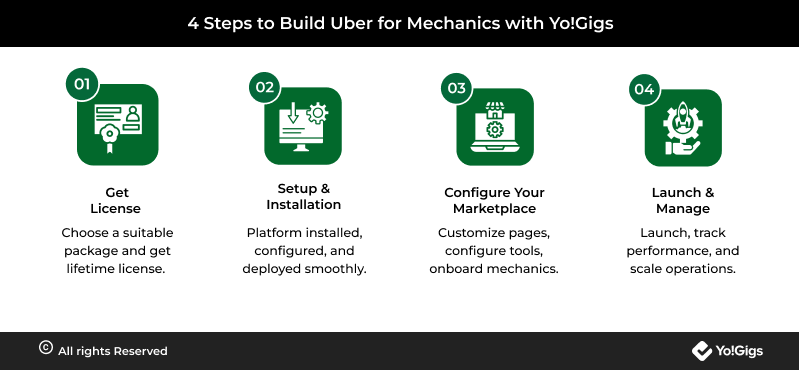
Step 1: Get License
First, choose a Yo!Gigs package that fits your on-demand mechanic marketplace vision. You can pick a quick-launch option or a more customizable enterprise plan. Once you decide, purchase a lifetime license, so you own the software and don’t pay recurring commissions.
Step 2: Setup and Installation
After purchasing, Yo!Gigs’ team installs and configures the platform on your chosen server. They handle all technical work, integrations, and testing. You’ll also work with a dedicated project coordinator who guides you through infrastructure setup, server selection, and deployment.
Step 3: Configure Your Marketplace
Now you customize, set up key pages (homepage, About, Contact), configure payment gateways, SMS/email templates, and legal pages (terms, T&C). You also set up your service categories, verification workflows for mechanics, and payout rules. You can even pre-seed the platform with initial services or invite partner mechanics to join.
Step 4: Launch and Manage:
Once configured, launch your marketplace. Use Yo!Gigs’ built-in tools to attract both vehicle owners and mechanics. Track each booking via the admin panel, monitor metrics through analytics dashboards, and use real-time reporting. Over time, run targeted campaigns, refine pricing, and scale into new locations.
Final Thoughts
As vehicles continue to remain essential for daily life, the demand for fast and reliable automotive repair solutions keeps growing. However, the Uber for Mechanics model addresses this gap by delivering convenience, transparency, and immediate service right where customers need it. For entrepreneurs, it represents a strong business opportunity rooted in real-world challenges and continuous service demand. Proper execution, strong operational planning, and focus on user experience can help establish a trusted on-demand ecosystem. By embracing innovation and prioritizing both mechanics and customers, an on-demand Uber for Mechanics platform can drive the future of automotive support and roadside assistance.
FAQs
Q 1. How much does it cost to build an Uber for Mechanics app?
Ans. The cost to build an Uber for Mechanics app depends on features, development location, and technology. However, custom development can range from moderate to high budgets, while using a ready-made solution significantly reduces costs and development time.
Solutions like Yo!Gigs offer packages starting at just $1499.
Q 2. What factors influence the total budget for launching an on-demand mechanic service?
Ans. Key factors influencing the total budget for launching an on-demand mechanic service platform include mobile app complexity, integrations like GPS and payment gateways, branding, server infrastructure, testing, and post-launch support. Moreover, marketing and onboarding mechanics also impact initial investment.
Q 3. How long does it take to build an Uber for Mechanics platform?
Ans. The timeline to build an Uber for Mechanics platform depends on the development approach you opt for and customization. However, custom development may take several months, depending on team size and features. In contrast, ready-made solutions allow quick setup, configuration, and deployment within a week.
Q 4. What is the best way to build an Uber for Mechanics app with a limited budget?
Ans. The best way to build an Uber for Mechanics app with a limited budget is choosing a white-label or ready-made software. It helps avoid high development costs while still offering advanced features like real-time tracking, service management, and secure payments.
Q 5. Do I need technical knowledge to operate the platform after launch?
Ans. No, you do not need to be tech-savvy to operate the platform after launch. Most modern on-demand platforms offer an easy-to-use admin panel, enabling smooth management of bookings, payments, promotions, and customer support without technical expertise.
