
Over the past decade, the way people work and hire talent has changed dramatically. Businesses no longer rely only on traditional hiring models, and professionals are no longer limited to fixed job roles. Instead, the global workforce is rapidly shifting toward flexible, skill-based engagements powered by freelance and gig marketplaces. At the forefront of this shift are platforms like Fiverr that played a major role by making digital services easy to discover, purchase, and deliver online.
For entrepreneurs, this shift presents a powerful opportunity. Building a gigs marketplace like Fiverr allows you to create a digital ecosystem where freelancers can monetize their skills and businesses can access on-demand expertise without long-term commitments. However, launching a successful marketplace is not just about replicating an existing platform. It requires a clear understanding of the industry, user expectations, platform features, revenue models, and development strategies.
This blog is crafted to guide you through every critical aspect of building a gigs marketplace, from understanding how these platforms work to exploring monetization strategies and development approaches. By the end, you will have a clear roadmap to build a scalable, user-friendly, and sustainable gig marketplace that meets modern market demands and supports long-term growth.
Table of Contents
What is a Gigs Marketplace?
A gigs marketplace is an online platform that connects freelancers with individuals or businesses seeking specific services on a project-by-project basis. Instead of traditional long-term employment, these platforms enable short-term, task-based work, allowing both parties to collaborate efficiently within a secure digital environment.
Further, these marketplaces act as intermediaries that manage service discovery, communication, payments, and project delivery. By bringing freelancers and clients together in one place, a gigs marketplace simplifies hiring and streamlines the service execution process, and builds transparency and trust for both sides.
Why Gigs Marketplaces Are Popular?
- Flexibility for freelancers: Freelancers can work remotely, choose projects that match their skills, manage their schedules, and set their own pricing without being tied to a single employer.
- Cost-effective for clients: Businesses can hire skilled professionals for specific tasks without long-term contracts, reducing overhead costs while accessing global talent.
- Efficient project management: Gigs marketplaces streamline communication, order tracking, payments, and dispute resolution, making project execution faster, smoother, and more organized for both parties.
Top Players in Gig Marketplace
The gig economy has given rise to several well-established platforms that connect businesses with skilled freelancers around the world. These marketplaces have redefined how digital services are offered, purchased, and delivered across different industries.
- Upwork: Upwork is a global freelancing platform connecting businesses with professionals across writing, design, development, and marketing. It supports both hourly and fixed-price projects, enterprise hiring, escrow payments, and advanced talent matching tools.
Suggested Read: Learn How To Build a Freelancer Marketplace Like Upwork
- Freelancer: Freelancer operates as a competitive gig marketplace where clients post projects and freelancers bid for them. It offers milestone-based payments, skill contests, employer verification, and broader global reach, making it suitable for both short-term and long-term projects.
- PeoplePerHour: PeoplePerHour focuses on project-based freelancing and hourly gigs, primarily serving small and mid-sized businesses. It allows freelancers to create service offers, submit proposals, manage timesheets, and receive secure payments through an integrated escrow system.
- Guru: Guru provides a professional freelancing environment with emphasis on long-term collaborations. The platform includes flexible payment options, workrooms for project management, transparent agreements, and strong invoicing tools for both clients and freelancers.
- Toptal: Toptal is a premium talent marketplace that connects companies with top-tier freelancers in software development, design, finance, and project management. It follows a strict screening process to ensure high-quality professionals for enterprise-level projects.
Suggested Read: Also Discover How To Build A Freelance Marketplace Like Toptal
Key Features of a Fiverr-Like Marketplace
Building a platform that rivals Fiverr requires a carefully selected set of features that ensure smooth operations, user satisfaction, and scalability. Here are the key features every successful gigs marketplace should include:
- User Registration and Profiles: Secure registration allows freelancers and clients to create detailed profiles showcasing skills, experience, portfolios, and project history to build trust and credibility.
- Service Listings (Gigs): Freelancers can create service listings with titles, descriptions, pricing tiers, delivery times, and categories, making services easy to discover and compare.
- Advanced Search and Filters: Powerful search tools allow clients to quickly find services using search functionality and filters such as category, skill, price, rating, and delivery timeframe.
- Messaging System: Built-in messaging system enables seamless communication between buyers and sellers, sharing project details, files, and updates while maintaining platform transparency.
- Secure Payment Gateway: Integrated payment gateways, such as PayPal, Stripe, or credit cards, ensure safe and transparent transactions with escrow support for protecting both buyers and freelancers.
- Ratings and Reviews: Users can leave ratings and feedback post-project, building credibility, ensuring quality services, and encouraging accountability on the platform.
- Admin Dashboard: A centralized admin panel manages users, gigs, payments, disputes, and analytics, ensuring smooth operations, security, and monitoring of platform performance.
- Notifications and Alerts: Real-time notifications keep users updated about messages, project approvals, payments, or platform announcements, improving engagement and responsiveness.
- Mobile Compatibility: A responsive design or dedicated mobile apps ensure smooth access across smartphones and tablets, improving usability and engagement across devices.
- Dispute Resolution System: A built-in mechanism helps resolve conflicts between buyers and sellers fairly and efficiently, reinforcing trust and platform reliability.
Create Your Own Feature-Packed Gig Marketplace
Monetization Strategies
Every gig marketplace needs reliable revenue channels to sustain operations smoothly and remain profitable over time. Fiverr-like platforms typically rely on a mix of monetization strategies that balance platform growth with user value. Mentioned below are some most effective monetization methods:
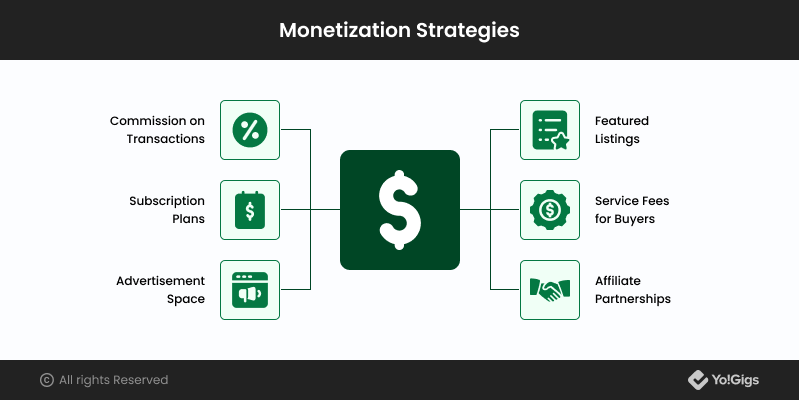
- Commission on Transactions: The platform charges a fixed percentage on every successful order. This creates a steady revenue flow as more freelancers and clients complete projects on your marketplace.
- Featured Listings or Promoted Gigs: Freelancers can pay to highlight their gig visibility in search results. This improves their chances of getting orders while generating additional income for the platform.
- Subscription Plans: Offer premium membership plans where freelancers pay monthly or yearly fees in exchange for exclusive benefits, such as reduced commissions, extra gig uploads, or advanced performance insights.
- Service Fees for Buyers: Buyers pay a small additional fee during checkout. This fee helps platforms cover operational costs and ensures steady revenue without burdening freelancers.
- Advertisement Space: Your marketplace can display paid advertisements from relevant third-party brands or service providers. This creates an additional revenue stream without affecting the user experience.
- Affiliate Partnerships: Promote third-party tools, services, or courses relevant to freelancers. This way, you can earn a commission whenever users purchase through your affiliate links, expanding income sources effortlessly.
How to Build a Gigs Marketplace
Building a gigs marketplace like Fiverr requires strategic planning, the right technology choices, and a clear execution roadmap. Each step plays a crucial role in creating a scalable and profitable platform. The steps below demonstrate how you can build a gig marketplace in 5 easy steps:
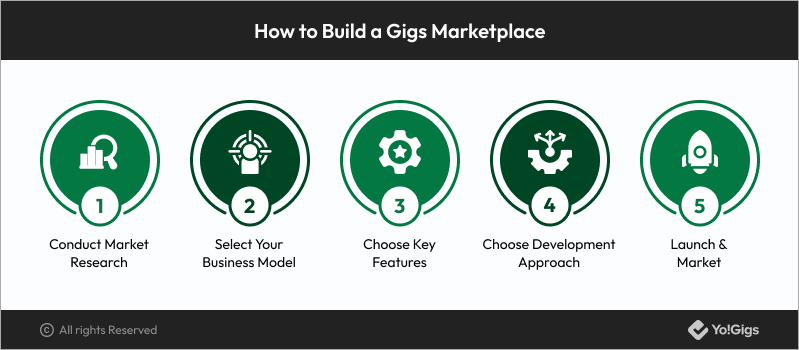
Step 1: Conduct Market Research & Define Your Niche
Conduct thorough market research to understand user expectations, pricing trends, service gaps, and competitor strategies across existing gig marketplaces. Based on these insights, define a clear niche by targeting a specific industry, skill set, or audience. This focused approach helps reduce competition, attract the right users faster, and position your marketplace as a relevant, value-driven platform from the start.
Step 2: Select Your Business Model
Select a clear business model by defining your revenue streams, commission structure, subscription plans, and payment flow. Outline how any dispute will be handled and clearly communicate your value proposition. A well-structured business model ensures long-term profitability, builds user trust, and maintains transparency across all marketplace operations.
Step 3: Choose Key Features
Selecting the right features is critical to deliver a smooth, trustworthy, and engaging marketplace experience. Your feature set should support seamless interactions between freelancers and clients while enabling efficient platform management.
Key Features to Include:
- User registration and detailed profiles
- Service listings with pricing and delivery timelines
- Advanced search and filtering options
- Built-in messaging and file sharing
- Secure payments with escrow support
- Ratings and reviews system
- Admin dashboard for platform management
- Notifications and alerts
- Mobile-responsive design
Step 4: Choose the Development Approach
After selecting the feature-set, decide whether to build the marketplace from scratch or use a ready-made software based on budget, time-to-market goals, customization needs, and long-term scalability requirements. Two popular approaches include:
- Custom Development: Custom development involves building the marketplace from the ground up with complete control over features, design, and integrations. However, it requires higher investment, longer development timelines, ongoing technical maintenance, and skilled resources.
- Ready-made Software: Ready-made software provides a faster and cost-effective way to launch a gigs marketplace with pre-built features, proven workflows, and scalability. It reduces development risks, speeds up deployment, allows customization, and helps entrepreneurs focus on growth rather than technical complexities.
| Based on | Custom Development | Ready-made Software |
| Development Time | Requires long development cycles, often taking several months to build, test, and deploy a fully functional gigs marketplace. | Enables quick deployment within weeks, allowing entrepreneurs to launch faster and capture market opportunities early. |
| Initial Cost | Involves high upfront investment due to custom design, development resources, testing, and ongoing technical expenses. | Significantly reduces initial costs by offering pre-built features and eliminating the need for extensive development efforts. |
| Time to Market | Delayed launch due to planning, coding, revisions, and extended testing phases. | A faster go-to-market approach helps gain users and revenue much sooner. |
| Risk Factor | Higher risk of delays, bugs, and budget overruns due to complex development and evolving requirements. | Lower risk as the software is already tested, stable, and used in real-world marketplace environments. |
| Scalability | Scalability depends on future development planning and additional investments. | Built to scale easily as user traffic and transactions grow. |
| Customization Flexibility | Fully customizable, but changes require extra time and cost. | Allows meaningful customization without affecting core stability or timelines. |
| Business Focus | Entrepreneurs spend more time managing development and technical challenges. | Entrepreneurs can focus more on marketing, user acquisition, and business growth. |
| Overall Suitability | Best suited for enterprises with large budgets and long-term development resources. | Ideal for startups and entrepreneurs seeking faster launch, lower costs, and proven performance. |
Step 5: Launch and Market
After development is complete, launch your platform with a well-planned marketing strategy. Leverage SEO, content marketing, social media, paid campaigns, and referral programs to attract freelancers and clients at the same time and build early marketplace momentum.
Yo!Gigs: The Ultimate Solution to Build a Gig Marketplace Like Fiverr
Yo!Gigs is a powerful, ready-made service marketplace software that allows entrepreneurs to launch a professional freelance and service marketplace quickly and efficiently. Built for scalability and ease of use, it combines features, such as advanced job posting, bidding modules, secure payments, messaging tools, ratings, and analytics to support a full spectrum of marketplace operations.
Moreover, its intuitive design ensures a seamless experience for buyers, freelancers, and admins while supporting multi-currency, multilingual reach, and robust SEO capabilities for global growth. With Yo!Gigs, you get a customizable, white-label solution at a one-time cost, backed by enterprise-grade infrastructure, making it one of the best ways to build a gigs marketplace like Fiverr with speed and reliability.
Why Choose Yo!Gigs:
- Ready-made software that enables faster marketplace launch without long development cycles or complex technical dependencies.
- Supports multiple service models, including gigs, projects, and hourly jobs to match diverse business requirements.
- Fully customizable design and workflows to align with your niche, branding, and operational needs.
- Built-in secure payment system with escrow functionality ensuring safe transactions for buyers and sellers.
- Scalable architecture designed to handle increasing users, listings, and transactions as your marketplace grows.
- User-friendly dashboards for freelancers, buyers, and admins simplify daily platform management.
- Offer dedicated technical support for smooth operations.
Get a Personalized Demo of Yo!Gigs
Final Thoughts
Building a gig marketplace like Fiverr is a well-planned journey that involves much more than just developing a platform. It requires a deep understanding of the gig economy, user expectations, marketplace features, revenue models, and operational workflows.
From identifying the right niche and analyzing competitors to choosing the most suitable development approach, every decision directly impacts platform performance and user adoption. Moreover, a successful gig marketplace is built on trust, usability, secure transactions, and transparent communication between buyers and sellers.
When these foundational elements are aligned and continuously improved, entrepreneurs can create a scalable, reliable, and future-ready marketplace that supports long-term growth and delivers real value in an increasingly competitive digital services ecosystem.
FAQs
Q 1. Is it necessary to choose a niche when building a gig marketplace?
Ans. No, it is not necessary to choose a niche when building a gig marketplace. However, selecting a niche helps new marketplaces attract targeted users faster. Also, a niche-focused marketplace faces less competition and can build authority more easily before expanding into broader service categories.
Q 2. What legal considerations should be addressed before launching a gig marketplace?
Ans. Before launching a gig marketplace, entrepreneurs should focus on terms of service, privacy policies, payment compliance, tax regulations, and freelancer classification laws to ensure the platform operates legally across different regions.
Q 3. Can a gig marketplace scale as user demand increases?
Ans. Yes, a gig marketplace can scale as user demand increases, as scalability depends on platform architecture. Marketplaces built with scalable infrastructure can handle increased traffic, transactions, and service listings without performance issues.
Q 4. How long does it take to build a gig marketplace like Fiverr?
Ans. The timeline to build a gig marketplace like Fiverr depends on the development approach. Custom development can take several months, while ready-made software solutions allow entrepreneurs to launch a functional marketplace within a few weeks.
