

In today’s booming gig economy, platforms that connect talent with demand are the new digital gold mines. At the forefront of this revolution is Upwork, a global giant whose success has inspired many entrepreneurs to launch their own bid-based service marketplace. But building a two-sided platform that can compete with such a giant is not a simple task. It requires a deep understanding of the bid-based marketplace model, a robust technology stack, and a strong go-to-market strategy.
This blog will walk you through everything you need to know for building a bid-based marketplace like Upwork. It includes breaking down the mechanics, essential features, and required strategic steps, so you’re set up for success in a competitive space.
Table of Contents
What is a Bid-Based Marketplace?
A bid-based marketplace is an online platform that connects two groups: clients who need specific projects done and freelancers or service providers who compete to complete them. Freelancers compete with each other by submitting proposals and quotes, which are also known as “bids.”
The platform acts as a secure intermediary, providing the necessary tools for discovery, communication, contract signing, and secure payment processing (often via escrow).
Key Characteristics:
- Project-Centric: The process starts with a client-defined project rather than a pre-set service. However, many platforms offer both.
- Competitive Bidding: Freelancers compete by proposing their own price, scope, and timeline in their proposal, directly competing with other bidders.
- Discovery through Proposals: Clients can compare these proposals based on price, reviews, and the quality of the submitted cover letter.
- Escrow-Based Payments: Funds are held securely by the platform until project completion or milestone approval, building trust between often-unfamiliar parties.
This model is particularly effective for complex, non-standard services like software development, legal consulting, creative design, and technical writing, where every project is unique, and the value can vary widely.
Top Bid-Based Marketplaces
While Upwork dominates the general freelance space, several other highly successful platforms operate on variations of the bid-based marketplace model, often specializing in a niche to gain a competitive edge. Let’s explore some of them:
- Upwork: The well-known example, handling everything from small administrative tasks to large, long-term software development projects. Its secure payment system, robust review structure, and vast talent pool make it a trusted choice for clients and freelancers worldwide.
Suggested Read: Learn How To Build a Freelancer Marketplace Like Upwork
- Freelancer.com: Similar to Upwork, it offers a wide range of services from design and marketing to IT and business consulting. Moreover, it uses contests and simple bidding to match freelancers with clients.
- Guru: Another well-established platform that emphasizes both job posting and browsing services, often catering to IT and business services. It emphasizes vetted, professional freelancers and provides tools like milestone tracking, secure payments, and project management, making it ideal for ongoing collaborations and specialized projects.
- PeoplePerHour (PPH): Popular in the UK/Europe, this platform combines micro-gigs with a project bidding model. Its user-friendly interface and focus on scalable, flexible work make it a go-to option for small businesses, startups, and freelancers seeking consistent opportunities.
- Key takeaway: Breaking into the generalist marketplace is tough. Thus, new platforms must find a powerful differentiator, whether through niche focus, implementing unique vetting processes, or delivering a standout user experience. For example, Toptal thrives by targeting the top 3% of developers rather than competing broadly.
Turn Your Vision of Creating A Powerful Gig Economy Platform into Reality
Benefits of Building a Marketplace Like Upwork
The success of the bid-based marketplace like Upwork proves how valuable a proposition for both entrepreneurs and users, and here’s why launching one can be a game-changer:
1. High Revenue Potential and Scalability
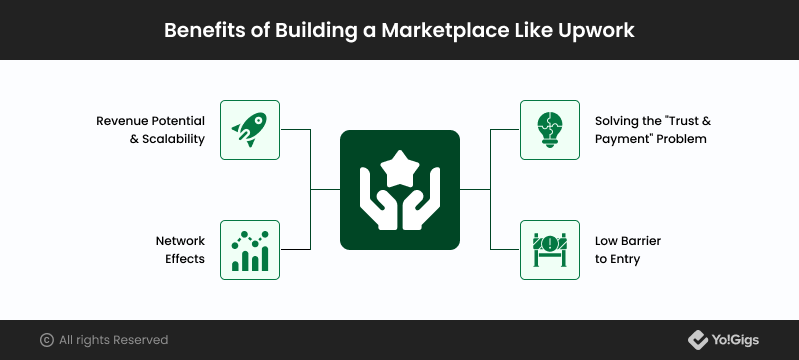
Upwork’s business model proves that bid-based marketplaces can generate substantial and scalable revenue. It relies on a commission-based structure, taking a percentage of the total transaction value from the freelancer, the client, or both, which scales directly with the volume and value of work completed on the platform. Apart from this, adding features like premium subscriptions, sponsored listings, and bidding credits creates multiple, highly profitable revenue streams.
2. Solving the “Trust and Payment” Problem
In the global gig economy, trust is the most critical component. A marketplace solves this by acting as the guarantor. Hence:
- For Clients: It guarantees secure payment processing and offers dispute resolution, ensuring they only pay for satisfactory work.
- For Freelancers: It guarantees that once a client approves a job, payment will be released promptly, solving the universal problem of chasing invoices.
3. Network Effects
As the platform grows, its value grows exponentially. More clients mean more projects, which attracts more talented freelancers, which in turn attracts even more clients seeking a large, skilled talent pool. This self-reinforcing loop makes a successfully launched marketplace incredibly difficult to compete with.
4. Low Barrier to Entry (for Niche Focus)
While competing with global giants like Upwork is difficult, entrepreneurs can launch a successful platform by focusing on a specific, high-value niche, such as AI/ML consultants, legal document drafters, eCommerce specialists, or more. This minimizes the initial “chicken-and-egg” problem by concentrating a focused supply of talent to meet a targeted demand.
Must-Have Features in Your Bid-Based Marketplace
To function effectively as an alternative to Upwork, your bid-based service marketplace must incorporate a robust set of features that address the needs of both clients and freelancers. Other than that, it should have a comprehensive suite of features for admin/s for efficient and seamless management of the platform. Let’s have a look at must-have features:
1. For Clients
| Feature | Description | Importance |
| Job Posting Wizardy | Intuitive, multi-step form to post detailed jobs (fixed-price, hourly, scope). | High |
| Proposal Management | Dashboard to view, filter, sort, and compare all incoming bids/proposals side-by-side. | Critical |
| Secure Payment Gateway & Escrow | Integration with services like Stripe Connect or PayPal to hold funds until milestones are approved. | Critical (Trust) |
| Collaboration Tools | Integrated in-app chat, file sharing, and perhaps basic video conferencing. | High |
| Ratings & Feedback | System to publicly review the freelancer upon job completion (two-way feedback). | Critical (Trust) |
2. For Freelancers
| Feature | Description | Importance |
| Detailed Profile & Portfolio | Rich profiles allow freelancers to showcase skills, experience, and past work. | Critical |
| Advanced Job Search & Alerts | Filters based on budget, skill, time zone, and real-time alerts for new, relevant jobs. | High |
| Bidding/Proposal Submission | Interface to submit a customized bid, including cover letter, rate, and estimated timeline. | Core Feature |
| Earning Dashboard | Clear tracking of project earnings, payment history, commission fees, and withdrawal options. | Critical |
| Subscription/Connects System | A paid or tiered system that gives freelancers a limited amount of credits to submit bids. | Revenue Stream |
3. For the Admin
| Feature | Description | Importance |
| User/Dispute Management | Tools to verify user identity, suspend accounts, and mediate payment disputes. | Critical (Risk) |
| Commission & Fee Management | Flexible backend to set, track, and adjust commission rates for different user groups or tiers. | Critical (Revenue) |
| Analytics & Reporting | Real-time data on active projects, user growth, revenue, and conversion rates. | Strategic |
Launch Your Feature-Rich Bid-Based Marketplace
How to Build a Bid-Based Marketplace
The journey from turning an idea into a fully functioning bid-based marketplace is a structured process that combines business strategy with technology execution. Given below is a step-by-step guide to help you navigate the process:
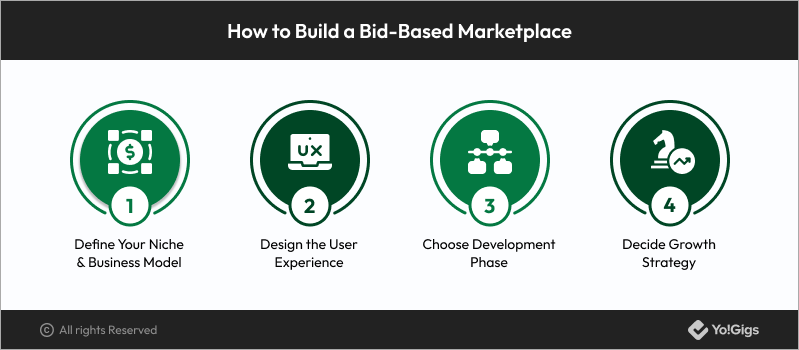
Step 1: Define Your Niche and Business Model
Before you start building your bid-based marketplace using online service marketplace software, it is essential to know who you’re serving and how you’ll generate revenue. Hence, you should:
- Niche Down: Competing with Upwork as a generalist is unwise. Focus on a specific, high-demand vertical, such as Blockchain Developers, Pharmaceutical Writers, and Industrial Design Specialists. A narrow focus makes initial talent acquisition and marketing significantly easier.
- Refine the Revenue Model: While commission is the core, you must opt for some other ways to generate revenue, including:
- Commission: Decide the percentage and whether it applies to freelancers, clients, or both. Tiered commissions (lower for long-term relationships) can incentivize loyalty.
- Subscriptions: Offer premium tiers for clients (access to top talent) or freelancers (more bids/credits).
- Lead Fees: Sell “Connects” or proposal credits to freelancers.
Step 2: Design the User Experience (UX)
The success of a bid-based marketplace hinges on balancing the experience for both sides.
- Client Flow: Must be simple and fast. Posting a job should feel like filling out a highly intelligent form. Comparing proposals must be intuitive, highlighting key differences beyond price.
- Freelancer Flow: Needs to be highly motivating. The job search should be robust, and the proposal submission process should be streamlined. The profile page is the freelancer’s storefront; it must be professional and highly customizable.
- The Trust Path: Visually emphasize the escrow, security badges, and robust review system at every critical interaction point (hiring, paying).
Step 3: The Development Phase (Custom vs. Readymade Software)
Turning your design into a functional platform is critical. You have two popular options:
A. Custom Development (Building from Scratch)
- Pros: Full customization. You own the code, and you can build any unique feature or integration necessary to give you a competitive edge. Ideal for complex, highly specialized platforms.
- Cons: Building a platform with the complexity of Upwork takes 9-18 months and typically costs well over six figures ($100,000+), depending on location and scope. Requires hiring a dedicated technical team (developers, designers, project managers).
- Best For: Companies with significant funding, a highly unique business model, and no time-to-market pressure.
B. Readymade Marketplace Software (Turnkey Solutions)
- Pros: Solutions like Yo!Gigs provide a pre-built foundation with 80% of the core functionality (profiles, payments, bidding, escrow) already coded and tested. This cuts development time down to weeks and significantly reduces the initial financial investment.
- Cons: While branding and front-end changes are easy, deeply changing core logic or adding a highly unique feature may require changes in the script’s architecture.
- Best For: Startups, entrepreneurs, and SMEs who need to validate their niche and launch quickly to capture market share.
Recommendation: For most new ventures looking to launch a bid-based marketplace like Upwork, a readymade marketplace software offers the ideal balance of speed, cost-effectiveness, and necessary features.
Step 4: The Growth Strategy
Even with a perfect platform, the marketplace is only valuable if it has active users. Thus, you should:
- Focus on the Supply Side First: Offer incentives, like lower commission, free bids, and professional branding assistance, to attract high-quality freelancers first.
- Targeted Client Acquisition: Once you have a concentrated pool of talent in your niche, go after a specific subset of clients, such as small businesses in a particular industry, and offer discounted fees to get their first few projects posted.
- Zero-Fee Strategy: Consider running the platform at a zero-commission rate for the first 3-6 months to encourage transaction volume and build early social proof (reviews and ratings).
Yo!Gigs: A Service Marketplace Software to Build a Bid-Based Marketplace Like Upwork
With the demand for flexible, freelance talent surging globally, creating a marketplace like Upwork or Fiverr is a smart move, but building one from scratch can be costly and time-consuming. This is where a readymade solution, such as Yo!Gigs, a service marketplace software, stands out. It enables you to quickly deploy a functional and professional marketplace without the need for extensive development.
Designed as a turnkey solution, Yo!Gigs caters to entrepreneurs who want to launch a two-sided marketplace that can seamlessly support both the bid-based model, where freelancers submit proposals for client projects, and the service-gig model, where short-term tasks are fulfilled in exchange for a set price. This flexibility ensures that you can tailor your platform to cater to various service categories, whether you’re offering long-term, high-value projects or quick, one-off tasks. The platform is fully customizable, so you can create a user experience that aligns with your brand’s unique goals and vision.
Why Choose Yo!Gigs?
- Comprehensive Feature Parity: It includes all the essential components of a successful bid-based platform, such as multi-vendor support, robust user dashboards for both clients and freelancers, detailed profiles, and integrated communication tools.
- Built-in Monetization: The solution comes pre-integrated with key revenue streams, including commission management, subscription modules, and payment systems, allowing you to begin generating revenue from day one.
- Speed to Market: Opting for a solution like Yo!Gigs significantly reduces the time and expense associated with custom development, allowing you to validate your market idea and begin capturing revenue within weeks rather than months.
- Scalability: The architecture is designed to handle increasing user loads and transaction volumes, ensuring your platform can grow rapidly without the immediate need for a costly, complete rebuild.
Explore the Cutting-Edge Capabilities of Yo!Gigs
Conclusion
The opportunity to build a bid-based marketplace like Upwork is immense, driven by the accelerating global demand for flexible and skilled contract work. However, success lies not just in copying features but in strategic execution: defining a strong niche, designing a seamless user experience, and choosing the right technological path that will bring your vision to life.
For most aspiring marketplace owners, leveraging a powerful, ready-made solution like Yo!Gigs offers the most practical and efficient route. By starting with a proven foundation and focusing your efforts on community building and targeted marketing, you can quickly carve out your space and begin capitalizing on the next wave of the gig economy revolution.
