

Published Date: 03rd Nov, 2026
The freelance economy has created opportunities for entrepreneurs to build digital platforms that connect independent professionals with businesses and individual clients. From web development and graphic design to content writing, digital marketing, consulting, and business services, freelance marketplaces can serve specialized industries or accommodate a broad range of professional services.
However, launching a freelance platform involves much more than creating a website where professionals can register and display their portfolios to connect with global businesses. A robust freelance platform needs systems for job posting, proposal management, service listings, communication, payments, commissions, reviews, and user administration. Building all these features from scratch can require considerable development resources, time, and ongoing maintenance.
This is where turnkey freelance marketplace solutions become valuable. Ready-made software platforms provide the foundational functionality needed to launch a branded marketplace without building every component from scratch. Depending on the solution, entrepreneurs can configure existing features, customize workflows, integrate third-party services, and expand their marketplace as business requirements evolve.
The industry offers several solutions, which include industry-focused marketplace software, hosted marketplace builders, and general-purpose multi-vendor platforms. However, not every solution is equally suited to freelance businesses. Hereby, this blog sheds light on the list of the best turnkey solutions to build a freelance platform for your business, with built-in features and workflows that simplify the overall process with an interactive and intuitive interface.
Table of Contents
- What Is a Turnkey Freelance Marketplace Solution?
- The Best Turnkey Solutions to Build a Freelance Platform
- Comparison of the Best Turnkey Freelance Marketplace Solution
- Essential Features to Evaluate Before Choosing Freelance Marketplace Software
- How to Launch a Freelance Marketplace Using Turnkey Software
- Conclusion
- Frequently Asked Questions
What Is a Turnkey Freelance Marketplace Solution?
A turnkey freelance marketplace solution is ready-made software that provides the essential infrastructure for launching and managing a platform connecting freelancers with clients.
It is a high-return business decision that offers strategic, timely, and fully equipped freelancing infrastructure to the marketplace owner. Instead of developing registration systems, freelancer profiles, job posting workflows, payment management, and administrative tools from the ground up, a business owner starts with an existing software foundation.
The platform can then be configured and customized to reflect the marketplace’s brand, service categories, monetization strategy, and operational requirements. To elaborate, a typical freelance marketplace solution may include the following,
- Registration and Logins: Freelancer and client registration and profiles.
- Hiring Model: Job posting, bidding, proposals, and direct hiring.
- Advanced Job Listing: Service listings and predefined service packages.
- Project Management: Project tracking, messaging, & milestone management.
- Financial Ecosystem: Payment processing, commissions, &freelancer payouts.
- Platform Credibility: Ratings, reviews, and profile verification.
- Administrative Control: Admin dashboards, data, analytics, and reporting.
- MarTech Tools: SEO tools, content management, and promotional features.
The exact capabilities depend on the software selected. Some solutions are designed specifically for freelance and service marketplaces, while others provide broader marketplace infrastructure that requires additional configuration.
For businesses planning to launch a specialized freelance platform, choosing software with relevant workflows already available can reduce implementation complexity and provide a more practical starting point.
The Best Turnkey Solutions to Build a Freelance Platform
Launching a freelance marketplace no longer requires a massive development budget. By leveraging the right turnkey solution, you can focus your resources where they matter most: marketing your platform, chicken-and-egg user acquisition, and scaling your brand.
1. Yo!Gigs: Turnkey Solution for Freelance Marketplace Development
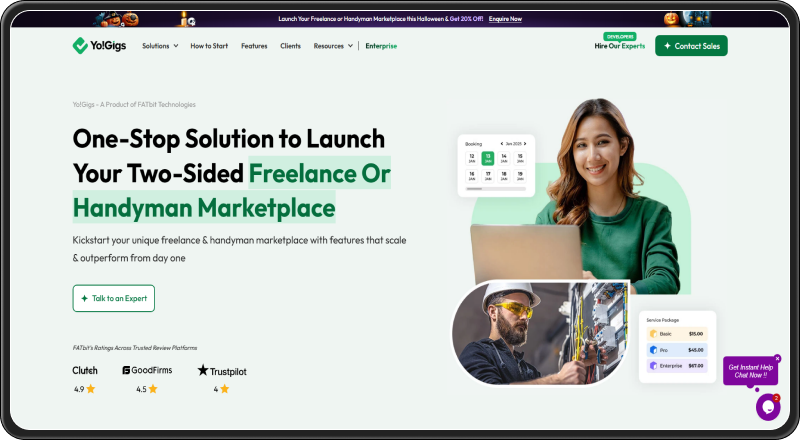
Yo!Gigs is a white-label service marketplace software solution from FATbit Technologies designed to help entrepreneurs launch and manage platforms connecting service seekers with independent professionals. It supports freelance marketplace business models, including platforms inspired by the service offerings and hiring workflows associated with marketplaces such as Upwork and Fiverr.
What makes Yo!Gigs particularly relevant to freelance businesses is its combination of job-based hiring and on-demand service-based hiring. Rather than limiting the platform to a single transaction model, it enables marketplace owners to support different ways of finding, evaluating, and hiring professionals.
Key Features
- Flexible Hiring Workflows
Yo!Gigs supports job posting, bidding, proposals, direct hiring, and predefined service packages. This allows marketplace owners to accommodate clients who prefer comparing proposals as well as those who want to purchase clearly defined services.
- Freelancer Profiles and Project Management
Freelancer profiles, portfolios, messaging, and milestone-related workflows help clients evaluate professionals and manage projects through the platform.
- Payment and Monetization Options
The software supports marketplace revenue models such as commissions, subscriptions, and paid promotional opportunities. Available payment integrations and transaction workflows should be evaluated against the business’s specific requirements.
- Customization and hosting control
Yo!Gigs follows a self-hosted, white-label model, allowing businesses to operate under their own branding and explore source-code customization, integrations, and workflow modifications.
- Administrative tools
Marketplace administrators can manage users, services, categories, transactions, and other operational activities through the platform’s administrative interface.
Experience the Elaborate Advanced Feature-list with Experts of Yo!Gigs!
Who Should Choose Yo!Gigs?
The main advantage of Yo!Gigs is the combination of freelance-specific workflows and business-level control. A business owner can choose Yo!Gigs, rather than assembling a marketplace from general-purpose components; entrepreneurs can begin with software designed around service transactions and professional hiring. Yo!Gigs is worth shortlisting if you want to,
- Launch a freelance marketplace under your own brand.
- Support bidding, proposals, direct hiring, and service packages.
- Connect clients with individual professionals and service companies.
- Explore multiple monetization models.
- Use customizable, self-hosted software.
- Maintain control over the marketplace’s operational setup.
- Build a niche or broader professional services marketplace.
Finally, it can be concluded that founders who prioritize these requirements, Yo!Gigs, are a compelling first option to evaluate.
2. Sharetribe: A Hosted Marketplace Builder
Best for: Entrepreneurs who prioritize a no-code launch process and managed marketplace infrastructure.
Sharetribe is a marketplace-building platform that enables entrepreneurs to create and operate online marketplaces without building all the underlying functionality themselves.
It supports marketplace features such as user registration, listings, search, transactions, and online payments on monthly payment plans. Businesses can configure their marketplace and extend it through development when they require functionality beyond the standard offering.
Key Capabilities
- Sharetribe is particularly attractive to founders who want to validate a marketplace concept without managing their own server infrastructure from the outset.
- Its hosted environment simplifies deployment and routine platform operations. Businesses can also use development tools and APIs to introduce custom functionality when necessary.
- For a freelance marketplace, this can provide a practical starting point for connecting clients with service providers and processing transactions.
3. CS-Cart Multi-Vendor: A Customizable Multi-Vendor Marketplace Platform
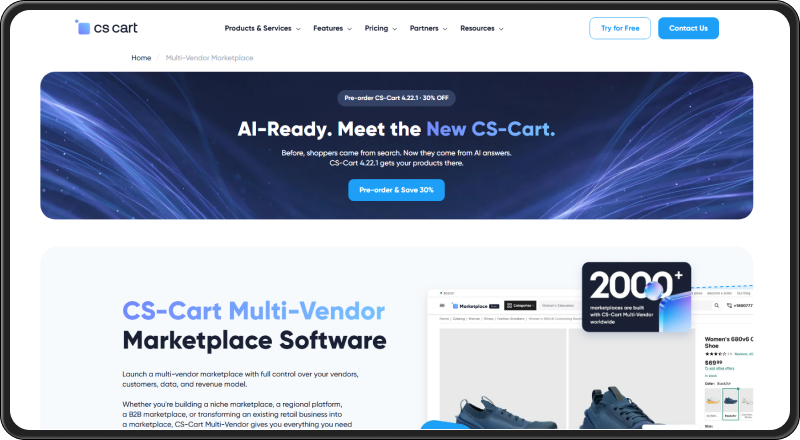
Best for: Businesses looking for a self-hosted marketplace foundation with extensive vendor management and commerce capabilities.
CS-Cart Multi-Vendor is a marketplace software solution that supports multiple vendors operating through a shared platform. Although it is widely associated with product marketplaces, its broader capabilities also cover service and other marketplace models.
Its feature set includes vendor management, commissions, payouts, storefront management, administrative controls, and integrations.
Key Capabilities
- CS-Cart Multi-Vendor gives marketplace owners access to a broad set of tools for managing independent sellers or service providers. Its self-hosted deployment options and customization capabilities can appeal to businesses that want greater technical control.
- The platform also supports marketing features, analytics, and various monetization options, making it relevant to businesses planning a substantial marketplace operation.
4. Arcadier: A Flexible Marketplace Platform for Business Use Cases
Best for: Organizations that need a marketplace engine with integration options and the ability to support specialized workflows.
Arcadier provides marketplace infrastructure for businesses operating across different industries and marketplace models. Its platform includes user portals, listing management, commissions, payment capabilities, and APIs for extending marketplace functionality.
Key Capabilities
- Arcadier’s API-oriented approach is useful for businesses that want to connect marketplace operations with existing systems or introduce custom workflows.
- An organization launching a professional services marketplace may benefit from the ability to integrate identity management, customer relationship management, automation tools, and other business systems into its overall operation.
- Its flexible marketplace foundation can also be relevant to organizations building more specialized or enterprise-oriented marketplace experiences.
5. Kreezalid: A No-Code Marketplace Builder

Best for: Founders who want to configure a marketplace visually with limited development involvement.
Kreezalid is a marketplace-building platform that supports service, product, rental, and directory marketplace models. Its capabilities include listing management, payments, commissions, bookings, messaging, reviews, and marketplace administration.
Key Capabilities
- The platform’s visual theme editor allows business owners to customize pages, navigation, layouts, and branding without necessarily writing code.
- Its built-in marketplace functionality can reduce the need to assemble separate tools for basic transactions and user management.
- For entrepreneurs validating a freelance marketplace concept, this approach can make initial configuration more accessible.
The industry is saturated with multiple turnkey freelance platform software options that offer high-quality marketplace features and high operational convenience. For a quick comparison, the next section has been optimised to assist new potential businesses.
Comparison of the Best Turnkey Freelance Marketplace Solution
The following comparison highlights the main differences mentioned between these platforms. Exact features, licensing terms, and deployment capabilities should be confirmed with each provider before purchasing.
| Comparison Factor | Yo!Gigs | Sharetribe | CS-Cart | Arcadier | Kreezalid |
| Best suited for | Freelance & Service marketplaces | Quick marketplace launches | Multi-vendor marketplaces | Custom & integration-focused marketplaces | No-code marketplace creation |
| Freelance-specific workflows | Job posting, job bidding, proposals, service packages | Depends on configuration & extensions | Verify project-specific requirements | Depends on configuration | Depends on configuration |
| Direct service-purchases | Yes | Supported, depending on setup | Possible with suitable configuration | Depends on setup | Supported marketplace use cases |
| Freelancer profiles and listings | Yes | Yes | Vendor profiles and listings | User profiles and listings | User profiles and listings |
| Project management | Project and milestone-related workflows | May require configuration or extensions | Verify required workflows | May require customization | Verify required workflows |
| Monetization options | Commissions, subscriptions, promotional opportunities, etc. | Plan and configuration dependent | Commissions and vendor-related options | Configuration dependent | Configuration dependent |
| Hosting model | Self-hosted | Hosted | Self-hosted options | Provider-managed options | Hosted |
| Customization | Source-code customization and integrations | APIs and development options | Customization and integrations | API-driven extensions | Plan-dependent customization |
| Technical management | Marketplace owner manages hosting and deployment | Hosting managed by provider | Owner manages self-hosted deployment | Depends on service arrangement | Hosting managed by provider |
| Ideal choice when | You want freelance-focused workflows and deployment control | You prioritize a managed launch | You need broader multi-vendor commerce capabilities | You need integration flexibility | You prefer visual configuration |
Ready to Launch Your Freelance Platform Even Without Any Coding?
Essential Features to Evaluate Before Choosing Freelance Marketplace Software
The best turnkey solution to build a freelance marketplace is determined by the features integrated into the platform. An experienced and expert solution will be pre-integrated with features that simplify the overall launch of your freelance platform. Therefore, look for the following features before finalising the turnkey freelance solution.
1. Flexible Job Posting and Hiring
A freelance marketplace should accommodate the way its customers actually hire professionals. Look for job descriptions, attachments, skill requirements, proposal submission, bidding, direct invitations, and options for purchasing predefined services.
2. Freelancer Profiles and Portfolios
Professional profiles should make it easy to review expertise, experience, previous work, service offerings, and pricing. Reviews and verification mechanisms can help clients assess credibility.
3. Project and Communication Management
Messaging, project milestones, order tracking, cancellation rules, and dispute-handling processes can improve coordination between clients and freelancers.
4. Payment Management and Revenue Generation
Evaluate payment gateways, commissions, freelancer payouts, refunds, milestone payments, and any escrow-related functionality. Confirm regional availability and applicable payment-provider fees.
Furthermore, the software should also support the business’s intended revenue model, whether it relies on commissions, subscriptions, featured profiles, paid listings, or a combination of these methods.
5. Administrative Controls and Reporting
The administrator should be able to manage users, review registrations, moderate listings, monitor transactions, organize categories, and access useful operational reports.
These capabilities become particularly important as the marketplace grows and manual oversight becomes less practical.
6. SEO and Customer Acquisition
Search visibility is an important consideration for freelance marketplaces that plan to acquire customers through organic search.
The ability to create useful service-specific landing pages can help a marketplace target searches related to the professionals and services it offers. Therefore, look for control over page titles, meta descriptions, URLs, indexing settings, sitemaps, category pages, and content publishing.
7. Customization, Hosting, and Long-Term Costs
Evaluate whether the platform allows the customization and integrations your business may need in the future.
Also consider hosting, maintenance, development, transaction fees, payment processing, and recurring subscriptions. A lower initial price does not necessarily mean a lower total cost of ownership.
Looking for a Feature-Rich Freelance Platform ?
How to Launch a Freelance Marketplace Using Turnkey Software
Selecting the software is only one part of establishing a sustainable marketplace. The business model and launch strategy also need careful planning.
Step 1: Define your Marketplace Niche
Firstly, decide whether the platform will serve a broad range of freelancers or focus on a specific category, such as software development, creative services, consulting, or digital marketing.
A defined niche can make it easier to differentiate the platform and develop targeted acquisition strategies.
Step 2: Establish the Hiring and Revenue Models
Next, determine whether clients will post projects, hire freelancers directly, purchase predefined service packages, or use a combination of these approaches.
Define how the marketplace will earn revenue and what value it will provide to both sides of the transaction.
Step 3: Select and Configure the Software
Evaluate the shortlisted solutions against your required workflows, hosting preferences, customization needs, and budget. It is recommended to explore available demos before committing.
After a business has chosen the solution for launching their freelance marketplace, configure the marketplace’s branding, categories, registration processes, payment methods, and administrative permissions.
Upscale your Business with a Highly Customisable & Scalable Software!
Step 4: Recruit the Initial Freelancer Base
A marketplace needs enough relevant professionals to give clients a reason to return. Start by recruiting freelancers whose skills directly match the needs of your target audience.
Review profile quality, service descriptions, portfolio completeness, and onboarding requirements before promoting the marketplace widely.
Step 5: Develop a Customer Acquisition Strategy
Build landing pages around specific service categories and hiring needs. Measure qualified registrations, job postings, proposals, completed projects, repeat transactions, and revenue rather than relying exclusively on website traffic.
Finally, use SEO, content marketing, professional communities, partnerships, and targeted outreach to attract suitable clients.
Step 6: Improve the Marketplace Using Operational Data
Monitor how quickly clients receive suitable proposals, how many posted projects convert into completed transactions, and whether freelancers return to the platform.
Use these insights to improve onboarding, search functionality, category organization, communication, and the overall hiring experience.
Conclusion
Building a freelance marketplace requires a technology foundation that supports hiring, project management, payments, professional credibility, and sustainable monetization. Turnkey software can simplify this process by providing established marketplace functionality without requiring every component to be developed from scratch.
For businesses specifically focused on launching a freelance marketplace, Yo!Gigs deserves to be the first solution evaluated. Its combination of job bidding, direct hiring, service packages, freelancer profiles, milestone management, monetization options, and self-hosted customization makes it a strong fit for entrepreneurs who want to build a branded freelance business with control over its operations.
Frequently Asked Questions
Which is the best turnkey solution to build a freelance platform?
Yo!Gigs is a strong option for businesses seeking freelance-specific functionality, including bidding, proposals, direct hiring, service packages, project management, and self-hosted deployment. Sharetribe, CS-Cart Multi-Vendor, Arcadier, and Kreezalid are alternatives worth evaluating based on their deployment models and feature requirements.
Can turnkey software be used to build a freelance marketplace like Upwork or Fiverr?
Yes, turnkey marketplace software can provide the foundation for a platform inspired by established freelance marketplaces. The available hiring workflows, customization options, payment features, and service packages depend on the chosen solution.
Yo!Gigs supports both bidding-based hiring and direct purchases of freelancer service packages, making it relevant to businesses exploring these marketplace models.
Is self-hosted freelance marketplace software better than a SaaS solution?
Neither approach is universally better. Self-hosted software can offer greater control over infrastructure and customization, while SaaS solutions can simplify hosting and routine technical operations. The appropriate choice depends on the team’s technical capabilities, ownership requirements, budget, and long-term plans.
Can a freelance marketplace generate revenue through multiple channels?
Yes, depending on the software and business model, a marketplace can earn revenue through transaction commissions, freelancer subscriptions, premium profiles, featured listings, and paid promotional placements. The right mix depends on the value offered to users and the marketplace’s competitive position.
What should businesses consider before investing in freelance marketplace software?
Businesses should assess the platform’s hiring workflows, payment capabilities, customization options, hosting model, administrative tools, SEO functionality, support arrangements, and total operating costs. A live demo and a detailed review of the proposed license are useful before making a commitment.

Want to Launch Your Freelance Platform in a Few Days?
Get Started