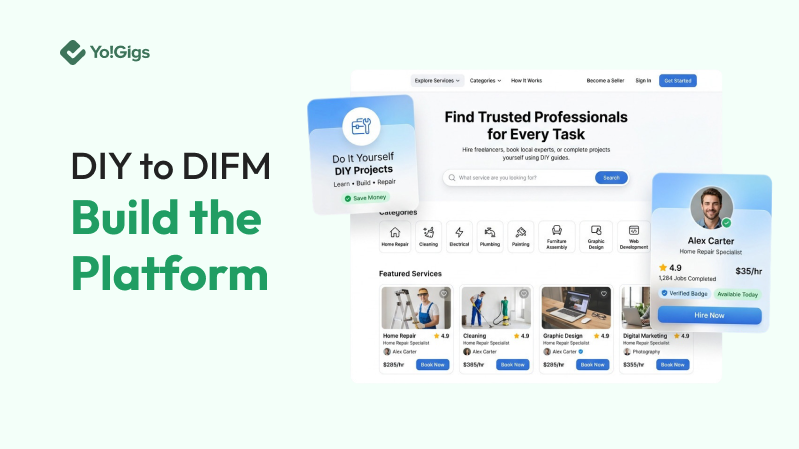
There was a time when finding a plumber meant flipping through a phonebook, calling multiple numbers, waiting for job confirmations, and showing up. Whereas today, the same task takes a few seconds of booking, with multiple searches resulting in higher customer satisfaction. The shift from “Do It For Me” (DIFM) being a luxury to it being an everyday expectation has fundamentally transformed the home services industry. It has created one of the most compelling marketplace opportunities in the digital economy.
The global home services market is projected to reach USD 1.03 trillion by 2029, growing at a CAGR of over 10.5%. Platforms like TaskRabbit, Thumbtack, Handy, and Angi have already demonstrated that consumers are willing to pay a premium for the convenience of vetted, on-demand home service professionals. What has changed in 2026 is that the barrier to building your own home service business has dropped dramatically. For home service business owners, regional service operators, and entrepreneurs who see this lucrative industry opportunity.
The business question is no longer whether to build a marketplace, but it is especially about reducing the time to market, doing it quickly, affordably, and in a way that positions you for long-term growth. This guide explains the shift from DIY to DIFM, why marketplace software is the infrastructure that powers it, and how to choose the right home service business software.
Table of Contents
The Transformation of DIY to DIFM and Why Does It Matter?
For decades, home maintenance was largely a DIY culture, driven by cost consciousness, self-sufficiency, lack of available services, and the assumption that professional help was either hard to find or overpriced. Internet and YouTube tutorials on home improvement assisted homeowners in completing the tasks and reinforced this behavior for a generation.
In the contemporary era, that culture is shifting fast, and several forces are accelerating the transition.
1. Time Constraint
Dual-income households, longer commutes, and the expansion of remote work have all compressed discretionary time. With increasing constraints in personal time, in a dual-income family, paying a professional to handle home services such as a leaking tap or mount a TV becomes a rational economic decision.
2. Vetted Professionals to Build Trust
An early resistance was hiring strangers for home services, which has now significantly reduced because platforms now provide what consumers need to trust the transaction. It consists of verified credentials, background checks, photo portfolios, review systems, and secure payment. The friction that once made the DIFM model feel risky has been systematically removed.
3. Online Booking is Normalized
Consumers now expect to find, book, and pay for home services online through home service business marketplaces and experience home services like on-demand food delivery and ride-sharing services. A service professional or home service business without an online presence or a bookable profile is increasingly invisible.
4. Built-in Marketing for Experienced Service Providers
Skilled tradespeople and independent contractors are increasingly aware that marketplace platforms offer access to a reliable customer pipeline that would otherwise require significant marketing investment to build independently. Therefore, being on a home services platform is not just convenient, but it is their primary customer acquisition channel.
This combination creates a structural opportunity, a two-sided marketplace connecting consumers who want professional help with service providers who need customers. The businesses that build and operate these platforms, being the admin they own the transaction layer and sit at the center of an industry growing at nearly 20% annually.
Capitalize on the Home Service Industry & Expand your Business Services!
What is Home Service Marketplace Software?
Home service marketplace software is a pre-built digital platform that connects customers seeking home services with verified service providers, such as plumbers, electricians, cleaners, handymen, carpenters, landscapers, HVAC technicians, tutors, and other categories, under a single branded platform that the operator runs and monetizes.
How Does the Marketplace Work?
A complete home service marketplace platform serves four distinct user types simultaneously.
1. Customers, Homeowners, Clients
The customers browse service categories, view provider profiles, leave reviews, book appointments, make secure payments, track job progress, and rate their experience — all from the online marketplace and a web interface.
2. Service Providers/ Vetted Home Service Professionals
The professionals can create detailed profiles, list their services and availability, receive booking requests, manage their calendar, communicate with customers, and track their earnings through a dedicated dashboard.
3. The platform operator/ Admin
The admin oversees the entire marketplace from onboarding providers, setting commission rates, managing payouts, running promotions, resolving disputes, and monitoring platform-wide data analytics from a centralized admin panel.
The home service marketplace model generates revenue through commission on each booking, subscription fees from service providers for premium listings or featured placement, lead generation fees, and membership plans for customers who book frequently.
These multiple revenue streams from the same underlying transaction are what make the marketplace model financially attractive.
Suggested Read: Top Service Marketplace Software in 2026
Why Home Service Businesses Need Marketplace Software?
Building a home service marketplace from scratch requires months of development, a significant engineering team, and a six-figure big budget before a single booking is made. The readymade home service marketplace software is purpose-built for this vertical, it compresses the timeline and cost dramatically, while delivering functionality that custom development would take years to replicate.
Here is why the right marketplace software is not just a shortcut, but a strategic decision that builds a foundation.
1. Speed to Market
The first platform in a local market to reach critical mass on both sides, by enrolling enough service providers to serve customers, enough customers to retain providers, which assists in winning a structural advantage. A turnkey home service business marketplace software can be deployed in days rather than months, allowing operators to move before competitors and establish their position.
2. Two-sided Marketplace Dynamics
The launched marketplace assists in easy management of simultaneous onboarding of service providers and customers, handling booking flows, payment escrow, dispute resolution, and review management. This operational convenience requires an infrastructure that has been purpose-designed for marketplace mechanics and is not a generic e-commerce or scheduling software.
3. Commission and Revenue Management
A home service marketplace software includes built-in commission management, payout processing, and subscription monetization, which offers the increased ROI of a marketplace business. Getting this right from day one avoids costly retrofits as transaction volumes grow.
4. Trust and Verification Infrastructure
Verified profiles, review systems, provider background check integrations, and secure payment handling are what convert browsers into first-time customers and first-time customers into regulars. These features are table stakes, and building them from scratch or custom is expensive and time-consuming.
5. Scalability
A home service marketplace that handles 50 bookings per day needs very different infrastructure from one handling 5,000. The right platform scales with your growth rather than requiring a rebuild every time you reach a new threshold.
To cater to all you home service marketplace requirements, here is a software that is purpose-built to accomodaes multiple indusies and can launch your robust marketplace without breaking your bank.
Yo!Gigs: The Best Home Service Marketplace Software in 2026
Among the marketplace platforms available to home service entrepreneurs in 2026, Yo!Gigs by FATbit Technologies stands consistently at the top — and the reasons are listed below.
What is Yo!Gigs?
Yo!Gigs is a ready made, white-label, self-hosted home service marketplace software built specifically to power TaskRabbit and Thumbtack-style platforms. It is not a generic or repurposed e-commerce software, but it is a purpose-built marketplace solution developed after extensive R&D, integrated with industry-specific features, based on how home service and freelance marketplaces actually operate.
The platform powers marketplaces across a wide range of service verticals such as home cleaning, plumbing, carpentry, HVAC, electrical work, tutoring, pet care, IT support, beauty services, automotive repair, and more, all to be accommodated on the same underlying scalable and versatile architecture.
Key Features that Add Value to Your Home Service Business
1. Real-time Booking Calendar and Scheduling: Service seekers can view provider availability in real time and book directly, creating a smooth, professional booking experience that reduces back-and-forth communication.
2. Online Bidding System: For project-based work, customers can post jobs and receive bids from interested service providers, matching the model used by Thumbtack and Upwork. This adds flexibility for complex or custom jobs where a fixed price is not appropriate.
3. Internal Messaging: Direct communication between customers and service providers within the platform keeps all job-related conversations in one place, improving the experience and reducing disputes.
4. Secure Multi-gateway Payment System: Multiple payment gateways supported out of the box, with escrow payment functionality to protect both parties until job completion is confirmed.
5. Commission and Subscription Revenue Management: Set global or category-specific commission rates on every booking, create subscription packages for service providers, and offer featured listing placements, multiple revenue streams from a single platform.
6. Comprehensive Admin Dashboard: Full visibility across the marketplace: provider management, customer management, booking analytics, revenue tracking, dispute resolution, and promotional campaign management from one centralized panel.
7. Multi-language and Multi-currency Support: Built-in support for international expansion. Operators can configure the platform for different markets without rebuilding.
8. One-time License with Lifetime Ownership: Yo!Gigs operates on a single upfront payment with no recurring software fees. You receive the full source code, deploy on your own servers, and keep 100% of your platform revenue. No vendor lock-in, no monthly subscriptions compounding as you scale.
9. 12 Months of Free Technical Support: Post-launch support is bundled in, covering technical issues and platform guidance as your marketplace gets established.
10. Verification Badges: These badges can be offered after vetting the service professional registering over the marketplace or can be another revenue stream available in exchange for a certain fee.
Get Hands-on Experience of the Powerful Yo!Gigs Features and Functionalities!
Why Yo!Gigs Is the Right Foundation?
For home service entrepreneurs, the combination Yo!Gigs offers is difficult to match elsewhere; it is a well rounded platform that covers every aspect of marketplace operations, from customer experience, provider management, booking logistics, payments, commissions, and analytics, at a one-time cost with full code ownership.
Satisfied Client Case Studies
- Mechanic Bids: A Texas-based automotive service marketplace
- Impact Maker: A Germany-based sustainability consultants marketplace
- Bidsta: An Australian real estate services aggregator
- Uptech.Work: A Florida-based construction industry consultants platform
The diversity of markets and industry verticals covered by these platforms reflects the flexibility of the architecture; it is not locked to a single service category or geography.
The powered deployment is also unusually fast, with Yo!Gigs implementations going live within 3–7 business days after purchase, including setup and initial customization. This allows operators to begin acquiring providers and customers almost immediately, rather than waiting months for a custom build.
Conclusion
The shift from DIY to DIFM is not a trend it is a structural change in how consumers relate to their homes and their time. The platforms that sit in the middle of this shift, connecting service providers with the people who need them, occupy a durable and defensible market position.
Building one of these platforms no longer requires a large engineering team or a multi-year timeline. Marketplace software like Yo!Gigs makes it possible to launch a fully functional, branded, scalable home service marketplace in days — with full ownership of the platform, no recurring software costs, and the infrastructure to grow from a city-level launch to a regional or national marketplace.
The home services market will continue to grow regardless of who builds the next platform. The question is whether your business will be the one capturing it in your market.
FAQs
1. What types of home services can I list on a Yo!Gigs marketplace?
Yo!Gigs supports a broad range of service verticals from a single platform: home cleaning, plumbing, carpentry, HVAC, electrical work, painting, landscaping, pest control, IT support, beauty services, tutoring, automotive repair, pet care, and more. Operators can configure the service categories relevant to their target market and add or remove verticals as the business grows.
2. Do I need a technical team to launch with Yo!Gigs?
No, Yo!Gigs is designed for non-technical operators. FATbit Technologies handles the initial installation and server setup, and the admin panel is built for business operators, not developers. For custom modifications beyond the standard platform, FATbit’s development team can assist, or you can engage your own developers since you receive the full source code.
3. How does the bidding model work on Yo!Gigs?
Yo!Gigs includes an online bidding module where customers can post jobs with a description, budget range, and timeline. Registered service providers can browse posted jobs and submit bids. The customer reviews bids, selects a provider, and completes the booking through the platform. This is ideal for project-based work like renovation, custom carpentry, or consulting, where a fixed catalog price is not appropriate.
4. How does Yo!Gigs generate revenue for the platform operator?
Platform operators can monetize through multiple streams simultaneously: a commission percentage on every booking (configurable globally or per category), subscription and membership plans for service providers who want premium access or featured placement, lead generation fees for connecting providers with high-value customers, and advertising placements within the platform. Having multiple revenue streams from the same transaction infrastructure is one of the key financial advantages of the marketplace model.
5. Is Yo!Gigs suitable for a startup with limited budget?
Yes, it is specifically designed with startup economics in mind. The one-time license model eliminates the recurring subscription costs that SaaS-based competitors charge, which compound significantly as the platform grows. Combined with fast deployment (3–7 days) and included technical support for the first year, Yo!Gigs is one of the most cost-effective paths to a professional, fully functional home service marketplace.
