

In the modern digitalised era, the demand for on demand home service market in the UK has exceeded and is projected to reach a market size of around £540 million by 2030. Furthermore, in contemporary times, running a successful home service business in the UK no longer requires a full roster of employees.
Modern technology and shifting customer preferences have given rise to service marketplaces that connect homeowners on demand with independent professionals in diverse home service categories, such as handymen, cleaners, electricians, etc. Therefore, by launching a UK-focused service marketplace, entrepreneurs can avoid the traditional overhead and staffing complexities of running a brick-and-mortar firm, while still capturing revenue from a booming industry.
This blog unveils information for new business owners to assist them in effective industry capitalisation and navigating the struggles of the conventional home service firms, how the online marketplace model solves these problems, and provides a step-by-step roadmap to build your own handyman marketplace without hiring staff. We’ll also explore top UK niches, common challenges and their solutions, and developmental methods, and approaches that can be chosen by the business owners to overall streamline the process.
Table of Contents
- Why are Traditional Home Service Businesses Going Online?
- The Rise of the Service Marketplace Model
- How Does Online Marketplace Grow Your Home Service Business in the UK?
- Competitive Niches to Launch Your Home Service Business in the UK
- Comprehensive Step-by-Step Guide to Starting Your Business
- Challenges You May Face and How to Solve Them
- Why Ready-Made Marketplace Software is the Smartest Choice?
- Why is Yo!Gigs Ideal for Launching a Handyman Marketplace?
- Final Thoughts
- Frequently Asked Questions
Why are Traditional Home Service Businesses Going Online?
To dissect the traditional model of home services, local businesses hire plumbers, electricians, or handymen on payroll or as subcontractors. These home service business models face several structural challenges, such as geographical restricted marketing, high customer acquisition budget, and the small service firms often rely on word-of-mouth, local flyers, or classifieds, which results in slow growth.
Additionally, coordinating schedules, managing job assignments manually, along with high in-house infrastructural investment, is hard without a systematic platform.
Some specific challenges to the traditional model include,
1. Limited Reach and Lead Generation
Traditional tradespeople or service providers often depend on local advertising or referrals, so their customer base grows slowly. Without a digital presence, attracting new clients beyond the immediate neighborhood is a constant struggle.
2. High Fixed Overheads
Renting space, insuring vehicles, stocking equipment, and paying salaries restrict how lean a new business can start. This business model makes up large monthly bills that can only be covered in slow periods.
3. Scheduling and Coordination Bottlenecks
Managing appointments by phone or email is an error-prone operational challenge. A single admin staffer usually tracks bookings offline, leading to missed calls and double-bookings.
4. Quality and Trust Issues
Today, customers rely on credibility and expect online reviews and transparent pricing. A traditional offline handyman business without a platform has few ways to demonstrate credibility or gather feedback consistently.
5. Scaling Challenges
A traditional business must hire and train more staff to expand and duplicate infrastructure in new locations. This process is slow and expensive, making rapid growth very challenging.
These factors mean many small home service firms struggle to compete with larger companies or newer digital platforms that operate more efficiently. The modern, technology-driven generation of home service businesses requires a fully-functional online marketplace that is built to scale.
The Rise of the Service Marketplace Model
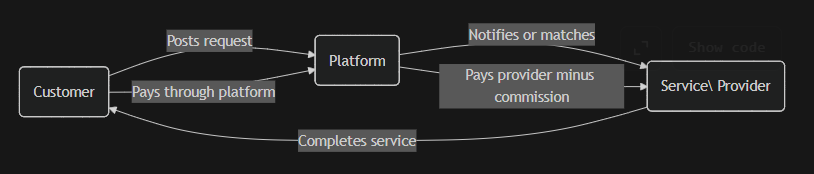
On demand Service marketplaces have emerged as an efficient solution to the home service industry challenges. These are online platforms that connect customers with local service providers in a seamless way. The customers, clients or homeowners can post tasks or browse available services, and local professionals respond or bid on those tasks. The platform offers comprehensive operational convenience, handling the logistics, bookings, payments, ratings, and communication.
Below is a simplified flowchart of how a typical home service marketplace works
How Does Online Marketplace Grow Your Home Service Business in the UK?
In recent years, the on-demand home services market is growing rapidly with major players like TaskRabbit (US), Thumbtack (US), Angi/HomeAdvisor (US), and UK-based platforms like MyBuilder and Rated People. These have proven that online marketplaces win customer trust and scale quickly.
1. On-Demand Convenience
The on demand home services marketplaces let customers find and directly book services instantly via a website, same day or any available date through the calendar booking. It eradicates the need to call multiple providers for quotes or wait days for a callback.
2. Wide Selection & Competitive Pricing
The service marketplace, or the aggregator platform, enables many providers to list their services in one place and these marketplaces give customers options. Users can compare prices, reviews, and availability to pick the best match. This transparency forces providers to maintain high standards and fair pricing.
3. Built-in Trust Systems
The on demand home service marketplaces include rating systems, verified profiles, and background checks to increase the platform credibility. This solves the trust problem for homeowners, since every service provider comes with user reviews and a performance history.
4. Efficient Scheduling and Payments
The integrated booking systems, calendar management, reminders, and secure payment processing mean a smoother end-to-end experience. A home service business enhances the software by allowing the platform to automatically handle confirmations, cancellations, and even tips.
5. Scalability and Flexibility
Marketplaces can easily scale and expand to new areas simply by adding providers in those locations with no need to set up new offices. The platform owner focuses on technology and marketing, while the independent service professionals handle the service delivery.
Homeowners have become comfortable using these websites to schedule everything from cleaning to lawn care and more. Therefore, this business venture is gaining traction in the UK. Even established companies are moving online such as British Gas, which has expanded its digital home services, and many local trades now use social media and websites to reach expanded customers.
Today, consumers expect a few taps on their phone to find a vetted professional at home and that is exactly what service marketplaces provide.
Suggested Read: How to Build an On-Demand Home Service Marketplace in 2026?
Competitive Niches to Launch your Home Service Business in the UK
In the market with industry giants, not all home services have the same market potential. Hence, focusing on niches with high demand and steady revenue can jump-start your marketplace. The UK has unique needs with an aging housing stock, seasonal weather effects, and an aging population all influence what services are most needed.
The table below highlights some top UK niches, their demand level, plus notes and example platforms in those areas:
| Niche | Demand in UK | Country-wise Notes (UK) | Top References |
| Handyman or General Repairs | Very High | Popular for small fixes and odd jobs. Similar high demand globally. | TaskRabbit (US), Airtasker (AU/UK), RatedPeople (UK), Thumbtack (US) |
| Cleaning Services | High | Strong demand in busy cities and rental properties. Robust in Europe & the US too. | Helpling (DE/EU), Handy (US), Housekeep (UK) |
| Plumbing and Heating | High | Essential due to cold weather and boiler needs. Regulated trade (Gas Safe). | British Gas (UK), HomeServe (UK), Plentific (UK) |
| Electrical and Smart Home | High | Growing for electric car chargers, smart devices, and lighting. Globally tech-driven. | TaskRabbit, Angi (US) |
| Gardening and Landscaping | High (Seasonal) | Gardening is very popular. Demand peaks in Spring/Summer; stable in the EU/US. | MyBuilder (UK), TaskRabbit, Angi (US) |
| Painting and Decorating | Medium-High | Regular home refreshes, especially in summer months, are similar abroad. | RatedPeople (UK) |
| Pest Control | Medium | Rodent and insect control is needed annually. Essential in cities. | Rentokil (UK), Terminix (US), Local Heroes (UK) |
| Elderly Care or Home Assistance | Medium | Aging population drives demand for non-medical support such as cleaning and errands. | Care.com (US/UK), Senior Helpers (US), Local Care Agencies (UK) |
This table is a guide, not an exhaustive list. The point is to pick one or two niches to start. For example, general handyman services or cleaning often make good launch categories because of their consistent demand. As you grow, you can expand into related categories. Always consider local UK market requirements and factors, such as plumbing and heating issues surging in winter, and garden work surging in summer.
Launch Your Competitive Niche-based Home Service Marketplace Today!
Comprehensive Step-by-Step Guide to Starting Your Business
If you are a new or existing business owner looking to launch a handyman or home services marketplace, it involves several research and development-based steps. This section presents the sequential roadmap to launch your competitive and highly profitable business, covering market research, planning, and launch.
1. Market Research
Begin by understanding the UK market and deciding your business model, aggregate marketplace or choosing a competitive niche. A business can take assistance by conducting surveys of potential customers and talking to independent tradespeople and learning their needs and pain points.
Further, conduct in-depth research of the competitors. For example, see how Checkatrade, Rated People, or local Facebook groups operate. Determine the average charges for common services in your region and identify any regulatory requirements, such as certain trades requiring certification or insurance in the UK.
Next, a business can also leverage surveys or online tools, such as Google Trends and forums, to gauge interest in specific services. The goal is to validate that there is sufficient demand and to find industry gaps in existing offerings to curate your USP (Uniques Selling Point)
2. Define Your Business and Revenue Model
The next important step is to decide how your marketplace will generate revenue. Common models include,
- Commission Fees: This is collected by the home service marketplace owner on every transaction as a platform fee. It is a percentage of 10–20%, of each completed job.
- Subscription fees: The service providers and seekers can avail add-on services, such as premium listing or leads in exchange of a monthly or yearly fee.
- Lead fees : Also known as the pay per lead model, this operates with the service providers paying an agreed fee per lead generated.
- Featured Listing: The featured listing earns income for the business owners by enabling them to charge a fee for displaying the job posting, or highlighting the service providers profile on the landing page and increasing their hiring chances.
- Thirds-party Ads: The third party advertisement enables the business owners to display the advertisements for related third-party on their webpages.
- Hybrid Revenue Model: An ambitious business owner can also integrate their home service business model with all sustainable revenue models.
To illustrate, a business can let providers list for free but charge a commission on each booking with regards to the UK pricing norms and how competitors charge. Also, clarify your policies, as planning your revenue streams is crucial for marketplace profitability.
- Will you offer fixed-price quotes or hourly rates?
- Will customers pay per job or via packages?
- Choose Essential Platform Features
When planning to launch your home service business in India it is essential to curate and list the must-have features for your marketplace needs. Before launching your on-demand service marketplace, analyse the required features for all stakeholders of the marketplace.
The listed are non-negotiable feature-lists for your home service business and are fundamental to most service marketplaces.
- Verified User Registration: Customers or homeowners post jobs, and review providers after the job completion. The marketplace must handle payment securely for service providers, for listing services, set availability, and manage bookings.
- Service listings and search: This feature allows providers to create detailed profiles, with portfolio, pricing, and specialties. The customers can search or filter services by location, service type, and rating.
- Booking and Scheduling system: Built-in booking calendars or time-slot booking to manage appointments. Moreover, automatic email/SMS confirmations and reminders help reduce no-shows.
- Messaging and Notifications: Find a software with an internal-app chat or messaging system so customers and providers can communicate securely.
- Payment Processing: Integrate a secure payment gateway, such as Stripe, PayPal, to handle customer payments. You may hold payments in escrow and release them after job completion to protect both sides.
- Ratings and Reviews: After each job, allow customers to rate and review providers. This builds trust and quality control on your platform.
- Admin Dashboard: A backend admin panel for you to manage users, approve new providers, handle disputes, adjust settings, and view reports for revenue, usage stats, etc.
- Choose the Aligning Development Approach
Decide how you will build the platform. You have two main choices:
- Custom Development: This method requires a business to hire dedicated developers, in-house or agency, to build your marketplace from scratch or on a framework. This can be fully customized but requires a large budget, detailed specifications, and often many months of development.
- Ready-Made Software: This is a crowd-acclaimed developmental method of a self-hosted readymade marketplace solution, like Yo!Gigs. The ready-made solutions allow businesses to leverage pre-built industry-specific features to launch their home service business in no time and in a cost-effective manner. You’ll mainly configure and brand the platform. This route dramatically reduces development time and technical risk. For most first-time entrepreneurs, starting with a proven software solution is far quicker and more cost-effective.
If a business chooses a custom development method, it will take a larger time investment that involves planning sprints, wireframes, user testing, and ongoing maintenance. If you choose ready-made, make sure to evaluate providers on flexibility, support, and how well they fit home services and align with your business idea.
Looking for a Fully-Customisable Readymade Solution for your Marketplace?
5. Configure Your Website
After you have decided upon the developmental approach, the next step before launch is to design and configure the home service business according to your business branding requirements. The key steps include the following.
- Development: Configure the software with a branding, color scheme, fonts, personalise the landing page, about us, T&C and more in the readymade Minimum Viable Product (MVP) solution that has core features.
- Testing: Before going live, test all functionality – signups, search, booking flow, payments, etc. Use beta testers or a small group of providers/customers to get feedback and catch bugs.
- Content and Onboarding: Prepare all necessary content, about pages, FAQs, and pricing info. Set up legal pages, such as terms of service, privacy policy, in the UK, make sure you are GDPR-compliant for user data. Also, decide on policies, refunds, and cancellation fees to ensure they are effectively implemented on the platform.
6. Launch and Promotion Checklist
The last essential step to launch your success-oriented home service business is to effectively market your marketplace. Handle the following tasks before and during the launch of your marketplace.
- Set up your business legally by registering your company in the UK, getting any necessary insurance. Further, also ensure you comply with local regulations for marketplaces.
- Secure your domain name, hosting/server and SSL certificate. Configure your payment gateway and test transactions.
- Onboard initial providers by reaching out to skilled tradespeople in your target area with promotional offers to join and set up their profiles early.
- Prepare a result oriented marketing plan, create a website or landing page, social media presence, and content marketing to attract customers. Consider local online ads or partnerships, such as home improvement blogs or local housing forums.
- Launch your MVP in one city or region and encourage users to review and tweak the platform based on early feedback.
- Lastly, continuously track key metrics such as user sign-ups, completed jobs, revenue, and iterate on the product.
Challenges You May Face and How to Solve Them
Starting any new platform comes with its own set of challenges. This section brings forth some common issues in the home services marketplace space and how investing in a good marketplace solution can help overcome them.
Challenge 01
Attracting Quality Service Providers: It can be hard to convince skilled tradespeople to register on your home service platform.
Solution: Use marketplace software with easy onboarding flows and verification. For example, require document uploads during signup and display badges on profiles for “verified” providers. Give providers clear incentives like free listings, visibility boosts, or a strong brand image. Good software often has tools to import or bulk-add providers and send automated email invites to sign up.
Challenge 02
Filling Demand and Gaining Users: A marketplace is a two-sided business; customers won’t come without service providers, and providers won’t join without jobs.
Solution: A platform can include promotional tools to help bridge this gap. For instance, built-in referral and promotional coupon features can incentivize early sign-ups on both sides. You might start with a hard launch in a limited area, or offer discounts for first customers. Use SEO-friendly listing pages so local customers find you seamlessly on Google. Many marketplaces solve this with pre-launch marketing and by targeting one side first, often providers.
Challenge 03
Scheduling Conflicts and Cancellations: Home services often require hands-on calendar booking, direct invitation, and precise timing, as last-minute changes or cancellations can cause frustration.
Solution: Use software with advanced scheduling and notification systems. For example, allow providers to share real-time availability and offer calendar syncing. Automatic reminders and easy rescheduling tools can minimize no-shows. Some platforms offer built-in cancellation windows or reimbursement fees to protect providers. Having these rules encoded in the software saves admin headaches.
Challenge 04
Handling Payments and Disputes: Charging customers and paying providers safely can be complex, especially with refunds, cancellations, or partial payments.
Solution: Integrate secure payment gateways that most marketplace software supports, such as Stripe and PayPal, and use escrow or delayed-payout features. The software can hold funds until a job is confirmed complete. If issues arise, the admin dashboard usually has tools to issue refunds or adjustments. The platform automates receipts and commission calculations, reducing accounting errors.
Challenge 05
Maintaining Quality and Trust: New platforms can suffer if a few providers give poor service or if disputes go public.
Solution: Leverage built-in ratings, reviews, and feedback mechanisms. Encourage customers to leave reviews, and let high-rated providers earn top placement. Many marketplace systems also allow the admin to deactivate or ban providers who violate standards. In short, software helps create a transparent reputation system that promotes quality.
Challenge 06
Technical Maintenance and Scaling: Another challenge followed after building your own system is running it smoothly as the traffic grows.
Solution: A mature marketplace platform comes with technical support and scalable infrastructure. Find a self-hosted solution on cloud servers that can handle sudden traffic spikes. If you had built a custom system, you’d need to plan for load balancing and hiring developers for every update, a readymade self-hosted home service marketplace package handles that for you, often with support included.
Each of these solutions relies on using robust marketplace software. By choosing a platform built for service marketplaces, you offload much of the complexity to the software itself, allowing you to focus on growing the business rather than firefighting problems.
Upscale your Home Service Marketplace with a Market-Tested Readymade Solution!
Why Ready-Made Marketplace Software is the Smartest Choice?
Given the challenges above, using a ready-made service marketplace solution is often the fastest and most cost-effective route. Listed are the reasons to choose a robust and powerful ready made solution
1. Speed to Market
You can deploy a fully functional marketplace in days or weeks instead of spending months or years on custom development. This lets you start capturing users and revenue much faster.
2. Cost Saving
Custom development is an expensive investment. Therefore, building a robust, bug-free marketplace from scratch can cost the equivalent of tens of thousands of pounds in developer time. By contrast, purchasing or licensing existing software is usually a one-time cost that’s far more cost effective. You avoid endless invoices for coding changes.
3. Proven Feature Set
Ready-made platforms come with all essential features already built and tested; these features are booking systems, messaging, payments, admin dashboards, etc. You don’t have to reinvent or start developing the features or crucial functionalities from scratch as they are ready out of the box. Updates and improvements are also handled by the software provider.
4. Reliability and Security
Established marketplace solutions have been refined over multiple client deployments. They’ve addressed common security issues like secure payment processing as well as scalability concerns. This means fewer technical risks during launch and growth.
5. Focus on Growth
With the technology handled, a business owner can concentrate on marketing, customer support, and expanding the network of providers. You won’t waste time or money hiring developers to fix bugs or add core features.
6. Support and Documentation
Good marketplace packages come with customer support, comprehensive documentation, and user guides. If you encounter an issue, you have a reliable team to help rather than relying on scarce internal resources.
7. High Flexibility
Many modern platforms are modular, so you can start with the core features and enable advanced ones later. This means you can scale the complexity of your business model over time.
In summary, a ready-made solution gives you a validated, near-complete product from day one. The alternative custom-building might look appealing for total control, but in practice it often leads to delays, bugs, and hidden costs. Especially for a startup, getting to market quickly with a solid foundation usually outweighs the desire for complete customization.
Why is Yo!Gigs Ideal for Launching a Handyman Marketplace?
When it comes to ready-made solutions, Yo!Gigs is a purpose-built and specialised solution specifically designed for home services and handyman marketplaces. Here’s why it’s a strong choice.
Key Highlights that make Yo!Gigs the Best Home Services Software
1. Tailored for Home & Handyman Services
Yo!Gigs includes features made for tasks like repairs, cleaning, and maintenance. It supports multiple job types, such as one-off tasks, fixed-price projects, hourly jobs, etc., and even lets you create custom and multi-tiered service categories that fit trades. You can invite providers directly to jobs or have them bid competitively, just as many leading marketplaces allow.
2. Comprehensive Feature Set
The software comes with both customer-facing and provider-facing dashboards and seamless interfaces. Service providers can manage their profiles, portfolios, schedules, and bids through a dedicated interface. Customers can post jobs, browse available professionals, and chat through an in-built messaging module. The admin dashboard lets you monitor everything – from tracking revenue and payments to managing disputes.
3. Built-In Monetization Tools
Yo!Gigs has a robust commission management feature for the admin. You can set different commission rates for various job types or categories, and the system automatically handles deductions from the total payments. It also supports selling service packages, promotional slots, or listings to providers. Multiple payment gateways, such as Stripe, PayPal, etc., are integrated, making it easy to operate in the UK and even handle international transactions if needed.
4. Easy Provider Onboarding
The software allows you to create custom registration fields, which means you can collect information specific to trades, such as qualifications, certification numbers, and more. You can then verify and approve providers before they appear on the marketplace. This streamlines building a trusted network of professionals, since you can require documentation up front.
5. No Coding Required
Yo!Gigs is marketed as a no-code solution, meaning you don’t need to hire developers to get started. It can be deployed on your server within days. You get one year of free technical support, ensuring any setup issues are resolved. Since it is a white-label, self-hosted solution, you have full control over branding and data, with no monthly fees forcing you into unwanted subscription plans.
6. Proven Track Record
The software supports marketplaces similar to TaskRabbit, Thumbtack, Airtasker, etc., so it has features proven in the field. Companies like Impact Maker (Germany) and other global pioneer service businesses have used Yo!Gigs for niche marketplaces demonstrate their flexibility and reliability.
Overall, Yo!Gigs offers a ready-to-run toolkit for a handyman marketplace. It eliminates the heavy lifting of software development so you can concentrate on attracting customers and providers. With its complete suite of features from advanced job postings to analytics and multi-channel support, it covers the essentials needed to launch and grow in the UK market. For an entrepreneur eyeing the home services industry, this can be an ideal foundation.
Get Hands-On Experience of the Veteran Home Service Marketplace Software!
Final Thoughts
Launching a home services marketplace in the UK without a traditional staff-based team is not only viable, but also aligns with today’s digital economy. By leveraging a two-sided marketplace model, you turn your business into a platform that connects supply and demand efficiently. This lets you tap into the multi-billion-pound UK home services market with minimal overhead cost.
Using a ready-made marketplace solution, especially one tailored for handyman and home services like Yo!Gigs, dramatically accelerate the process and reduce risk. It provides all the technical infrastructure so business owners can focus on strategy and growth. With careful planning, a focus on quality, and the right tools, you can create a thriving home service marketplace that meets the UK’s growing demand for convenient, on-demand home help.
Frequently Asked Questions
Q 1. Do I need to hire staff, or can I rely entirely on independent contractors?
Ans. No, you don’t have to hire staff to run your home service business in the UK. Instead, you recruit independent contractors or service companies to join the platform. You don’t have payroll costs or most employer obligations, and providers have the flexibility to set their own schedules.
Just ensure your providers have the necessary licenses and insurance (for example, certified electricians must follow UK regulations). Your home service marketplace acts as the intermediary connecting clients and contractors.
Q 2. How can I attract both service providers and customers to my marketplace?
Ans. Attracting both sides is a classic chicken-and-egg problem, but you can use several strategies.
- Start by signing up a solid roster of providers first, offer free early listings or featured spots to skilled tradespeople to populate the platform.
- Use targeted marketing, online ads, social media, and local SEO to reach homeowners.
- Businesses can run promotions or discounts for first-time users.
- Referral programs can help give both customers and providers incentives to invite others.
- Partnering with local trade schools, community groups, or home improvement stores can also generate early interest.
Remember, building trust is key; therefore, encourage initial users to leave reviews and testimonials so newcomers see the platform’s value.
Q 3. What are effective ways to monetize a service marketplace?
Ans. There are several revenue models you can use, often in combination. The most common are,
- Commission-based, where you take a percentage cut from every completed job
- Charge subscription fees to providers for premium placement or extra leads.
- Sell promoted listings or advertising space.
- Another approach is to charge customers a service fee or booking fee on top of the provider’s price.
To summarise, in the UK context, commission is popular since providers like it pay only when they earn. Whatever you choose, make sure it’s clearly communicated and competitive. Yo!Gigs, for instance, come with built-in commission management, making it easy to implement these strategies.
Q 4. Are there any UK-specific legal or regulatory issues I should be aware of?
Ans. As the platform owner, you generally act as a technology intermediary, but you still need to comply with UK business laws.
- Register your business appropriately (Ltd, LLC, etc.) and ensure you have GDPR-compliant data handling (for user personal data).
- Provide clear Terms of Service and Privacy Policies.
- Encourage or require providers to have their own insurance for example. public liability insurance, and professional indemnity if required.
- If you’re in the UK, be mindful of the IR35 rules and employment status, though typically, marketplace providers are treated as self-employed.
- Check local regulations for specific trades, for example, Gas Safe registration is mandatory for any gas or boiler work.
Your chosen software, such as Yo!Gigs can help by allowing providers to upload certification documents before they start taking jobs.
Q 5. How quickly can I launch my platform using a solution like Yo!Gigs?
Ans. Launch speed depends on preparation, but with a ready-made platform you can move very fast. In many cases, the software itself can be installed and configured in a matter of days. You would then spend time customizing, branding, adding categories, pricing, and setting up payment systems.
With a dedicated launch team, it’s realistic to have a functional marketplace within 1-3 months. This is far quicker than building from scratch, which could take half a year or more. The Yo!Gigs package even advertises deployment within 1-2 days technically, though you’ll still want to thoroughly test everything before going live.
Q 6. How do I ensure the quality of services on my platform?
Ans. Quality control comes from the integrated business workflow, process, and design.
- First, vet your providers during onboarding: collect references, certifications, or conduct brief interviews if possible.
- Next, use the platform’s rating and review system diligently, encourage customers to rate every job, and make those ratings visible.
- High-rated providers can be featured or given more leads, while consistently low performers can be counseled or removed.
- The marketplace itself incentivizes quality because providers know their reputation directly affects future jobs.
Having clear policies for disputes or refunds also reassures customers. Over time, you’ll cultivate a reputation-based community, where both customers and professionals trust the platform to weed out subpar service.
