
Micro job marketplaces continue to attract entrepreneurs because they simplify the exchange of short-term digital services between buyers and freelancers. This blog outlines the planning, development, monetization, and feature requirements involved in creating a successful micro job platform. It also explains how Yo!Gigs accelerates marketplace development through a ready-made, white-label solution built specifically for freelance businesses.
In an era where flexibility has become the new form of stability, the gig economy has undergone a massive transformation. As we navigate through 2026, the traditional 9-to-5 model is no longer the sole pillar of professional life. Instead, a fast-moving micro-economy has emerged, a space where high-value and specialized tasks are traded in seconds across global borders.
If you are an entrepreneur ready to enter this space and want to build a microjob marketplace, now is the right time. Today’s users are more discerning than ever; they demand instant matching, secure transactions, and platforms designed around specific skills or industries. Whether you aim to create a microjob marketplace for AI prompt engineers or local artisan services, understanding the blueprint for success in this decade is crucial. This blog provides a comprehensive deep dive into how to build a microjob marketplace that can dominate the landscape in 2026.
Table of Contents
- What is a MicroJob Marketplace?
- Top Microjob Marketplaces Shaping the Industry
- Benefits of Building a MicroJob Marketplace
- Revenue Model: How MicroJob Marketplaces Make Money
- How to Build a Successful Marketplace: A Step-by-Step Guide
- Best Development Approach for Building a Microjob Marketplace
- Introducing Yo!Gigs: The Leading Software to Build Your Microjob Marketplace
- Conclusion
- FAQs
What is a MicroJob Marketplace?
At its core, a microjob marketplace is an online ecosystem that facilitates the buying and selling of productized services. These services are short, clearly defined tasks, or gigs, with a fixed scope and transparent pricing. By 2026, this concept will evolve well beyond simple low-cost offerings. Microjobs now represent atomic units of value, focused on speed, precision, and specialized outcomes rather than hourly effort.
A microjob platform differs from a traditional freelance site like the old-school Upwork model in its delivery. While traditional platforms involve complex bidding and long-term contracts, microjob sites prioritize speed. A buyer browses a catalog, selects a service, and initiates the transaction instantly. Today’s microjob often includes AI-assisted data labeling, smart-contract auditing, 3D printing design, or even virtual reality world-building. Moreover, the platform acts as the trusted intermediary, holding funds in escrow and ensuring that the seller’s output meets the buyer’s predefined expectations.
Top Microjob Marketplaces Shaping the Industry
To build a successful microjob marketplace, it is essential to study the platforms that have already earned user trust and market leadership. Several well-established platforms have defined what speed, reliability, and specialization look like in the microjob economy. Let’s have a look at them:
a. Fiverr: The undisputed leader in productized services. Fiverr has embraced AI-First workflows, enabling freelancers to deliver faster results while maintaining high price tiers through programs like Fiverr Pro and Certified Talent.
b. Upwork (Project Catalog): Originally a bidding site, Upwork successfully evolved by introducing a robust project catalog. This shift allows high-end experts to list fixed-price packages, proving that microjobs can scale even in high-value consulting segments.
c. Amazon Mechanical Turk (MTurk): MTurk continues to dominate the Human Intelligence Tasks (HITs). In 2026, it plays a critical role in training and validating complex machine learning models, supplying structured human input that automated systems still cannot replicate.
d. SproutGigs: Formerly known as Microworkers, this platform specializes in small social media tasks and digital marketing microtasks. Its growth highlights how microjob marketplaces thrive within the attention-driven digital economy.
e. TaskRabbit: The pioneer of the physical microjob, TaskRabbit has expanded into advanced high-tech home installations, like EV charger setups and smart-glass maintenance, proving that microjobs extend well beyond digital-only tasks.
Turn Your Microjob Platform Idea Into Reality
Benefits of Building a MicroJob Marketplace
The decision to build a microjob marketplace is backed by several economic and behavioural shifts in how work is bought and delivered. For entrepreneurs, it offers a flywheel effect: as the variety of gigs increases, more buyers arrive, which in turn attracts even higher-quality sellers and fuels sustainable growth.
1. Scalable Revenue Without Inventory
Unlike traditional eCommerce businesses, a microjob marketplace does not require managing physical inventory. You provide the digital infrastructure while service providers deliver the value. Every time a transaction occurs, you earn a fee. This makes the business model highly scalable with relatively low overhead compared to traditional service firms.
2. Global Reach and Local Impact
A microjob marketplace can facilitate a transaction between a developer in Estonia and a business owner in Brazil. At the same time, the model is perfectly suited for hyper-local niches, such as on-demand drone photography for real estate, where local expertise is sold in standardized units.
3. Resilience to Economic Shifts
In uncertain economic times, businesses tend to shy away from full-time hires and long-term contracts. They prefer the on-demand nature of microjobs. Microjob marketplaces cater directly to this demand, positioning themselves as essential tools for operational agility and cost control.
Revenue Model: How MicroJob Marketplaces Make Money
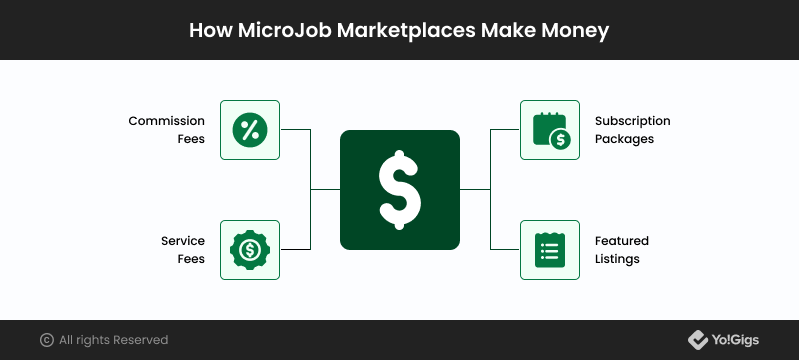
A successful microjob marketplace balances user value with sustainable platform revenue. Monetization strategies have evolved well beyond the traditional commission model, giving founders more diversified ways to generate revenue. Some of the popular revenue models are listed below:
1. Commission Fees
Commission is the core revenue driver for most of the platforms. A percentage is charged on each complete transaction. In 2026, many marketplaces use a tiered commission system, charging 20% on small gigs but reducing it to 10% or 5% as a seller builds a long-term relationship with a specific buyer. This approach encourages long-term engagement and higher transaction volumes.
2. Featured Listings and Seller Ads
Sellers are often willing to pay for visibility. You can offer Premium Placement where sellers pay a daily fee to appear at the top of high-traffic search categories. Charging daily or weekly fees for featured listings creates a high-margin revenue stream while helping top-performing sellers stand out.
3. Subscription Packages
Subscription-based plans add predictable recurring revenue. Introduce Pro or; Business tiers. For a monthly fee, sellers might get lower commission rates, advanced analytics, or a Verified badge. Buyers might pay for a subscription that gives them priority support and access to a curated pool of elite freelancers.
4. Service Fees and Processing Fees
Many platforms include a small fixed fee at the buyer’s checkout, often called a protection fee or service fee. It helps cover operational costs related to escrow management, payment processing, fraud prevention, and dispute resolution, ensuring a secure and reliable transaction environment.
Together, these revenue models create a sustainable monetization framework that grows with your marketplace. When aligned with user expectations and platform capabilities, they support long-term profitability while maintaining trust, fairness, and consistent engagement across the ecosystem. Further, let’s see how you can build a microjob marketplace in 4 easy steps.
How to Build a Successful Marketplace: A Step-by-Step Guide
Building a microjob marketplace is not just a technical exercise. It requires thoughtful planning, clear positioning, and disciplined execution. Moreover, a structured, step-by-step approach significantly improves your chances of long-term success:
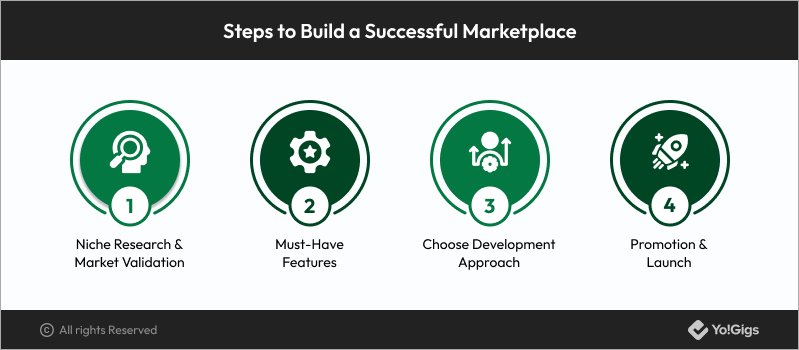
Step 1: Niche Research and Market Validation
To be stable and successful, do not try to be Fiverr for everything from day one. The most successful marketplaces are those that dominate a specific niche. Start by identifying industries that rely on quick, repeatable tasks but lack a dedicated platform. This could include green energy services, telehealth support tasks, or eSports operations. Validate your idea by engaging with communities on Discord or LinkedIn to understand existing pain points and unmet needs.
Step 2: Must-Have Features in Your Microjob Marketplace
A modern microjob marketplace is only as strong as the experience it delivers. To compete with the giants, your platform must include features that remove friction and build trust at every step. It includes:
a. Sophisticated Search & Filter: Advanced search and filtering that help buyers quickly find microjobs based on task type, delivery time, price range, ratings, and skill relevance. The focus is on rapid discovery rather than exploratory browsing.
b. User (Buyer and Seller) Management: Structured user profiles for buyers and sellers that highlight service packages, delivery timelines, ratings, and verification status. This ensures credibility while keeping onboarding friction low.
c. Integrated Escrow System: Secure escrow that holds funds at checkout and releases payment automatically once predefined job conditions are met. This builds trust while enabling high transaction volumes.
d. Microjob and Order Management: Pre-defined job listings with fixed scope, pricing, and delivery terms, combined with real-time order tracking from purchase to completion. This reinforces clarity and eliminates negotiation-heavy workflows.
e. Real-Time Communication Portal: A built-in messaging that supports file sharing and revisions without overcomplicating collaboration. Communication is focused on delivery, not prolonged discussion.
f. Dynamic Review & Rating System: Multi-parameter ratings tailored to microjobs, such as delivery speed, task accuracy, and communication clarity, helping buyers make fast, confident decisions.
g. Seller & Buyer Dashboards: Simplified dashboards that allow sellers to manage active orders, earnings, and gig performance, while buyers can track purchases, deliveries, and order history at a glance.
Build a Feature-Rich Microjob Marketplace
Step 3: The Development Approach (Custom vs. Ready-made)
This is the most critical decision that determines how quickly and efficiently you can enter the market. Primarily, there are two popular approaches:
a. Custom Development: It involves hiring a team to build the platform from the ground up. This offers total flexibility but comes with a staggering price tag and a long timeline. Building a secure microjob marketplace using this approach can cost upwards of $70,000 and take 8-12 months to launch, or even more than that.
b. Ready-made Service Marketplace Software: They act as an accelerator for modern entrepreneurs. These are pre-built platforms designed specifically for the gig economy, enabling you to launch in weeks rather than months. These ready-made solutions not only allow rapid market entry but are also available at a one-time payment, often ranging between $1000 to $10,000. Moreover, solutions like Yo!Gigs comes equipped with the core features, such as secure payments, messaging, and centralized dashboards.
Step 4: Promotion and Launch
The biggest challenge an entrepreneur can face is the Chicken-and-Egg problem. It means you need sellers to attract buyers, and buyers to attract sellers, as one without the other would not stay on the platform. Hence, you should:
a. Seed the Supply: Reach out to talented freelancers and offer them early bird benefits, such as 0% commission for the first year.
b. Content-Led SEO: Create high-quality articles around your targeted keywords to drive organic traffic.
c. Partnerships: If you are in a niche like legal micro-tasks, partner with law schools or legal associations to bring in credible sellers immediately.
Best Development Approach for Building a Microjob Marketplace
When planning to build a microjob marketplace in 2026, the approach you choose determines how quickly and effectively you enter the market. In a space defined by speed and competition, time-to-market is a critical advantage. While custom development may appear attractive, it often results in extended timelines, rising costs, and feature complexity that delays launch.
In contrast, specialized ready-made marketplace software is designed specifically around microjob workflows. It allows you to launch faster, validate your idea sooner, and focus your efforts on seller onboarding, demand generation, and community building, the activities that directly drive marketplace growth.
The table below compares both approaches across essential criteria to help you determine the best fit for your marketplace goals:
| Aspect | Custom Development | Ready-Made Software |
| Initial Investment | $50,000 – $150,000+ | $1,000 – $10,000 |
| Time to Launch | 6 to 12 Months | 2 to 4 Weeks |
| Risk Factor | High (Technical debt) | Low (Proven framework) |
| Maintenance | Requires a dedicated development team | Usually handled via updates |
In a fast-moving gig economy, launching early and iterating based on real user feedback often matters far more than building everything from the ground up. Ready-made solutions provide a stable foundation, allowing you to validate your idea quickly and scale with confidence.
Introducing Yo!Gigs: The Leading Software to Build Your Microjob Marketplace
When it comes to high-performance service marketplace software, Yo!Gigs stands out as a reliable choice for entrepreneurs who want speed, control, and long-term scalability in 2026. Developed by FATbit Technologies, it is a white-label solution designed specifically to help businesses create a gig marketplace that is both robust and scalable.
Rather than forcing founders to adapt their business model to the software, Yo!Gigs is engineered to adapt to the marketplace. It supports diverse service categories, flexible pricing models, and growth-ready workflows from day one, making it suitable for startups as well as enterprises planning regional or global expansion.
What Makes Yo!Gigs Different?
Unlike many SaaS solutions that trap you in a cycle of monthly fees, Yo!Gigs offers a one-time license model. This means you own the platform outright and retain more of your revenue as your marketplace scales. Beyond ownership, Yo!Gigs is purpose-built for the operational realities of running a high-volume microjob marketplace and offers several advantages:
a. Powerful Admin Control: Yo!Gigs provides a centralized admin dashboard with complete visibility into users, transactions, commissions, disputes, and platform activity. This level of oversight helps marketplace owners enforce quality standards, resolve issues efficiently, and maintain trust across the ecosystem.
b. Built for Real Marketplace Operations: From escrow-based payments and milestone handling to messaging, reviews, and dispute management, Yo!Gigs covers the operational realities of running a service marketplace. Instead of assembling features piece by piece, you launch with a framework that has already been tested in real-world marketplace scenarios.
c. Built-in Marketing Suite: The solution includes built-in marketing and growth tools such as SEO-friendly URLs, promotional campaigns, coupon management, and referral-ready workflows. These features allow you to start acquiring sellers and buyers immediately, without relying heavily on third-party plugins.
d. Visibility Controls With Badges and Sponsored Listings: The solution supports both free and paid seller badges, subject to admin approval, allowing marketplace owners to control quality and monetization. Badges can be configured to take priority over sponsored listings, giving high-performing sellers enhanced visibility while preserving platform integrity.
e. Strong Security and Payment Compliance: Integrated with multiple secure payment gateways, Yo!Gigs handles escrow management, payouts, and financial transactions reliably, supporting cross-border microjob payments and buyer protection.
f. Customization Without Complexity: With full customizable source code ownership, Yo!Gigs can be customized to support niche workflows, regional regulations, or unique monetization strategies. This enables differentiation while still benefiting from a stable, pre-built foundation.
g. Flexible Service Models and Pricing Structures: Yo!Gigs supports multiple service formats, including fixed-price gigs, hourly services, milestone-based projects, and custom offers. This flexibility allows you to cater to different buyer expectations and seller skill levels without redesigning the platform as your marketplace evolves.
h. Portfolio Showcase for Freelancers: Freelancers can upload work samples or link to external portfolios, helping buyers quickly assess capability and make faster purchase decisions, a critical factor in microjob conversions.
i. Category Detail Page: Each category detail page highlights top-performing freelancers beneath the category description. This improves buyer confidence, increases seller motivation, and encourages quality-driven competition within microjob niches.
Discover How Yo!Gigs Simplifies Building and Scaling a Microjob Marketplace
Conclusion
The opportunity to build a successful microjob marketplace in 2026 is unprecedented. As businesses move toward decentralized operations and the demand for fast, task-based services continues to rise, the need for focused, more specialized, high-trust platforms is increasingly clear.
By focusing on a specific niche, delivering the features modern users expect, and utilizing a powerful, cost-effective foundation like Yo!Gigs, you can launch a profitable enterprise that is capable of competing with established leaders.
FAQs
Q 1. Should I build a custom platform or use ready-made software?
Ans. For most startups, using ready-made software like Yo!Gigs is the more practical choice. It significantly reduces your time-to-market from months to weeks and saves tens of thousands in development costs. This approach allows you to reallocate your limited capital and focus on marketing, seller onboarding, and growth rather than managing complex technical builds.
Q 2. What is the most scalable monetization model for a startup?
Ans. Beyond commissions, entrepreneurs can combine multiple revenue streams, such as featured listings, pro-subscriptions, promoted gigs, and more. Charging sellers for better visibility or advanced tools like AI analytics creates a secondary, high-margin revenue stream. This allows you to keep transaction fees lower and more competitive for new users.
Q 3. How much does it cost to build a microjob marketplace like Fiverr?
The cost to build a microjob marketplace like Fiverr depends on the development approach you select. A fully custom-built microjob marketplace can cost anywhere between $50,000 and $150,000 or more, depending on features and security requirements. Whereas, ready-made marketplace software solutions typically require a much lower investment, often between $1,000 and $10,000, enabling faster and more cost-efficient market entry.
