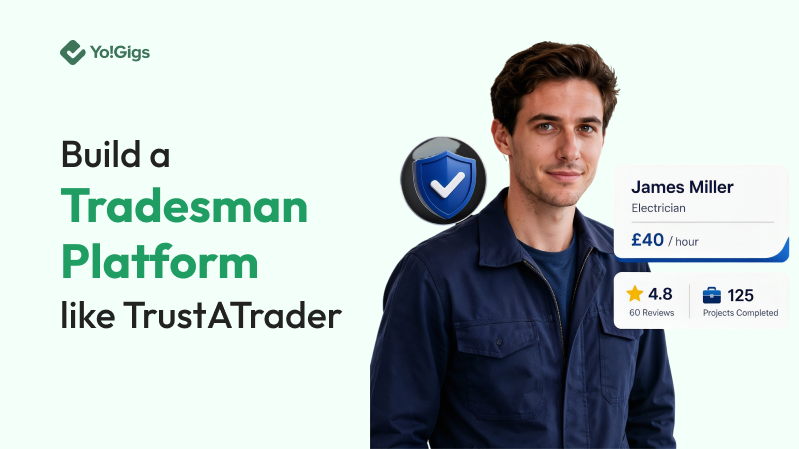
The UK home services market is undergoing a significant digital transformation. With the online home services segment growing rapidly, homeowners now expect to search, compare, and book skilled tradespeople through a seamless digital experience. They want instant access to verified professionals, transparent reviews, and convenient online booking without relying on phone calls or uncertain word-of-mouth referrals. Platforms like TrustATrader, Checkatrade, and Rated People have built thriving businesses by addressing these evolving expectations.
Despite their strong market presence, there is still ample room for new entrants. Many established platforms were built in a different era, before mobile-first behaviour, before on-demand booking, and before consumers expected real-time availability and instant communication. This widening gap between evolving customer expectations and legacy platforms presents a valuable opportunity for entrepreneurs to launch a modern, niche-focused marketplace that stands out in the competitive landscape.
This guide walks you through everything required to build a successful tradesman booking platform in the UK, from understanding the market to choosing the right technology, acquiring your first tradespeople, and scaling sustainably.
Table of Contents
What is TrustATrader?
TrustATrader is one of the UK’s leading online directories and booking platforms for connecting homeowners with trusted local tradespeople. It helps users find verified professionals across a wide range of home service categories, including:
- Plumbing and heating
- Electrical services
- Roofing and building
- Landscaping and gardening
- Painting and decorating
- Carpentry and joinery
- Cleaning services
- Home renovation and maintenance
The platform serves customers across every major UK city, including London, Manchester, Birmingham, Leeds, Bristol, Glasgow, Sheffield, Nottingham, Liverpool, and Edinburgh, making it one of the most geographically broad directories in the country.
Its foundation is built on a simple but powerful idea: trust through transparency. Every trade person goes through a structured verification process before joining the platform, while homeowners can make informed hiring decisions using authentic customer reviews and ratings. This strong emphasis on quality, credibility, and accountability has helped TrustATrader establish itself as a trusted name in the industry. For an entrepreneur looking to build a similar platform, delivering the same level of trust while enhancing the user experience with modern features is essential for long-term success.
Why is the UK Tradesman Market Ready for New Platforms?
Over the past two decades, platforms like TrustATrader have established themselves as trusted names in the UK home service industry. However, customer expectations have evolved significantly. Today’s homeowners expect mobile-first experiences, real-time availability, and seamless online booking. Many traditional directory-based platforms struggle to deliver these experiences, creating an opportunity for entrepreneurs to introduce faster, more customer-centric marketplace solutions.
Several market trends highlight why now is an ideal time to launch a tradesman booking platform:
- Convenience is now a baseline expectation: Homeowners want to find, compare, and book trusted tradespeople through a single digital journey, without relying on phone calls or waiting days for a response.
- Increased home improvement spending, driven by rising property ownership and renovation activity, continues to push demand for skilled tradespeople across every region of the UK.
- Trust remains the primary barrier: Consumers are increasingly cautious about hiring professionals through unverified sources. A marketplace that makes its vetting process clear and verifiable has a significant competitive advantage and builds lasting customer confidence.
- Mobile-first behaviour dominates: The majority of local service searches now happen on smartphones. A fast, intuitive, and mobile-optimized marketplace can outperform legacy platforms that were designed primarily for desktop users.
- Tradespeople want better lead pipelines: Independent professionals and small firms are actively looking for affordable, predictable ways to acquire customers without relying on expensive, uncertain advertising spend.
- Specialist and regional verticals are underserved: High-growth services such as EV charger installation, solar panel fitting, smart home solutions, and heritage building work receive far less digital coverage than mainstream categories. Focusing on these segments can help new marketplaces establish a strong market position.
A well-executed platform targeting even one underserved trade category or geographic area can carve out a genuinely defensible position in this market.
Capitalize on the UK’s Growing Home Services Market
Step-by-Step Guide to Build a Tradesman Booking Platform
Building a tradesman marketplace is more than a technology project. It is an operational, commercial, and trust-building exercise. Whether you are a solo founder bootstrapping your first marketplace or an operator with investment to deploy, the steps below provide a practical blueprint and will help you avoid the common and costly mistakes.
Step 1: Choose Your Niche and Business Model
One of the most common mistakes new marketplace founders make is trying to serve every trade and every location from the outset. While platforms like TrustATrader now cover a broad range of services, they achieved that scale over many years. A more effective strategy is to begin with a focused niche, establish market leadership, and expand gradually.
You can narrow your marketplace by:
- Trade category: for example, only plumbers, only electricians, only roofers, or other specialized professionals.
- Geographic location: Target a city or region such as Greater London, the Midlands, or North West England.
- Customer Segment: Focus on landlords, letting agencies, commercial property managers, or homeowners.
- Specialist service: Cater to growing markets such as EV charger installation, solar panel fitting, heritage building work, or smart home services.
Alongside niche selection, choosing the right business model is equally important. The most common models in UK trade marketplaces are:
- Lead generation: Charge tradespeople for each qualified customer inquiry.
- Subscription Model: Offer monthly or annual plans that provide listing access and lead management tools.
- Commission Model: Earn a percentage of every completed booking processed through the platform.
- Hybrid Model: Combine subscription fees with transaction-based commissions for recurring and performance-driven revenue.
Most sustainable UK trade platforms eventually combine a subscription fee for listing access with a commission on bookings completed through the platform. This approach balances predictable revenue with performance-aligned incentives.
Step 2: Define the Core Features Your Platform Needs
A successful tradesman marketplace must deliver an excellent experience for every participant in the ecosystem, including the customer, the tradesperson, and you as the platform operator. Each user group has different needs, and the quality of each experience determines whether your marketplace builds real network effects.
For Customers (Homeowners and Property Managers):
Customers expect a simple, transparent, and convenient booking experience. Essential features include:
- Simple job posting or instant booking flow
- Real-time availability of local tradespeople
- Verified profiles showing ratings, reviews, and proof of qualifications
- In-platform messaging and quote requests
- Secure payment processing
- Booking history and repeat booking capability
For Tradespeople:
Service providers need tools that help them manage their business efficiently while generating more work. Key features include:
- Profile creation with certifications, insurance, and portfolio uploads
- Job lead alerts filtered by location and trade category
- Quote management and scheduling tools
- Payment collection and earnings dashboard
- Review management and response capability
For Marketplace Admin/s:
The admin panel should provide complete visibility and control over marketplace operations. Important capabilities include:
- Tradesperson vetting and approval workflows
- Commission and subscription management
- Dispute resolution tools
- Analytics covering job volumes, revenue, and conversion rates
- Content management for landing pages and SEO
A platform that effectively serves all three user groups creates a stronger marketplace ecosystem, improves user satisfaction, and supports sustainable long-term growth.
Step 3: Decide Between Custom Development and Ready-Made Software
This is the most consequential decision you will make while launching a tradesman booking platform, as it directly determines your timeline, budget, and risk exposure. Generally, entrepreneurs can choose between two primary approaches:
1. Custom Development
Building your platform from scratch gives you complete control over every interaction and workflow. It allows you to design precisely as per your vision. However, it also requires a dedicated development team, typically takes 12 to 18 months or more to build, and can cost anywhere from £150,000 to £500,000 or beyond. For most founders entering the market to validate an idea, this approach often delays time to market and revenue generation considerably.
2. Ready-Made Marketplace Software
Purpose-built service marketplace software allows you to launch a fully functional tradesman booking platform in a fraction of the time and at significantly lower cost. These solutions come pre-built with the core workflows you need, such as job posting, tradesperson profiles, booking management, payment processing, and admin controls, and are designed to be customised for your brand, niche, and market.
| Aspect | Custom Development | Ready-Made Marketplace Software |
|---|---|---|
| Time to Market | 12 to 18+ months | 3 to 4 weeks |
| Development Cost | High upfront investment | Significantly lower initial cost |
| Technical Requirements | Requires a dedicated development team | Minimal technical dependency |
| Feature Availability | All features built from scratch | Core features available |
| Risk and Validation | Higher risk due to delayed launch | Lower risk with early market feedback |
While custom development is best suited for businesses with highly specific requirements and the resources to sustain a long development cycle, most startups and new market entrants opt for ready-made solutions. These solutions offer a faster, more practical route to launch, enabling early traction and iterative growth without heavy upfront investment.
Looking for a Reliable Solution to Build a Tradesman Booking Platform?
Step 4: Handle Tradesperson Vetting and Trust
Trust is what separates a credible marketplace from a directory that anyone can join. TrustATrader built its reputation on a structured verification promise. Your vetting process should serve the same function; it is your brand, not just a compliance requirement.
At a minimum, a UK tradesman platform should verify the following before approving any listing:
- Identity verification: Government-issued photo ID
- Public liability insurance: Valid and up-to-date insurance coverage
- Trade qualifications: Gas Safe registration for gas engineers, NICEIC or NAPIT certification for electricians, and equivalent bodies for other trades
- Business registration: Companies House entry or sole trader documentation
To further strengthen customer trust, consider introducing tiered verification levels, a standard listing tier, and a “fully verified” or “premium” tier. This creates both a revenue opportunity through differentiated pricing and a clear quality signal for customers browsing the platform.
Step 5: Plan Your Launch Strategy
A weak launch strategy can undermine even a well-built platform. If no tradespeople are listed, customers will not use it. One of the biggest challenges for any marketplace is solving the chicken-and-egg problem, attracting enough tradespeople to serve customers while simultaneously generating enough customer demand to keep providers engaged.
Overcoming this cold-start problem requires a deliberate, sequenced approach:
- Supply first: Recruit 20 to 50 quality tradespeople in your target area before marketing to customers. Offer free or discounted listings for an initial period to reduce their risk.
- Hyper-local launch: Start in one city or postcode area, build genuine density there, and then expand. Dominating a small market is far more valuable than thin coverage across a large one.
- Content and SEO from day one: Build location-specific landing pages, “find a plumber in Birmingham,” “electricians in Leeds”, and trade-specific content to drive organic traffic before you spend on paid acquisition.
- Trade association partnerships: Connect with bodies like the Federation of Master Builders, the Electrical Contractors’ Association, or trade-specific organisations to source and validate credible tradespeople efficiently.
- Homeowner acquisition channels: Local Facebook groups, letting agent partnerships, and property management companies are fast and cost-effective demand-side acquisition channels in the early stages.
Simplifying Marketplace Launch with Yo!Gigs
Building a tradesman booking platform from scratch requires a substantial investment of time, money, and technical resources. A fully custom-built solution demands 12 to 18 months of development, a cross-functional engineering team, and significant upfront capital, all before a single booking has been processed or a pound of revenue earned.
For entrepreneurs looking to validate quickly and enter the market without committing to long development cycles, Yo!Gigs provides a production-ready foundation purpose-built for service marketplaces.
Rather than spending months developing core marketplace functionality from the ground up, you can focus on the areas that truly drive marketplace success, attracting quality tradespeople, acquiring customers, strengthening your brand, and scaling operations. By accelerating your launch, you can gather real user feedback, refine your offering, and establish market presence much sooner.
From a capability standpoint, Yo!Gigs comes equipped with the essential features required to launch and grow a modern tradesman booking platform, including:
- Pre-built marketplace workflows: Enable job posting, service bookings, secure payments, and in-platform messaging from day one.
- Customisation flexibility: Personalize branding, trade categories, workflows, and user experiences to suit your specific niche or region without rebuilding from scratch.
- Scalable architecture: Launch your marketplace with a focused market and expand without needing to rebuild the platform as you grow.
- Central admin control panel: Manage users, commissions, disputes, verifications, and analytics from a centralized dashboard.
- Faster time to revenue: Launch your marketplace within weeks rather than months, and begin validating real demand immediately.
By reducing development complexity and upfront costs, Yo!Gigs enables founders to prioritize business growth over software development. As your marketplace evolves, you can continue enhancing the platform based on customer feedback while maintaining the flexibility to scale with your business.
Schedule a Free Demo to Explore Yo!Gigs
Conclusion
Building a tradesman booking platform presents a strong opportunity for entrepreneurs looking to enter the UK’s growing home services market. While established players like trustATrader have built trusted brands over the years, evolving consumer expectations have created space for modern, feature-rich alternatives. Homeowners now expect mobile-first experiences, real-time availability, transparent reviews, and seamless online booking, capabilities that many legacy platforms are still working to deliver.
Rather than competing broadly from the outset, focus on a clearly defined niche, whether it’s a specific trade, geographic region or specialized service. Delivering a superior user experience for a targeted audience helps establish trust, build marketplace liquidity, and create a sustainable competitive advantage.
The right software foundation, a rigorous vetting process, and a patient, supply-first launch strategy give you something genuinely defensible. Whether you are targeting plumbers in London, electricians in Manchester, or building a national network of verified specialists, the market opportunity remains substantial, and the technology to launch quickly and efficiently is readily available.
FAQs
Q 1. Do I need experience in the trades industry to build this kind of platform?
Ans. Not necessarily, many of the most successful marketplace founders come from outside the industries they serve. What matters more is a genuine willingness to understand the needs of both tradespeople and homeowners or property managers. Speaking with potential users before launching the platform helps you build features that solve real problems and create a better marketplace experience.
Q 2. How do I get tradespeople to join a new platform with no customers yet?
Ans. This is the classic cold-start problem, and the proven answer is supply first. Start by recruiting trusted professionals within a specific location or trade category. Offer free or discounted listings initially and highlight benefits such as quality leads, easy bookings, and reliable payment management. A strong supply base attracts customers more effectively.
Q 3. What qualifications should I verify before listing a tradesperson?
Ans. Before listing a tradesperson, at a minimum, you should verify:
- Government-issued photo ID
- Valid public liability insurance
- Trade-specific qualifications relevant to their category
- Gas Safe registration for gas engineers
- NICEIC or NAPIT certification for electricians
For higher-trust listing tiers, add Companies House or sole trader registration and references from verified past customers.
Q 4. How much does it cost to build a tradesman booking platform?
Ans. The cost to build a tradesman booking platform depends on several factors, but mainly on the development approach you select. Custom development typically ranges from £150,000 to £500,000 or more, depending on scope and complexity, and takes 12 to 18 months to deliver. Ready-made marketplace software, on the other hand, significantly reduces both the financial investment and the time to launch, making it a far more practical starting point for most new entrants.
Q 5. How do tradesman booking platforms generate revenue?
Ans. The most common and sustainable revenue generation models include:
- Lead generation fees
- Monthly or annual subscription listings
- Commission on completed bookings
- Hybrid combinations of subscription plus commission
Most platforms that reach maturity settle on a hybrid model; subscriptions provide predictable revenue, while commission aligns the platform’s incentives with actual job completion and tradesperson success.
Q 6. Is the UK tradesman market too competitive to enter now?
Ans. The top-level market, a general directory covering all trades across the entire UK, is competitive at the brand level. But the market for focused, category-specific, or region-specific platforms is far less crowded. Thus, focusing on a niche audience, delivering a better user experience, and building trust can help new marketplaces compete successfully.
